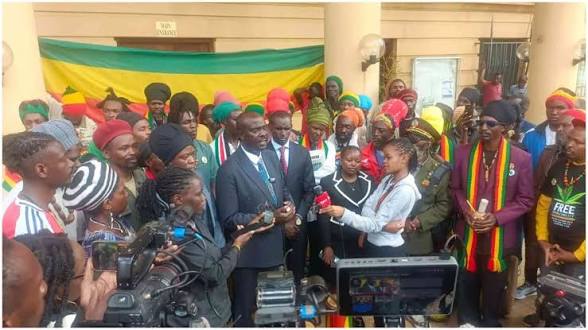
The priest admitted that Rastafari members continue using cannabis during prayer despite it being illegal in Kenya, saying the community is in court to seek legal recognition of the practice as part of their religious freedom. The case could determine whether Rastafari followers will be allowed to use marijuana legally for worship.] include tags separated by commas
Rastafari priest’s bold testimony in Kenyan court challenges cannabis ban as sacred sacrament vital to faith.
Sacred herb at heart of faith
A Rastafari movement priest has told Kenya’s High Court that cannabis—known to believers as ganja or the “holy herb”—is a sacred sacrament central to their spiritual worship and cannot be separated from their religious identity.[1] Testifying before Justice Bahati Mwamuye at the Milimani Law Courts in Nairobi, Jacob Ogundo described how the plant enhances meditation, deepens communal reasoning sessions (known as “nyabinghi” or groundations), and connects adherents to the divine essence of Jah, their term for God.[1][2]
Ogundo’s testimony underscores a core tenet of Rastafari, a spiritual movement born in Jamaica in the 1930s that reveres Ethiopia’s Emperor Haile Selassie I as divine and draws from Old Testament traditions, including references to herbs like calamus and kaneh-bosm interpreted by Rastas as cannabis.[1] For Kenyan Rastas, who number in the thousands across East Africa, ganja is not recreational but sacramental, smoked in chalices during prayers, Bible studies, and rituals to foster clarity and unity.[2]
Defiance amid illegality
The priest openly admitted that Rastafari members continue using cannabis during prayer sessions despite Kenya’s strict Narcotic Drugs and Psychotropic Substances Act, which classifies it as a banned substance with severe penalties.[1] “We cannot abandon our sacrament; it is woven into our faith,” Ogundo told the court, framing the practice as an act of conscience rather than criminality.[1]
This testimony forms part of a landmark test case where the Rastafari community seeks judicial recognition of cannabis use as a protected religious freedom under Kenya’s 2010 Constitution, which guarantees the right to worship and prohibits discrimination based on belief.[1][2] The plaintiffs argue that blanket prohibitions infringe on Article 32 (freedom of religion) and Article 27 (non-discrimination), drawing parallels to global precedents like a 2020 South African ruling allowing Rastafari use of cannabis in worship.[2]
Broader stakes for Africa
The case resonates across the continent, where Rastafari communities thrive from Cape Town to Addis Ababa, blending African diasporic spirituality with local customs. In Ethiopia, cannabis enjoys semi-tolerated status tied to ancient Orthodox traditions, while Uganda and Malawi have seen similar advocacy amid shifting drug policies.[2] A favorable ruling could embolden decriminalization movements in conservative East Africa, where cannabis convictions disproportionately affect youth and informal economies.
Critics, including anti-drug campaigners, warn of public health risks and potential slippery slopes toward broader legalization, but Rastafari leaders counter that regulated sacramental use poses no societal threat.[1] Justice Mwamuye has yet to rule, but the testimony has spotlighted how colonial-era drug laws clash with indigenous and diasporic spiritual rights in post-independence Africa.
Pan-African implications
For Pan-Africanists, this Nairobi courtroom drama highlights a decolonization frontier: reclaiming African-centered spiritual practices from prohibitive frameworks inherited from British opium and hemp controls. Rastafari’s ganja sacrament echoes traditional herbalism across the continent—from dagga in Southern Africa to bhang in East African Swahili culture—urging a rethink of punitive bans in favor of culturally sensitive reforms.[2]
As African Union talks on drug policy evolve, Kenya’s verdict could set a precedent, affirming that spiritual sovereignty includes the right to sacred plants.
Leave a Reply