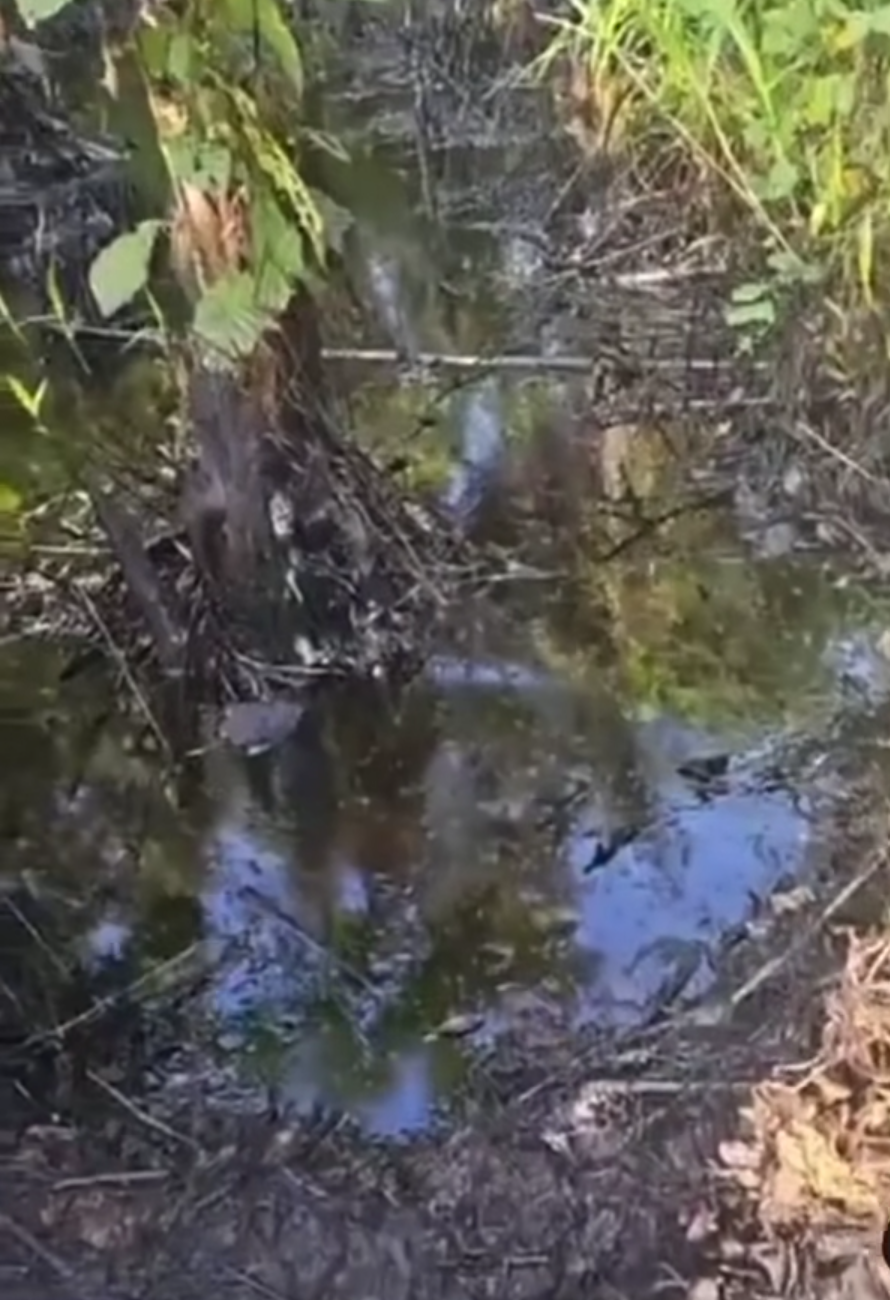
Grand Bassa County, Liberia — For a nation weary from economic hardship, the news that spread on December 3, 2025, felt like a gift: residents of Compound Two in Grand Bassa County reported a strange, dark liquid seeping from the ground, widely believed to be crude oil. Social media quickly flooded with videos of townspeople gathering around shallow pools of the substance, dipping sticks and plastic containers into it, their actions filled with a tangible mix of curiosity and hope.
Almost immediately, a joint government team including the Environmental Protection Agency (EPA) and county officials launched a fact-finding mission to the site near Doewein Town. However, the National Oil Company of Liberia (NOCAL) and the Ministry of Mines & Energy appeared displeased that any public announcement was made before scientific verification. This reaction underscores a critical tension for Liberia: the desperate hope for transformative wealth versus the hard-learned lessons of a turbulent history with natural resources.
As of December 4, 2025, the substance has not been confirmed as crude oil. Samples have been collected and a second round of testing is underway by NOCAL’s technical team. The Liberia Petroleum Refining Company (LPRC), which possesses the necessary petroleum-testing laboratory, is working to determine if the liquid is crude oil, another hydrocarbon, or simply organic matter common in swampy terrain.
🔍 The Long Road to Verification
The current process highlights the need for institutional coordination. The government’s response involves multiple agencies:
· Environmental Protection Agency (EPA): Initially responded to the scene for environmental assessment.
· Liberia Petroleum Refining Company (LPRC): Conducting crucial laboratory testing to scientifically identify the substance.
· National Oil Company of Liberia (NOCAL): Dispatched a technical team for a second round of sample testing and will interpret any geological implications.
A History of Hope and Disappointment
Liberians have good reason to temper their excitement. The country’s history is, in the words of former Education Minister George Kronnisanyon Werner, “full of moments when discoveries—real or rumored—generated excitement but delivered little for ordinary citizens”.
Past experiences that ended in disappointment include:
· 1970s: Seismic surveys offshore hinted at hydrocarbon traps, sparking early “black gold fever,” but political instability prevented development.
· 2009-2012: Major companies like Chevron and ExxonMobil conducted seismic activities. ExxonMobil paid $120 million for rights in Block 13, but drilled wells were not commercially viable.
· Recent Years: Viral videos of an apparent oil seep in Grand Kru County turned out to be organic soil residue, not crude oil.
This pattern of excitement followed by institutional confusion and eventual letdown has been painfully consistent. The challenge has never been Liberia’s geological potential—neighboring Ivory Coast and Ghana have confirmed finds in similar basins—but its governance and institutional strength.
Learning from Africa’s Oil Experiences
As Liberia awaits the test results, it can look to other African nations for models of what to pursue—and what to avoid.
· Positive Examples from the Continent:
· Ghana transformed its Jubilee oil discovery into a national development pillar through strong laws, transparent oversight, and political restraint.
· Nigeria is now hailed by the Pan-African Parliament for its “revolutionary” reforms under the Petroleum Industry Act (PIA), which introduced transparent, digital licensing rounds and “drill or drop” provisions to spur development.
· Uganda is methodically progressing toward production in the Albertine Graben, having recently completed drilling the minimum wells needed to start commercial output.
· Cautions from Liberia’s Own Present:
Even as this onshore discovery is investigated, Liberia is finalizing major offshore exploration agreements with international players. TotalEnergies was recently awarded four offshore blocks, and a joint agreement with Oranto Petroleum and TotalEnergies for eight blocks is before the legislature. These deals have sparked debate, with lawmakers warning they could repeat past mistakes where foreign interests profited disproportionately.
NOCAL’s president-designate, Fabian Lai, acknowledges past errors and claims new agreements emphasize national benefits, environmental protection, and scholarships across all 15 counties. He envisions transforming NOCAL into a “dynamic engine of national development”. However, he admits a fundamental truth: Liberia’s oil reservoirs have not yet been confirmed as commercially viable.
Governance: The Real Discovery to Be Made
Whether the Grand Bassa seep turns out to be oil or not, this moment presents Liberia with a clear imperative. As an editorial in the Liberian Investigator noted, the promise of new deals must be matched with material capacity, clear communication, and structural integrity in policy implementation.
The nation’s leadership is at a crossroads. The real “discovery” Liberia needs to make is not underground, but within its institutions: the strength to verify before celebrating, the wisdom to legislate for the long term, and the integrity to ensure that if wealth does flow, it benefits the many and not the few.
As one commentary poignantly stated, “Good news is lovely on the mountains, but in Liberia it must also be credible in the laboratory, defensible in the ministries, and beneficial to the communities whose lives depend on it”. For the people of Grand Bassa and all of Liberia, that lesson may be the most valuable resource of all.
🇱🇷 Liberia’s Potential Oil Discovery: Grand Bassa Seep Ignites Hope and Calls for Caution
Leave a Reply