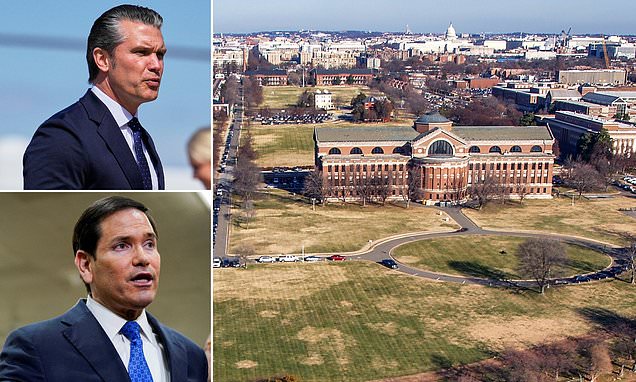
Unidentified drones recently detected over Fort McNair in Washington, D.C. have triggered a fresh wave of security anxiety in the United States, underscoring how cheap, off‑the‑shelf technology can penetrate even highly protected military spaces in the middle of a major geopolitical crisis.
Rising drone scare in Washington
Multiple unidentified drones were spotted over Fort Lesley J. McNair on at least one night within the past ten days, according to U.S. officials cited in American media.[1][2][3] The base sits just a few kilometres from the White House and Capitol Hill, yet lacks the extensive security buffer of other Washington‑area installations, making any airspace intrusion particularly sensitive.[1][4]
Fort McNair is not just another military compound; it houses the National Defense University and the official residences of senior officials, including Secretary of State Marco Rubio and Defence Secretary Pete Hegseth, both key figures in the Trump administration’s current war‑time decision‑making.[1][5][2] That senior civilian leaders now live on base is itself a response to earlier security worries, but the latest drone sightings show those adaptations are far from sufficient.[1][4]
Origin unknown, intent unclear
For now, U.S. authorities have not determined where the drones came from, who is operating them, or whether they are being controlled locally or from afar.[5][2][3] Officials have only confirmed that several drones appeared in a short time window, enough to trigger internal alarm bells and lead to a dedicated White House meeting on how to respond.[1][4][3]
The lack of attribution opens a wide spectrum of possibilities: adversarial states, non‑state actors, lone‑wolf actors, or even probing by criminal networks testing U.S. responses.[2][4] In an environment where the United States is waging a high‑stakes confrontation with Iran and its allies, even ambiguous incidents like this are quickly read through a strategic lens of potential retaliation, escalation, or coercive signalling.[1][2][3]
War with Iran and the spectre of retaliation
The drone incidents come as the United States escalates joint military operations with Israel against Iran, with officials warning of possible Iranian‑backed retaliation against U.S. targets worldwide.[1][2][4] U.S. bases in New Jersey and Florida have already raised their force protection posture to “Charlie,” signalling credible intelligence of a potential threat, while diplomatic missions have been instructed to conduct immediate security reviews.[2][4]
Drone‑linked fears are not new in the U.S.–Iran rivalry: after the 2020 U.S. strike that killed Iranian General Qasem Soleimani, American security agencies repeatedly flagged drones as a tool Iran or aligned groups could use for asymmetric attacks against high‑profile U.S. figures.[2][4] During Donald Trump’s 2024 presidential campaign, security teams also reported unidentified drones at multiple events, reinforcing the perception that drones are now a favoured instrument for both surveillance and potential targeted attacks.[2][4]
Vulnerable skies over “secure” bases
What Fort McNair is exposing—again—is that the U.S. military footprint at home was not designed for an era in which small unmanned systems can loiter above bases, collect imagery, map patterns of life, or even deliver explosives while blending into urban clutter.[6][7] A previous drone detection pilot project at Fort McNair and nearby Fort Myer revealed dozens of previously unnoticed unmanned flights, suggesting that what is being detected today is likely just the visible tip of a much larger, persistent phenomenon.[6]
The current scare has already prompted tighter local security measures, including enhanced monitoring of low‑altitude airspace and internal discussions about whether to relocate Rubio and Hegseth from the base.[5][4][3] A senior official has said no relocation has yet occurred, but the fact that such moves are on the table illustrates how unmanned threats are now influencing where senior decision‑makers can safely live and work.[5][2]
Why it matters for Africa and the Global South
For a Pan‑African audience, this episode in Washington is not a distant curiosity; it is a signal of how drone technology is rewriting the rules of national security for powerful and weaker states alike.[6][7] African governments from the Sahel to the Red Sea are already grappling with armed groups and foreign actors using commercial or improvised drones for reconnaissance, propaganda footage, and on occasion, kinetic attacks, often outpacing regulatory and defence frameworks.[6][7]
If a high‑security U.S. base housing cabinet‑level leaders can be overflown by mystery drones without immediate attribution, the vulnerabilities facing African capitals with far fewer resources become glaring.[1][6][7] The Fort McNair incident should therefore be read as both a warning and an opportunity: a warning that the drone age is fully upon us, and an opportunity for African policymakers to push for cooperative airspace management, regionally adapted counter‑drone technologies, and legal regimes that balance innovation with security.[6][7]
Leave a Reply