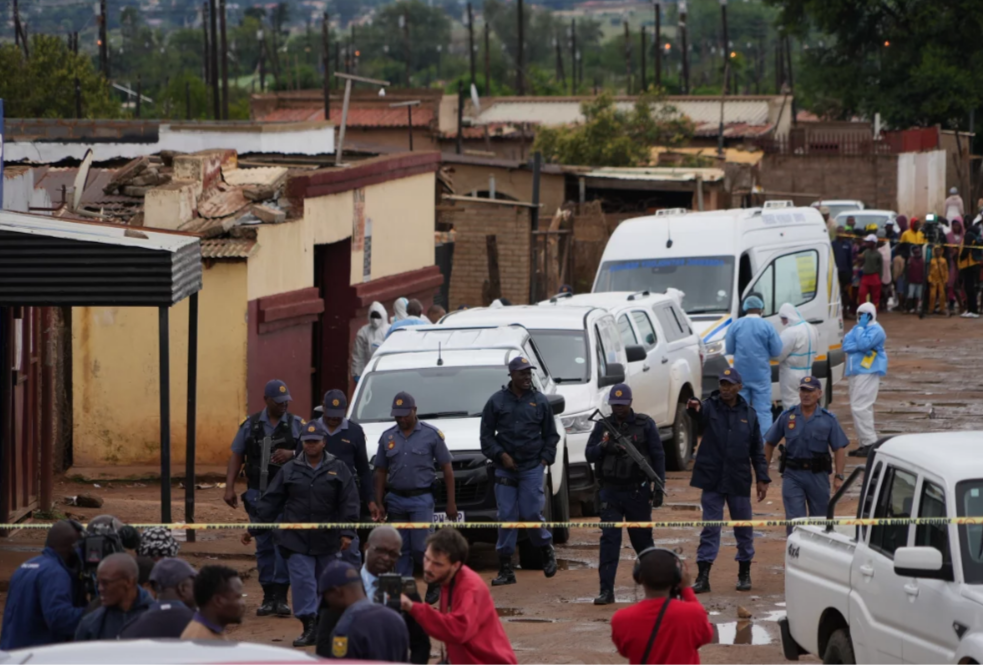
Tavern in Bekkersdal, South Africa, where a mass shooting left nine people dead on December 21, 2025. (Photo: Timothy Bernard / Independent Newspapers)
Summary of the Attack
· What Happened: A coordinated assault by approximately 12 gunmen on the KwaNoxolo tavern in Bekkersdal township.
· Casualties: 9 people killed (7 men, 2 women) and at least 10 others wounded.
· Victims: Included patrons inside and outside the tavern, and an e-hailing driver who had just dropped off a client.
· Weapons Used: Gunmen armed with pistols and at least one AK-47 rifle.
· Current Status: A major manhunt is underway; motive remains unestablished.
The Attack: A Methodical and “Inhuman” Assault
In the early hours of Sunday, December 21, 2025, the Tambo section of Bekkersdal township was shattered by an act of extreme violence. According to police statements, around 1 a.m., a group of approximately twelve armed suspects arrived at the licensed KwaNoxolo tavern in two vehicles: a white Toyota Quantum minibus and a silver Toyota Etios sedan.
The gunmen, some wearing balaclavas, opened fire without warning or provocation on patrons both inside and outside the establishment. Gauteng Deputy Provincial Commissioner Major General Fred Kekana described the scene as “inhuman,” stating, “The poor patrons were just enjoying themselves when people came and shot”.
Sequence of Violence
The attack followed a brutal and methodical pattern:
· Initial Assault: Gunmen first opened fire inside the tavern, killing three people.
· Chaotic Flight: As patrons tried to flee, the attackers continued shooting randomly. Two people were shot and killed as they attempted to escape in a black Volkswagen Golf.
· Street Execution: The gunmen pursued people into the streets. Three individuals were shot while trying to reach a nearby clinic and later succumbed to their injuries.
· Final Victim: As the assailants fled the scene, they encountered and killed an elderly e-hailing driver who had just dropped off a passenger in the area.
In a chilling postscript, the attackers returned to the scene to rob their victims, searching both the dead and the wounded for cell phones and other valuables before making their final escape.
The Investigation and Response
A massive multi-unit police response was immediately mobilized. The Gauteng Serious and Violent Crime Investigations unit, in collaboration with the Crime Detection Tracing Unit, has launched a province-wide manhunt for the suspects.
At the scene, Major General Kekana outlined the comprehensive investigative effort: “Our national crime and management team has arrived… the provincial crime scene management team has arrived, and a team from the local criminal record centre is here. So is our serious crime investigating team, crime intelligence and the provincial crime detective team is on scene”.
Despite the swift response, authorities have not yet established a motive for the attack. The acting Gauteng Premier, Jacob Mamabolo, pledged the provincial government’s full support to the police investigation and reiterated concerns about “the challenges posed by liquor establishments within communities, particularly where non-compliance with the law contributes to criminal activity”.
A Recurring Nightmare: South Africa’s Tavern Violence Epidemic
The Bekkersdal massacre is not an isolated incident but part of a devastating pattern of mass shootings at South African drinking establishments. These venues, often called shebeens or taverns, have repeatedly become killing grounds:
· December 2025: Just weeks before the Bekkersdal attack, at least 12 people were killed and 13 injured when multiple suspects opened fire at an unlicensed bar near Pretoria.
· July 2022: A shooting at a tavern in Soweto, Johannesburg, left 16 people dead. On the same day, four people were killed in a separate bar shooting in another province.
These incidents spotlight the complex intersection of widespread illegal firearms, social inequality, and localized conflicts that often revolve around competition between informal businesses and criminal groups.
The Broader Context: South Africa’s Homicide Crisis
To understand the Bekkersdal tragedy, one must view it within South Africa’s staggering rates of violent crime. The statistics present a national emergency:
· Homicide Rate: With nearly 26,000 murders in 2024—averaging more than 70 lives lost every day—South Africa has one of the highest homicide rates in the world.
· Firearms as Tools: Firearms are by far the leading cause of death in these homicides. Despite comparatively stringent gun control laws on the books, officials acknowledge that a vast number of murders are committed with illegal weapons.
· Daily Reality: More recent police figures indicate the situation may be worsening, with an average of 63 people killed every day between April and September 2025.
Community in Fear, Continent in Reflection
In the aftermath of the shooting, Bekkersdal residents voiced profound fear and frustration. Community members reported that frequent gunfire has become normalized, attributing it to ongoing gang-related activity and expressing feeling inadequately protected by law enforcement.
On social media, the reaction reflected a mixture of grief and anger. One comment on a news post captured the despair: “People are becoming something else that can’t be explained… may the souls rest in peace and those who killed them to never know peace”. Another commentator drew a dire comparison, warning that South Africa’s high crime could eventually mirror crisis-stricken regions like Haiti if not urgently addressed.
Conclusion: A Crossroads for South Africa and a Lesson for Africa
The massacre in Bekkersdal represents more than a local crime story—it is a symptom of deep-seated challenges facing Africa’s most industrialized nation. As police continue their manhunt, fundamental questions remain about how to stem the flow of illegal weapons, address the social and economic conditions that fuel such violence, and restore public safety in communities terrorized by recurrent bloodshed.
For the broader African continent, South Africa’s struggle offers crucial lessons in the complex relationship between development, inequality, and public security. The nation’s stringent gun laws exist alongside rampant illegal firearms, suggesting that legislation alone cannot solve the problem without effective enforcement and broader social interventions.
As Major General Kekana vowed, law enforcement “will not rest until all the perpetrators are apprehended”. Yet for the people of Bekkersdal and countless similar communities across South Africa, justice in this single case will provide little comfort without a comprehensive national strategy to break the cycle of violence that has made mass shootings at taverns a recurrent feature of South African life.
Leave a Reply