
By Panafrican.email
MONROVIA / ACCRA — March 1957
Before Martin Luther King Jr. became one of the world’s most recognized advocates of civil rights, he was already beginning to see the African liberation struggle as part of a much larger story about freedom.
That connection became personal in March 1957, when King and his wife, Coretta Scott King, traveled to West Africa to witness the independence of Ghana—the first sub-Saharan African colony to emerge from European colonial rule in the modern independence era.
Their journey included a brief but historically significant stop in Monrovia, Liberia, followed by several days in Accra during Ghana’s independence celebrations.
For King, the journey was more than a diplomatic visit. He saw the emergence of Ghana as a possible symbol of what freedom could mean for African Americans confronting segregation in the United States. (MLK Research Institute)
A West African Journey Begins
The Kings left the United States on March 2, 1957, traveling with a distinguished delegation that included civil-rights leader A. Philip Randolph, Congressman Adam Clayton Powell Jr., and United Nations official Ralph Bunche. (MLK Research Institute)
Their destination was the Gold Coast, which would officially become the independent nation of Ghana on March 6, 1957.
The invitation came directly from Ghana’s Prime Minister Kwame Nkrumah, who invited King to participate in the independence celebrations.
Nkrumah wrote that it would give him “great personal pleasure” if King could attend the ceremonies marking the birth of the new nation. (MLK Research Institute)
But before reaching Accra, King’s aircraft crossed the African Atlantic route through Lisbon, Dakar and Monrovia.

Martin Luther King Jr. in Monrovia
March 3, 1957
King’s stop in Liberia was brief.
According to the Martin Luther King Jr. Research and Education Institute, the aircraft stopped in Monrovia on March 3, before departing for the Gold Coast later that evening.
At the Monrovia airport, King was met by Romeo Houghton, president of the Bank of Liberia. (MLK Research Institute)
This is one of the most important documented Liberia connections in King’s African journey.
It is also important to put the visit in perspective: the surviving historical record identifies Monrovia as a stopover, rather than describing a multi-day Liberian tour.
There is therefore no reliable evidence that King toured Liberia’s interior or visited a long list of Liberian landmarks during this journey.
The documented Liberian connection
Place: Monrovia, Liberia
Date: March 3, 1957
Known meeting: Romeo Houghton
Position: President of the Bank of Liberia
Purpose: Stopover while traveling to Ghana
The aircraft departed Monrovia for the Gold Coast at approximately 11 p.m. (MLK Research Institute)
For Liberia, the significance lies in the fact that King physically passed through the capital at a moment when the African independence movement was reshaping the political imagination of the African diaspora.
Arrival in Accra
King arrived in Accra during the early hours of March 4, 1957.
The city was preparing for one of the most consequential political celebrations in modern African history.
The Gold Coast was about to become Ghana.
King’s arrival placed him among African leaders, diplomats, journalists, intellectuals and representatives from around the world who had come to witness independence.
The King Institute describes the journey as part of King’s growing recognition of the connection between African anticolonial movements and the African-American struggle against racism and segregation. (MLK Research Institute)
The University of Ghana
One of King’s documented Accra locations was the University of Ghana, where he held an impromptu press conference on March 5.
There he connected Ghana’s independence with the struggle for racial equality in the United States.
The visit was not simply ceremonial. King used his presence in Ghana to speak about the racial situation in America and the responsibilities of the United States government. (MLK Research Institute)
Landmark
University of Ghana — Accra

Event
Press conference — March 5, 1957
Meeting Richard Nixon
Another significant encounter occurred on March 5.
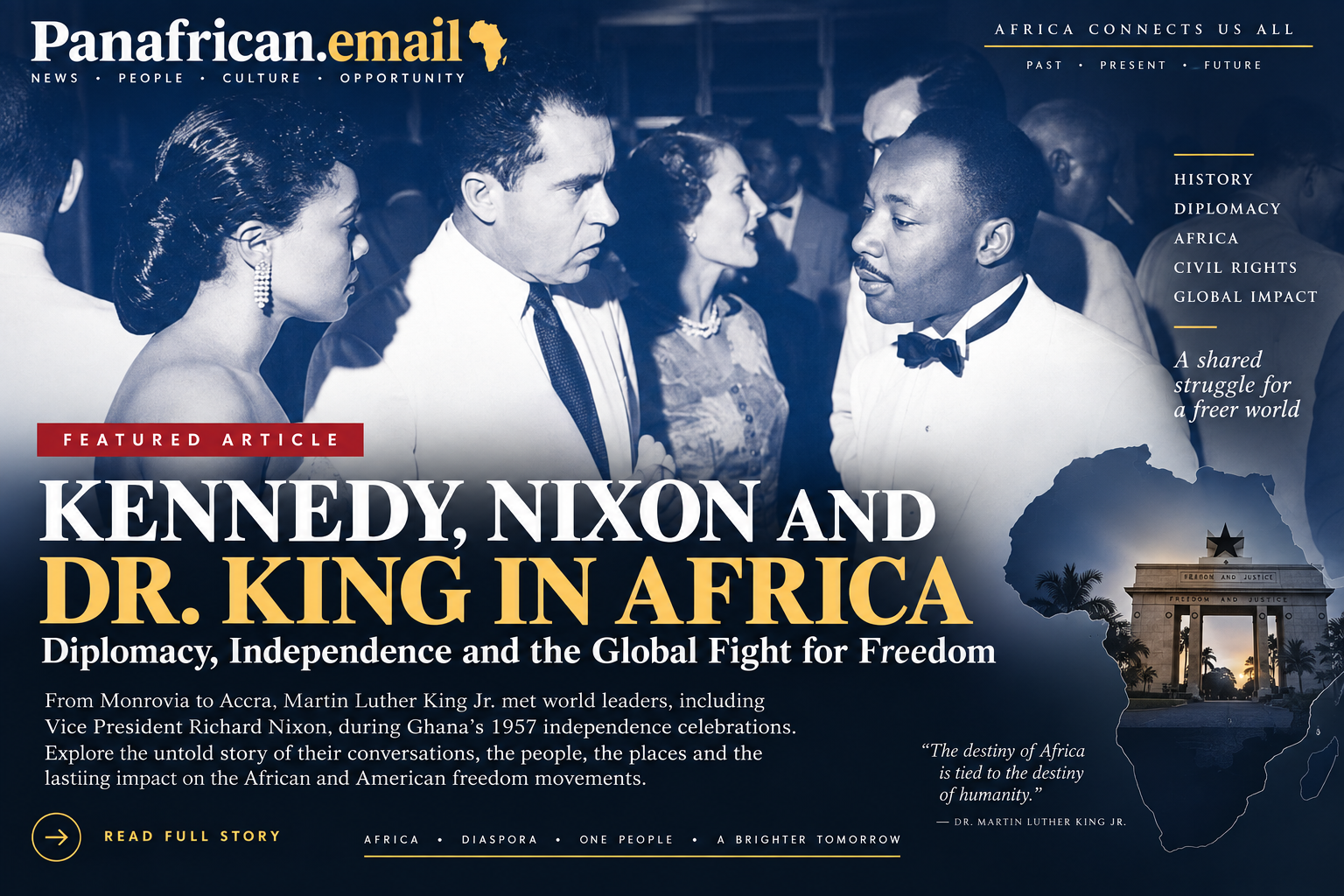
At a reception in Accra, King met Richard Nixon, then Vice President of the United States.
King used the opportunity to draw a direct comparison between Ghana’s struggle for independence and the American civil-rights struggle.
He reportedly invited Nixon to visit Alabama, where Black Americans were fighting for the same freedom that Ghanaians were celebrating.
Nixon subsequently invited King to meet with him in Washington. (MLK Research Institute)
It was an extraordinary diplomatic moment: an American civil-rights leader speaking to the country’s vice president on African soil about freedom in both Africa and America.
The Last Night of the Gold Coast
On March 5, King attended the closing session of the Gold Coast Legislative Assembly, marking the final hours of colonial government.
The next day would bring the formal birth of Ghana.
King was particularly struck by the appearance of Nkrumah and his ministers wearing prison caps associated with their imprisonment during the struggle for independence.
For King, the image carried a powerful lesson:
Freedom had been achieved through struggle.
He would later incorporate that experience into his famous sermon, “The Birth of a New Nation,” delivered after returning to Montgomery. (MLK Research Institute)
Independence at the Accra Polo Grounds
March 6, 1957
At midnight, King joined the enormous crowd gathered at the Accra Polo Grounds.
The British Union Jack was lowered.
The new Ghanaian flag was raised.
The Gold Coast ceased to exist as a British colony.
Ghana was independent.
King later recalled seeing an enormous crowd surrounding the polo grounds. In his recollection, the gathering approached half a million people. (MLK Research Institute)
For King, the sight was profoundly emotional.
He saw Ghana’s independence as evidence that political systems based upon domination could eventually be challenged and replaced.
Years later, he would repeatedly return to the Ghana experience when explaining the meaning of freedom to Americans.
Landmark
Accra Polo Grounds
Historic event
Ghana Independence Ceremony — March 6, 1957
The New Parliament of Ghana
The morning after independence, King witnessed the opening and seating of Ghana’s new Parliament.
This was another symbolic transition: political authority was moving from the colonial government into the institutions of an independent Ghana.
The King Institute records that King attended the opening at approximately 9:15 a.m. on March 6. (MLK Research Institute)
Landmark
Parliament of Ghana
Event
Opening of Ghana’s independent Parliament
Christiansborg Castle
That evening, King and Coretta attended a formal reception at Christiansborg Castle in Accra.
The castle—one of the most historically significant buildings on Ghana’s coast—was associated with the country’s colonial political history.
King had therefore witnessed Ghana’s independence ceremonies in spaces representing both sides of the country’s transition: the colonial state and the newly independent nation. (MLK Research Institute)
Landmark
Christiansborg Castle, Accra
Event
Independence reception — March 6, 1957
Lunch With Kwame Nkrumah
One of the most important personal encounters of King’s trip came through a private meal with Prime Minister Kwame Nkrumah.
After King became ill, the Kings nevertheless had a private lunch with Nkrumah at his residence.
King remembered the hospitality for years afterward.
In a 1959 letter to Nkrumah, King thanked him for taking time from his extremely busy schedule to receive King and Coretta for lunch at his residence. (MLK Research Institute)

Achimota College
During their stay, the Kings were accommodated on the Achimota College campus.
After falling ill, King spent several days recuperating there.
On March 7, the English Anglican priest and anti-colonial activist Michael Scott visited the ailing King.
The two men discussed the similarities between African liberation movements and the American struggle for civil rights. (MLK Research Institute)
Landmark
Achimota College
Significance
The location became part of the quieter side of King’s Ghana experience—the period when illness forced him away from the major public celebrations but gave him opportunities for conversation and reflection.
Michael Scott and the Anglican Cathedral
King later attended a Sunday service at the Anglican Cathedral in Accra, where Michael Scott preached.
Scott was an important figure in anti-colonial activism in Africa, and his meeting with King reflected the international network of religious and political figures involved in struggles against colonialism and racial discrimination. (MLK Research Institute)
Landmark
Anglican Cathedral, Accra
Event
Sunday service — March 10, 1957
Other People Connected to King’s Ghana Journey
The trip brought King into contact with a remarkable collection of African, American and international figures.
Kwame Nkrumah
Prime Minister of Ghana
The central African political figure of King’s journey. Nkrumah invited King to Ghana and later hosted the Kings privately.
Romeo Houghton
President of the Bank of Liberia
Met King at the airport during the March 3 stopover in Monrovia. (MLK Research Institute)
Richard Nixon
Vice President of the United States
Met King at a reception in Accra. (MLK Research Institute)
K. A. Gbedemah
Ghanaian Minister of Finance
Gbedemah was involved in the arrangements surrounding King’s invitation and later maintained correspondence with King. (MLK Research Institute)
Michael Scott
Anglican priest and anti-colonial activist
Visited King while he was ill and later preached at the Anglican Cathedral. (MLK Research Institute)
Homer Jack
Peace activist
Met King during the Ghana trip. (MLK Research Institute)
A. Philip Randolph
American labor and civil-rights leader
Traveled with the delegation.
Ralph Bunche
United Nations official and diplomat
Also traveled with the delegation.
Adam Clayton Powell Jr.
U.S. Congressman
Traveled with the delegation to Ghana. (MLK Research Institute)
The Meaning of Ghana for Martin Luther King Jr.
King did not return to America viewing Ghana merely as a distant African country.
He returned with a political and spiritual interpretation of what he had witnessed.
Ghana’s independence became a metaphor for the possibility of liberation.
On April 7, 1957, at Dexter Avenue Baptist Church in Montgomery, King preached “The Birth of a New Nation.”
He used the Exodus story to interpret Ghana’s struggle against colonial rule and connected Ghana’s experience to the African-American freedom struggle.
His message was essentially that freedom was not something willingly handed down by those holding power—it was something people had to organize and struggle to achieve. (MLK Research Institute)
Liberia and Ghana: Two Different Stops, One African Journey
King’s 1957 journey deserves to be remembered as more than a trip to Ghana.
It was a journey through West Africa that briefly placed him in Monrovia, before bringing him into the heart of Ghana’s independence celebrations.
In Liberia, the documented record gives us a short airport encounter with Romeo Houghton.
In Ghana, the record opens into a much larger historical landscape:
- University of Ghana
- Gold Coast Legislative Assembly
- Accra Polo Grounds
- Parliament of Ghana
- Christiansborg Castle
- Achimota College
- Anglican Cathedral
And around those places were meetings with Kwame Nkrumah, Richard Nixon, K. A. Gbedemah, Michael Scott, Homer Jack and other figures involved in the emerging international struggle for freedom.
For King, Ghana’s independence demonstrated something larger than the creation of another nation.
It demonstrated that an African people could move from colonial rule toward self-government—and that the psychological impact of that transformation could reach far beyond Africa.
For an African-American minister fighting segregation in Alabama, the message was unmistakable.
Africa’s liberation and the African-American freedom struggle were not separate stories.
They were becoming part of the same global conversation about freedom, dignity, self-determination and human rights. (MLK Research Institute)
Martin Luther King Jr.’s 1957 West African Journey at a Glance
Date
Location
Documented event
March 3
Monrovia, Liberia
Stopover; King met Romeo Houghton
March 4
Accra, Ghana
Arrived in the Gold Coast
March 5
University of Ghana
Press conference
March 5
Accra
Met U.S. Vice President Richard Nixon
March 5
Gold Coast Legislative Assembly
Attended closing session
March 6
Accra Polo Grounds
Witnessed Ghana’s independence
March 6
Parliament of Ghana
Witnessed opening of Parliament
March 6
Christiansborg Castle
Attended formal reception
March 7
Achimota College
Michael Scott visited King while ill
March 10
Anglican Cathedral, Accra
Heard Michael Scott preach
March 12
Accra
Departed Ghana
A Journey That Still Resonates
Nearly seven decades later, the significance of King’s West African journey remains visible.
He arrived in Ghana as an American civil-rights leader.
He left having witnessed the birth of an independent African nation.
And between Monrovia and Accra, he encountered a historical reality that would influence his thinking for the rest of his life:
The struggle for freedom was global.
Liberia was a brief stop on the journey.
Ghana was the destination.
But the ideas King encountered in West Africa became part of the intellectual and spiritual vocabulary of the movement he would lead back home in the United States.
March 1957 was therefore not simply Martin Luther King Jr.’s first journey to Africa. It was one of the moments when the American civil-rights movement and the modern African independence movement visibly met on African soil.
🎙️ Hear Dr. King in Ghana
Just hours after Ghana became independent, Martin Luther King Jr. spoke with radio journalist Etta Moten Barnett in Accra. The original interview was later broadcast by WMAQ radio in Chicago.
Archival recording from the Etta Moten Barnett Collection, Schomburg Center for Research in Black Culture, New York Public Library.
Leave a Reply