
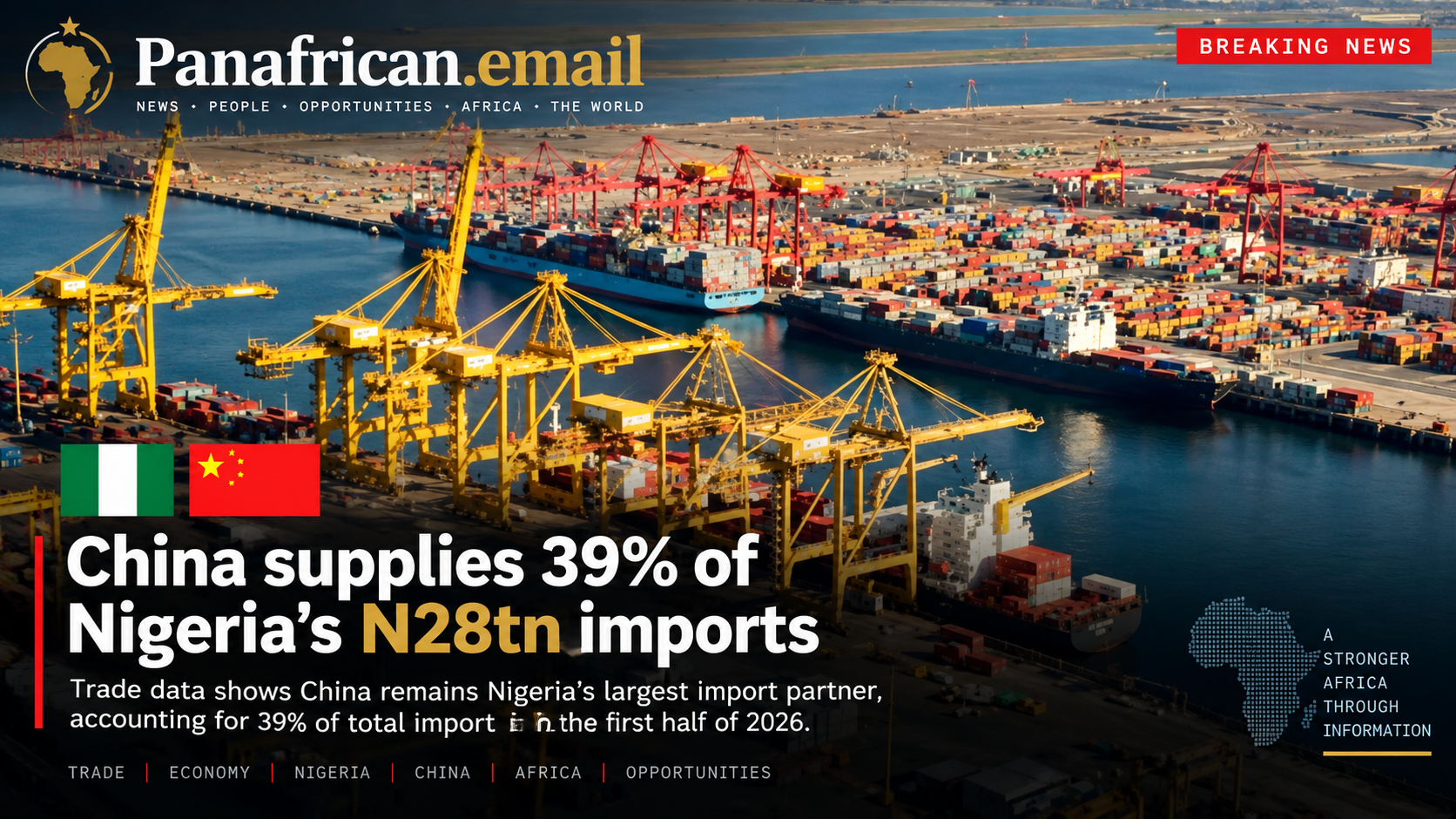
ABUJA — China remained by far one of Nigeria’s largest sources of imported goods during the first half of 2026, with imports from China reaching N11.01 trillion, according to an analysis of Nigeria’s latest foreign-trade statistics.
The figure represented about 39.27% of Nigeria’s total imports of N28.04 trillion between January and June. The share was higher than the corresponding period of 2025, when China accounted for a smaller proportion of Nigeria’s imports.
A rapidly expanding commercial relationship
The data shows how deeply Chinese manufactured goods are integrated into Nigeria’s consumer and business economy. Imports from China increased from N5.10 trillion in the first quarter of 2026 to N5.92 trillion in the second quarter.
The scale of the trade relationship covers consumer goods, machinery, equipment, electronics, industrial inputs, vehicles and other manufactured products. For Nigerian businesses, Chinese supply chains can provide access to products and equipment at prices that may be difficult to match from some alternative sources.
The trade-deficit challenge
The same relationship creates a structural challenge. Nigeria recorded an estimated merchandise trade deficit with China of about N9.92 trillion during the first half of 2026, according to reporting based on National Bureau of Statistics data.
A persistent bilateral deficit does not automatically mean that trade is harmful; imports can provide machinery, equipment and inputs that support domestic production. The more important question is whether imported inputs contribute to a larger domestic productive base.
Manufacturing opportunity
Nigeria’s enormous consumer market gives the country an opportunity to move from being primarily a destination for finished Chinese products toward becoming a location for manufacturing and assembly.
Potential areas include electrical equipment, solar products, agricultural machinery, motorcycles and electric mobility, building materials, consumer electronics and industrial components. Partnerships that combine Chinese capital and technology with Nigerian labour, local suppliers and regional market access could create a different form of economic relationship.
Quality and consumer protection
Nigerian authorities have also raised concerns about counterfeit and substandard products in the wider import market. That makes product standards, customs enforcement and consumer protection important parts of the China-Nigeria trade discussion.
For legitimate businesses, stronger enforcement can also create a more predictable market in which compliant manufacturers are better able to compete.
What Nigerian SMEs should watch
The size of the China trade corridor creates opportunities for Nigerian entrepreneurs in sourcing, logistics, distribution, product adaptation and manufacturing. It also creates competitive pressure for businesses that depend on imported finished goods.
Companies considering China-linked supply chains should pay close attention to landed costs, quality control, customs requirements, currency exposure and after-sales support rather than focusing only on factory prices.
The bigger African picture
Nigeria’s figures fit into the continent-wide debate over Africa-China trade. African countries are importing more from China while trying to increase exports of higher-value products.
Nigeria’s market size gives it unusual potential to shape that relationship. If more Chinese investment is connected to Nigerian production, training, technology and regional exports, the commercial relationship could increasingly operate as a manufacturing partnership rather than simply an import channel.
Sources
- https://punchng.com/china-supplies-39-of-nigerias-n28tn-imports/
- https://www.thetimes.com.ng/2026/09/china-accounts-for-39-of-nigerias-n28tn-imports-in-six-months/
Leave a Reply