
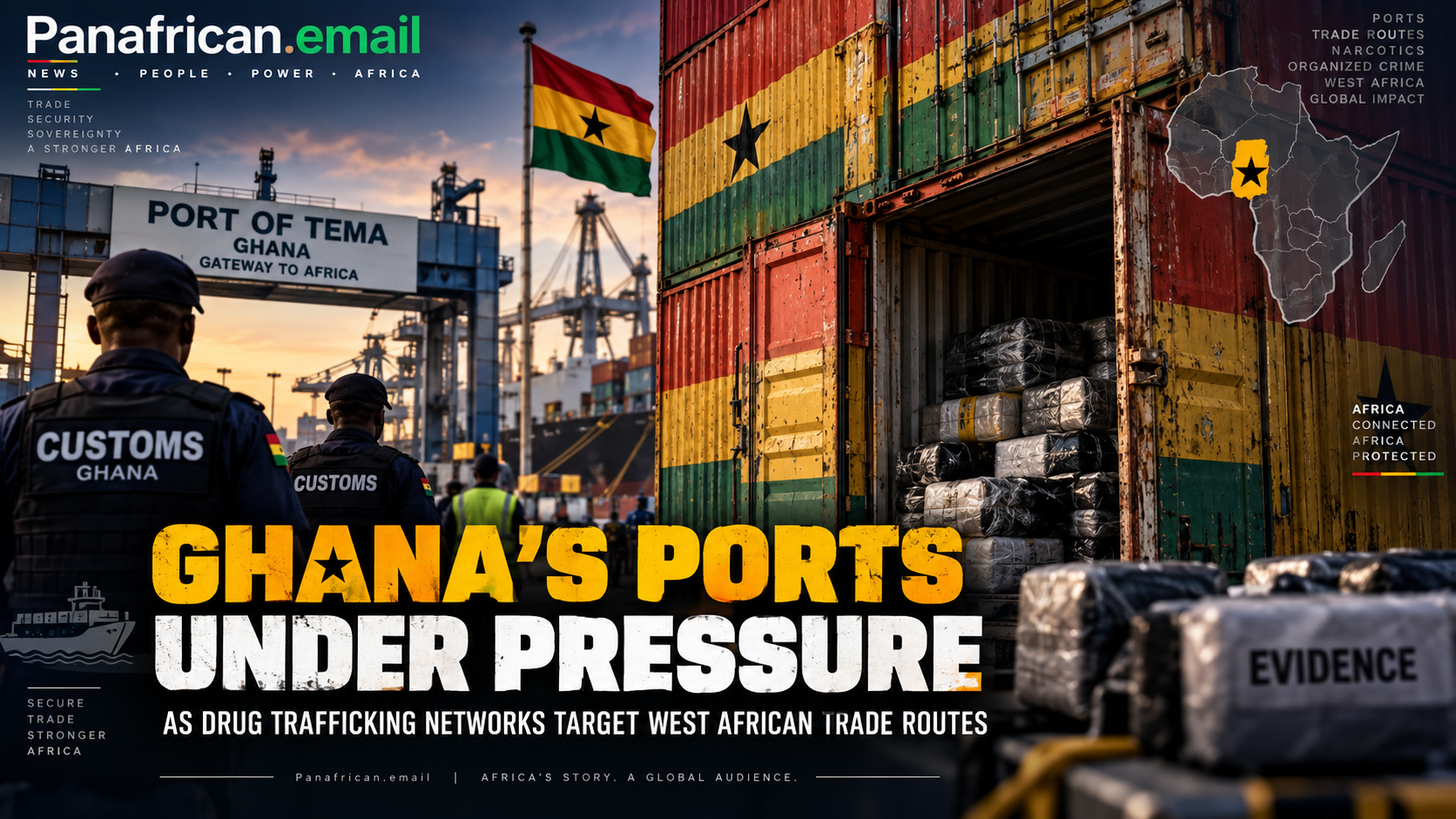
Ghana’s ports are facing renewed scrutiny over their role in international narcotics trafficking following a series of high-profile drug seizures, highlighting the growing challenge of protecting West Africa’s commercial gateways from transnational criminal networks.
As Ghana expands its role as a major maritime and logistics hub, the country’s ports connect West Africa to shipping routes spanning Europe, Asia, the Americas and other regions. That connectivity also makes the maritime sector an attractive target for criminal organizations seeking to move illicit drugs through legitimate commercial supply chains.
Recent narcotics seizures have drawn attention to the sophisticated methods used by trafficking networks, including the concealment of drugs within commercial cargo and the use of complex international shipping routes designed to make the origin and destination of consignments more difficult to establish.
Ghana at the Crossroads of Global Trade
Ghana’s maritime infrastructure is central to the country’s economy. The Port of Tema, in particular, handles substantial volumes of international cargo and serves as an important gateway for trade across Ghana and neighboring countries.
The strategic position of Ghana’s ports means that effective maritime security has implications far beyond Ghana’s borders.
Drug trafficking networks operating across West Africa frequently exploit the same transportation infrastructure used by legitimate businesses. Containers, freight corridors, warehouses, trucking networks and distribution centers can all become potential points of vulnerability.
This creates a difficult security problem: authorities must increase scrutiny of suspicious cargo without unnecessarily disrupting legitimate commerce.
The Changing Nature of Narcotics Trafficking
International drug trafficking has increasingly become a sophisticated logistics operation.
Criminal networks can operate across multiple jurisdictions, separating the production, transportation, financing and distribution of narcotics among different groups. A shipment passing through Ghana may therefore be only one segment of a much larger international supply chain.
That complexity makes cooperation between customs agencies, port authorities, maritime-security organizations, police, intelligence services and international partners particularly important.
Technology is also becoming increasingly important. Cargo-risk profiling, container tracking, intelligence sharing, surveillance systems and financial investigations can help authorities identify suspicious movements before illicit shipments reach their final destinations.
Beyond the Seizure
A drug seizure is an important law-enforcement result, but it does not necessarily reveal the full structure of the organization behind a shipment.
The larger intelligence question is what happens after the drugs are intercepted.
Investigators can potentially use seizures to identify shipping routes, companies, intermediaries, financial transactions, communication networks and individuals connected to trafficking organizations.
This turns a single seizure into a potential intelligence opportunity.
For West African governments, the objective is therefore not simply to intercept narcotics but to understand and disrupt the networks that finance, organize and facilitate their movement.
A Regional Security Challenge
Ghana is not isolated from the broader security challenges facing West Africa’s maritime corridors.
The Gulf of Guinea has long been an important commercial maritime zone, connecting African economies with global markets. While maritime security discussions have historically focused heavily on piracy and armed robbery, illicit trafficking represents another dimension of the region’s security environment.
The movement of narcotics through West African transportation networks can also generate additional criminal activity, including money laundering, corruption and organized violence.
Strengthening port security consequently has implications for economic security as well as public safety.
Protecting West Africa’s Trade Gateways
Ghana’s experience illustrates a wider challenge confronting African ports: how to maintain the speed and efficiency required by modern international commerce while preventing criminal organizations from exploiting global trade infrastructure.
The answer requires more than physical inspections.
Modern port security increasingly depends on intelligence-led screening, international information sharing, advanced cargo analysis and investigations that follow the money behind trafficking operations.
For Ghana, protecting its ports means protecting more than containers and cargo. It means protecting the integrity of one of West Africa’s most important connections to the global economy.
As international narcotics networks continue adapting their methods, Ghanaian authorities and their regional partners will face increasing pressure to stay ahead of increasingly sophisticated trafficking operations.
PanAfrican.email Perspective: Africa’s ports are becoming increasingly important nodes in global commerce. That makes maritime intelligence, customs cooperation and secure logistics infrastructure strategic components of African economic sovereignty—not simply law-enforcement concerns.
Leave a Reply