
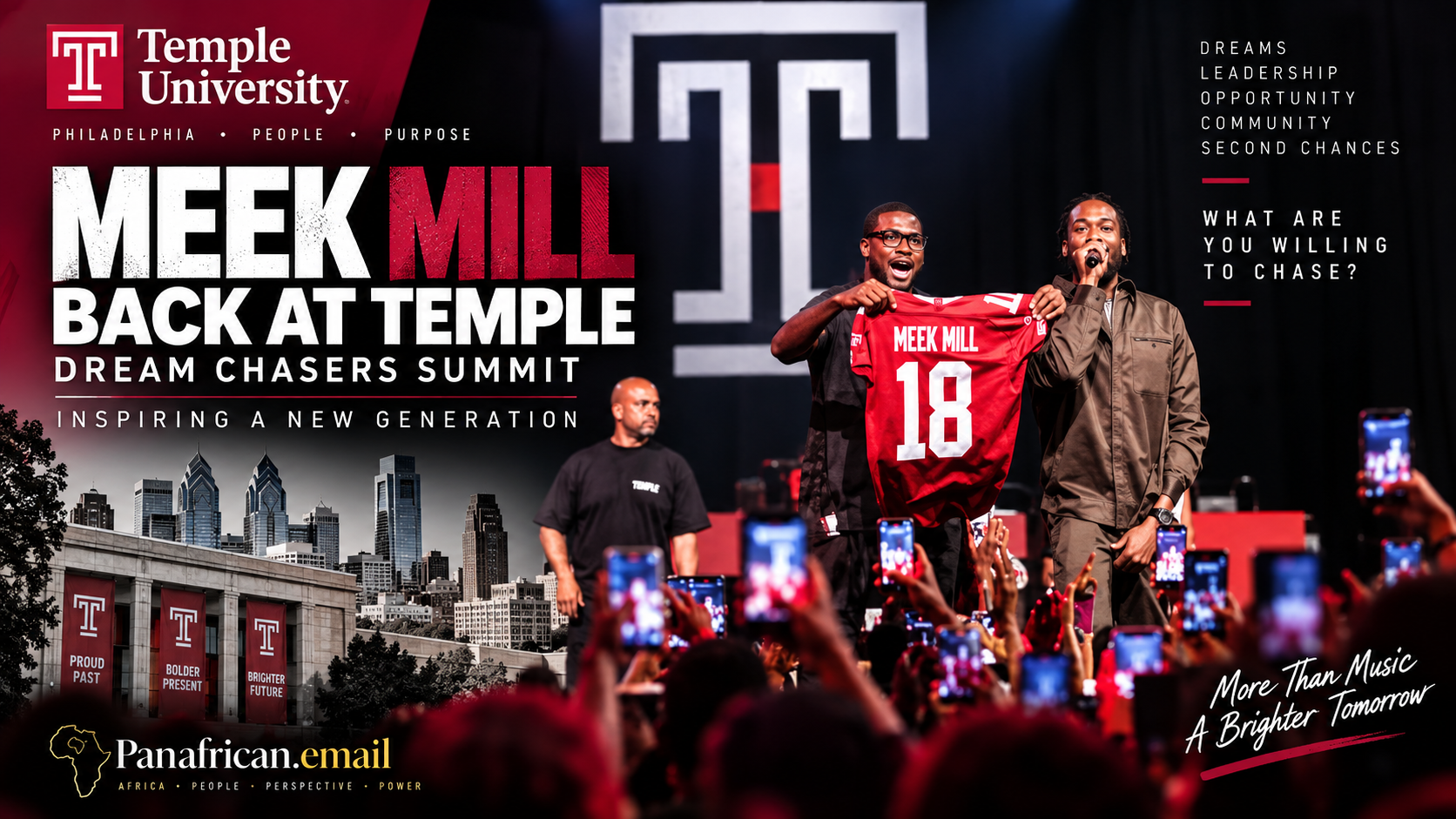
PHILADELPHIA — Thirteen years after the original Dream Chasers Summit was held at Temple University, Philadelphia-born rapper and entrepreneur Meek Mill returned to North Broad Street with a message that reached beyond music: success is not simply about making it out—it is about creating opportunities for the people coming behind you.
On September 10, 2026, Temple University’s Liacouras Center became the gathering place for more than 1,000 Temple students and Philadelphia high school seniors attending the Dream Chasers Sports & Entertainment Summit. The event brought together figures from music, sports, business, entertainment and community leadership for conversations about careers, ownership, adversity, leadership and second chances. (Temple Now)
For Meek Mill, the setting carried particular significance. He grew up in North Philadelphia, only blocks from the Liacouras Center, making the summit more than another celebrity appearance on a university campus. It was a return to the environment that helped shape his identity and ambitions. (Inquirer.com)
From North Philadelphia to Global Impact
The summit’s central theme reflected the trajectory of Meek Mill’s own career.
Known internationally for his music and the Dreamchasers series, Mill has increasingly used his platform to discuss entrepreneurship, opportunity, criminal-justice reform and community investment.
Temple announced the summit around three major pathways:
- Dreams and Nightmares — Culture, Music and Ownership
- Championships — Sports, Leadership and Legacy
- Wins and Losses — Community, Career and Second Chances
The themes were designed to connect the entertainment and sports industries with broader questions about economic opportunity, leadership and personal development. (Temple Now)
The program also included a featured conversation involving Mill and Temple alumnus Larry Miller, along with other speakers from the worlds of sports, business, music and entertainment. The summit culminated in a discussion focused on adversity, second chances and rebuilding. (Temple Now)
A Different Kind of Meek Mill Appearance
There was no conventional concert agenda at the center of the day.
Instead, Mill appeared as a speaker, entrepreneur and mentor.
The summit was structured around conversations intended to give students direct access to people who had experienced the highs and setbacks of professional careers. Temple described the event as an opportunity for students to hear candid accounts of the work, challenges and decisions behind success. (Temple Now)
That distinction mattered.
For young people considering careers in entertainment, sports, technology or business, the event offered something different from watching successful people from a distance. Students were able to hear how people built careers, navigated setbacks and developed professional networks.
NBC Philadelphia reported that the summit lasted approximately six hours and brought together hundreds of students, while Temple reported attendance of more than 1,000 students and Philadelphia high school seniors. (NBC Philadelphia)
Meek’s Message: Use the Technology You Already Have
One of the most contemporary parts of Mill’s message focused on technology.
Reflecting on his own career, he discussed how social media and mobile technology helped him promote his music, tell his story and build his brand.
His advice to students was straightforward: the smartphone in their pocket can be more than a device for consuming content.
It can become a business tool.
Students, he suggested, can use technology to connect with people, develop brands, produce films, record music and even launch clothing companies. (Temple Now)
That message reflects a broader transformation in how young entrepreneurs can enter industries that were once controlled primarily by traditional gatekeepers.
A musician no longer necessarily needs a major label to reach an audience.
A filmmaker can distribute work online.
A clothing designer can sell internationally from a phone.
A young entrepreneur can build a global network without leaving Philadelphia.
For Mill, technology became part of the infrastructure through which he transformed a local story into an international career.
“Philly’s Always Going to Be Home”
Despite the global reach of his career, Mill emphasized his connection to Philadelphia.
During the summit, he reflected on how growing up in North Philadelphia shaped his approach to ambition, resilience and competition.
Temple’s account quoted Mill describing Philadelphia as a place that influenced him “on every level,” including the way he approaches success. He also emphasized that despite having traveled around the world, Philadelphia would remain home. (Temple Now)
That relationship between hometown identity and global success became one of the defining elements of the summit.
Mill’s story is deeply associated with Philadelphia’s music culture, but the summit placed that story inside a larger conversation about economic mobility and community development.
From 2013 to 2026
The 2026 gathering was particularly notable because the first Dream Chasers Summit at Temple took place in 2013.
The return after 13 years created a generational bridge.
Some students attending the 2026 event were children or young teenagers when the first summit took place. Others were not yet born.
The return therefore represented more than a repeat event. It demonstrated how a concept built around Mill’s early success could be brought back to a new generation of students facing a dramatically different economic and technological environment. (Inquirer.com)
Temple specifically partnered with the School District of Philadelphia and Heights Philadelphia to bring 300 specially selected high school seniors to the summit. Those students were given an opportunity to participate in career exploration and leadership development alongside Temple students. (Temple Now)
Ownership Beyond the Music
One of the summit’s most important themes was ownership.
The idea appeared directly in the “Dreams and Nightmares” pathway, which focused on culture, music and ownership.
That emphasis reflects the evolution of Mill’s public career.
His story is no longer simply about becoming a successful recording artist. It also involves entrepreneurship, investing in communities and building institutions around ideas that extend beyond music.
For students, the ownership conversation is particularly relevant.
Creative industries can generate enormous cultural value, but the question of who owns the underlying businesses, intellectual property, brands and distribution channels can determine how much of that value ultimately remains with creators and their communities.
The summit placed that question alongside music, sports and entertainment rather than treating entrepreneurship as a separate field.
Lessons From Failure
Another major theme was the role of setbacks.
The summit’s “Wins and Losses” pathway focused on community, careers and second chances, while the final conversation centered on adversity and rebuilding. (Temple Now)
That subject has particular resonance within Mill’s public story.
His career has included major professional success as well as highly publicized legal and personal challenges. Rather than presenting success as a straight line, the summit emphasized the idea that careers can contain setbacks, reversals and opportunities to rebuild.
NBC Philadelphia reported that Mill spoke about witnessing people around him fail, go to prison and lose their lives, experiences that influenced his decision to redirect his energy toward building the life he has today. (NBC Philadelphia)
For students, the larger lesson was not that failure disappears once someone becomes successful.
It was that failure can become part of the story rather than necessarily being the end of it.
Philadelphia’s Next Generation in the Room
The significance of the summit also came from the students themselves.
Temple students and Philadelphia high school seniors were not simply spectators. The event was designed around conversations, questions, professional connections and exposure to leaders across multiple industries. (Temple Now)
Temple Athletics Vice President Arthur Johnson described the experience as an opportunity for students to hear directly from people who had achieved success while also learning about the challenges and setbacks they encountered.
That model places mentorship at the center of the event.
Instead of telling young people that success is mysterious or reserved for a select few, the summit attempted to expose them to the people, industries and experiences behind successful careers.
Why the Temple Partnership Matters
For Temple University, the summit also fits into its broader emphasis on community engagement and what the university calls place-based impact.
Temple President John Fry said the partnership with Mill provided an opportunity to connect students with prominent figures in entertainment, sports and business while strengthening the university’s relationship with Philadelphia. (Temple Now)
The location itself is important.
Temple sits in North Philadelphia, a community with deep cultural history and significant economic challenges. Bringing nationally recognized artists, athletes, business leaders and entrepreneurs into the neighborhood creates a different kind of educational environment—one where professional networks and classroom learning can intersect.
The Dream Chaser Becomes the Mentor
Perhaps the most symbolic element of the 2026 summit was the transformation of the phrase “Dream Chaser.”
When Mill’s Dreamchasers music became part of his identity, the phrase represented ambition: pursuing success despite obstacles.
At Temple, the concept was expanded.
The dream chaser was no longer simply the person trying to make it.
It was also the person trying to help someone else make it.
That distinction changes the meaning of success.
A career becomes more than personal achievement when its platform can be used to open doors for others.
A New Generation, A Familiar Question
The summit ultimately returned to a simple question that Temple announced as part of Mill’s keynote: What are you willing to chase? (Temple Now)
For a Temple student, the answer might involve becoming an entrepreneur.
For another, it could mean music, sports, technology, journalism, fashion or public service.
For a Philadelphia high school senior, it might simply mean believing that a future beyond the circumstances of today is possible.
And for Meek Mill, returning to Temple after 13 years transformed the Dream Chasers concept from a chapter of his musical history into a platform for mentorship and community engagement.
The significance of the day was therefore not just that a famous rapper returned to Philadelphia.
It was that a Philadelphia native who once represented the city’s aspirations through music returned to speak directly to young people who are now building their own versions of the future.
From North Broad Street to the global stage, the story had come full circle.
And this time, the microphone was not only about music.
It was about what comes next.
Leave a Reply