
By Panafrican.email News Desk
ACCRA, Ghana — September 18, 2026
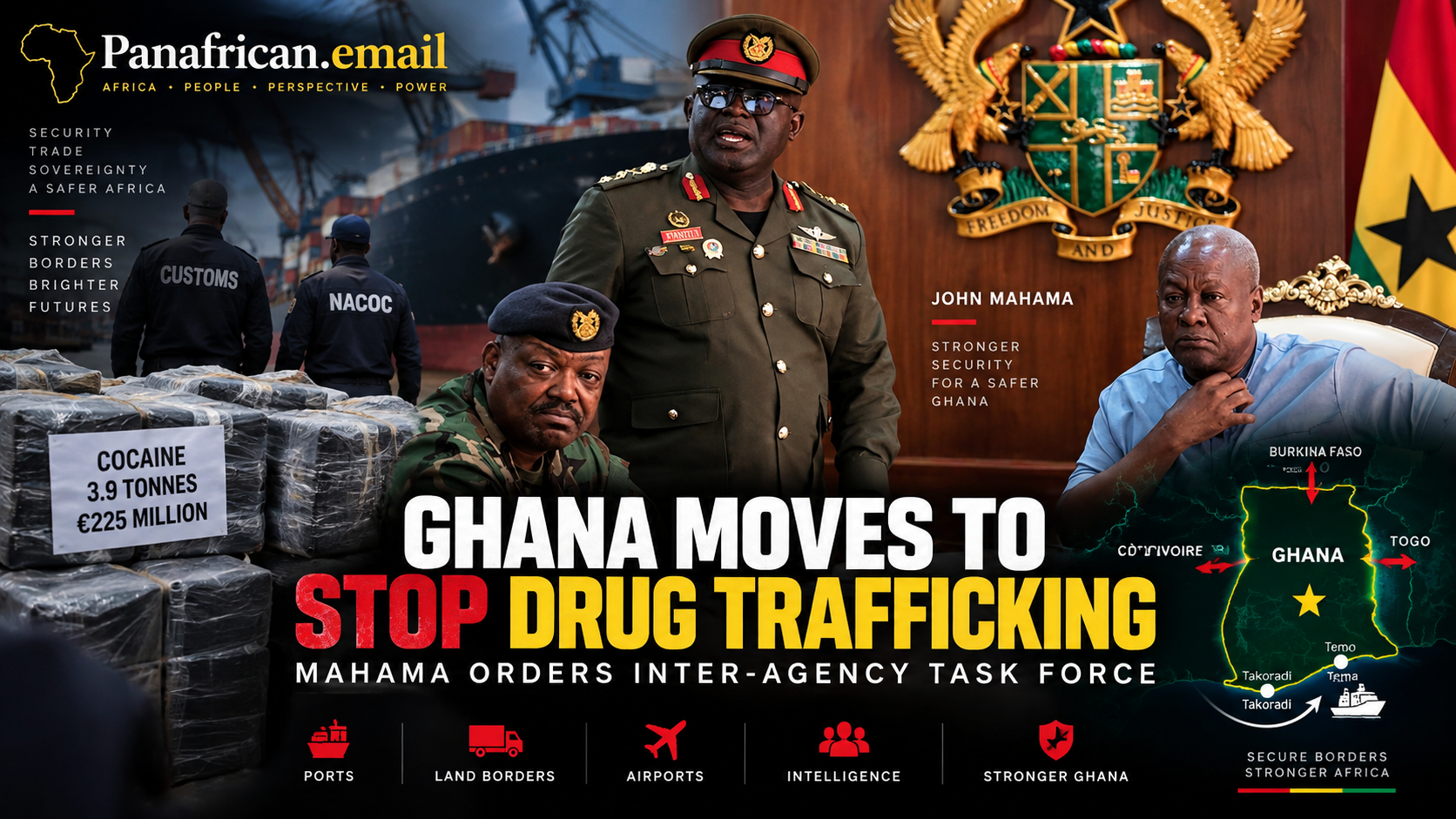
Ghana is moving to strengthen its defenses against international drug trafficking following the seizure in France of nearly 3.9 tonnes of cocaine concealed in a container of plastic waste that had arrived from Ghana.
President John Dramani Mahama has ordered the creation of an inter-agency task force to develop a national roadmap for preventing narcotics trafficking through Ghana’s borders. The task force has been given two weeks to submit its recommendations.
The presidential directive follows an emergency meeting with security chiefs and ministers on Thursday, September 17, where officials reviewed recent drug-trafficking investigations and Ghana’s existing port and border-control systems.
According to the government’s Information Services Department, 10 people, including four officers of the Customs Division of the Ghana Revenue Authority, are currently being held as investigations continue. Their alleged involvement and the wider circumstances surrounding the shipment remain matters for investigators and the courts to establish.
The Dunkirk Cocaine Seizure
The investigation was triggered in part by the September 10 seizure at the French port of Dunkirk.
French customs intercepted approximately 3.9 metric tonnes of cocaine, with an estimated value of about €225 million, hidden inside a container carrying plastic waste originating from Ghana. Part of the shipment was reportedly destined for Antwerp, Belgium.
The seizure has created an international investigation stretching from West Africa into Europe.
Ghana’s Narcotics Control Commission (NACOC) subsequently arrested suspects in connection with the shipment. Four accused persons were later brought before an Accra High Court and remanded to custody, while a fifth suspect, Dutch national Jos Leijdekkers, has been reported as being at large. The accused persons face charges including conspiracy and the alleged exportation of narcotic drugs and have pleaded not guilty.
The investigation remains ongoing.
Why Ghana’s Ports and Borders Are Under Scrutiny
The Dunkirk seizure raises a crucial question for Ghanaian investigators: how did such a large quantity of narcotics allegedly pass through the country’s export and cargo-control system?
Reporting by Citi Newsroom indicates that investigators are examining areas including the exporter, freight-forwarding arrangements and the Customs scanning process through which the container passed.
The government’s new task force is therefore expected to look beyond a single shipment.
Its mandate is to develop a coordinated national system involving security agencies and border authorities, with recommendations addressing the movement of people and cargo through Ghana’s ports and land borders.
Ghana’s Major Border Corridors
Ghana’s geography makes border security a complex national issue. The country shares land borders with Côte d’Ivoire, Burkina Faso and Togo, while its southern coastline provides access to international maritime trade.
The Ghana Immigration Service currently identifies five major entry controls: KIA, Paga, Elubo, Aflao and Akanu, alongside two sea-port offices at Tema and Takoradi.
These locations should not be interpreted as being linked to the Dunkirk shipment. Rather, they illustrate the principal international entry and exit points that form part of Ghana’s wider border-security architecture.

1. Tema Port — Greater Accra
Tema is one of Ghana’s principal maritime gateways and a major center for containerized international trade.
The Dunkirk seizure involved a container shipment, making maritime cargo controls an important part of the national conversation following the French interception.
The task force will therefore have to consider questions surrounding:
- Container scanning
- Cargo documentation
- Exporter verification
- Freight-forwarding processes
- Customs intelligence
- Risk profiling
- Physical inspection
- Information sharing between agencies
The government says Thursday’s meeting specifically reviewed the security structures and systems governing Ghana’s ports.
2. Takoradi Port — Western Ghana
Takoradi represents another major maritime gateway.
The Ghana Immigration Service lists Takoradi among its sea-port offices, while the Western Region also contains the Elubo border corridor, linking Ghana with Côte d’Ivoire.
This gives the western corridor strategic importance for both maritime and overland movement.
3. Elubo — Côte d’Ivoire Corridor
The Elubo border is Ghana’s major western land crossing toward Côte d’Ivoire.
The Ghana Immigration Service identifies Elubo as a major sector command and border location in the Western Region.
For the new task force, western-border security will involve more than checking individual travelers. It also involves understanding the movement of commercial vehicles, agricultural products, manufactured goods and other cargo across the Ghana–Côte d’Ivoire frontier.
4. Aflao — Togo Corridor
On Ghana’s eastern frontier, Aflao is a major crossing connecting Ghana with Togo.
The Ghana Immigration Service lists Aflao among its five major entry controls. Its regional border-management information also identifies approved routes and numerous identified unapproved routes around the Aflao sector.
This makes intelligence coordination particularly important along the eastern corridor.
5. Akanu — Togo Corridor
The Akanu crossing is another major Ghana–Togo entry point recognized by the Ghana Immigration Service.
GIS identifies Akanu among the country’s five major entry controls and lists additional approved and identified routes within the sector.
6. Paga — Burkina Faso Corridor
In northern Ghana, Paga is a major entry control connecting Ghana with Burkina Faso.
The corridor has particular geographic significance because it links Ghana to the wider Sahelian region and the north-south movement of people and commercial traffic.
GIS lists Paga among Ghana’s five major entry controls.
7. Hamile and Other Northern Crossings
Beyond the five major controls, Ghana has additional border posts and approved crossings.
GIS records Hamile in the Upper West Region, alongside other northern border locations. The national immigration system also includes numerous minor border controls and inland checkpoints.
The challenge for authorities is therefore not limited to the largest official crossings.
The Border Is More Than a Line on a Map
Ghana’s new approach will have to address several interconnected layers of security.
A shipment can move through a chain involving an exporter, warehouse, truck, freight forwarder, port, shipping company, customs declaration and foreign destination.
Consequently, border security begins before a container reaches a port.
It can involve:
Exporter → Warehouse → Transport → Customs documentation → Port screening → Shipping → Foreign customs
The Dunkirk case demonstrates why investigators may need to examine the entire chain rather than focusing exclusively on the point where drugs are physically discovered.
Intelligence Sharing
One of the central areas under discussion is coordination among Ghana’s security agencies.
Drug-trafficking organizations operate across jurisdictions, meaning information gathered by customs officials may have relevance to immigration authorities, police, intelligence services or narcotics investigators.
The government’s task force is expected to translate recommendations from the security meeting into a coordinated implementation plan.
Cargo and Passenger Screening
The task force is also expected to examine systems for screening both cargo and travelers.
Modern trafficking networks can attempt to exploit legitimate commercial supply chains, making cargo-risk assessment an important component of border enforcement.
For Ghana, this means examining whether existing scanning, intelligence and inspection systems can identify suspicious consignments without unnecessarily disrupting legitimate international trade.
Customs Integrity
The fact that four Customs Division officers are among the 10 people reported to be in custody has added another dimension to the investigation.
However, the government’s announcement does not establish guilt. Those investigations must proceed through the appropriate legal process.
The wider issue is institutional: how can Ghana strengthen systems so that border-control procedures remain resistant to corruption, manipulation and exploitation?
Ghana and the European Connection
The Dunkirk seizure also illustrates how West African trafficking investigations can quickly become international investigations.
The alleged shipment originated in Ghana, was intercepted in France and was reportedly partly destined for Belgium.
That means information-sharing between Ghanaian and European authorities can become critical.
NACOC has already said it is working with French authorities to obtain information related to the seizure and trace how the consignment allegedly left Ghana.
The investigation therefore has implications beyond Ghana’s domestic borders.
It touches the broader international fight against organized narcotics trafficking and the security of global commercial supply chains.
A Two-Week Deadline
President Mahama’s directive gives the newly formed task force a relatively short period to produce its roadmap.
The government says the roadmap will consolidate recommendations from the security agencies into an implementation plan aimed at preventing narcotics trafficking through Ghana’s ports and border entry points.
The key question will be what happens after the report.
A strategy document can identify weaknesses, but effective border security ultimately depends on implementation, resources, technology, personnel, intelligence coordination and accountability.
For Ghana, that means the task force’s work could extend from the country’s biggest container ports to major land crossings such as Paga, Elubo, Aflao and Akanu, as well as smaller border controls and inland checkpoints.
A Regional Security Issue
Ghana occupies a strategically important position on the West African coast, connecting the Atlantic maritime economy with neighboring countries and the wider Sahel.
That geography creates legitimate economic opportunities while also creating potential vulnerabilities that criminal networks can attempt to exploit.
The response to the Dunkirk seizure is therefore becoming a broader conversation about how Ghana manages its borders in an era of increasingly sophisticated transnational criminal networks.
For the government, the immediate task is clear: identify the weaknesses, improve coordination and produce a workable national roadmap within two weeks.
For the region, the larger issue is equally important.
West Africa’s security does not stop at national borders.
Cargo, people, money and criminal networks can cross multiple jurisdictions. Effective enforcement consequently requires cooperation between neighboring states as well as coordination with international partners.
The Dunkirk seizure has brought that reality into sharp focus.
And as Ghana begins its review, attention will turn from the drugs seized in Europe to the systems operating much closer to home.
Leave a Reply