
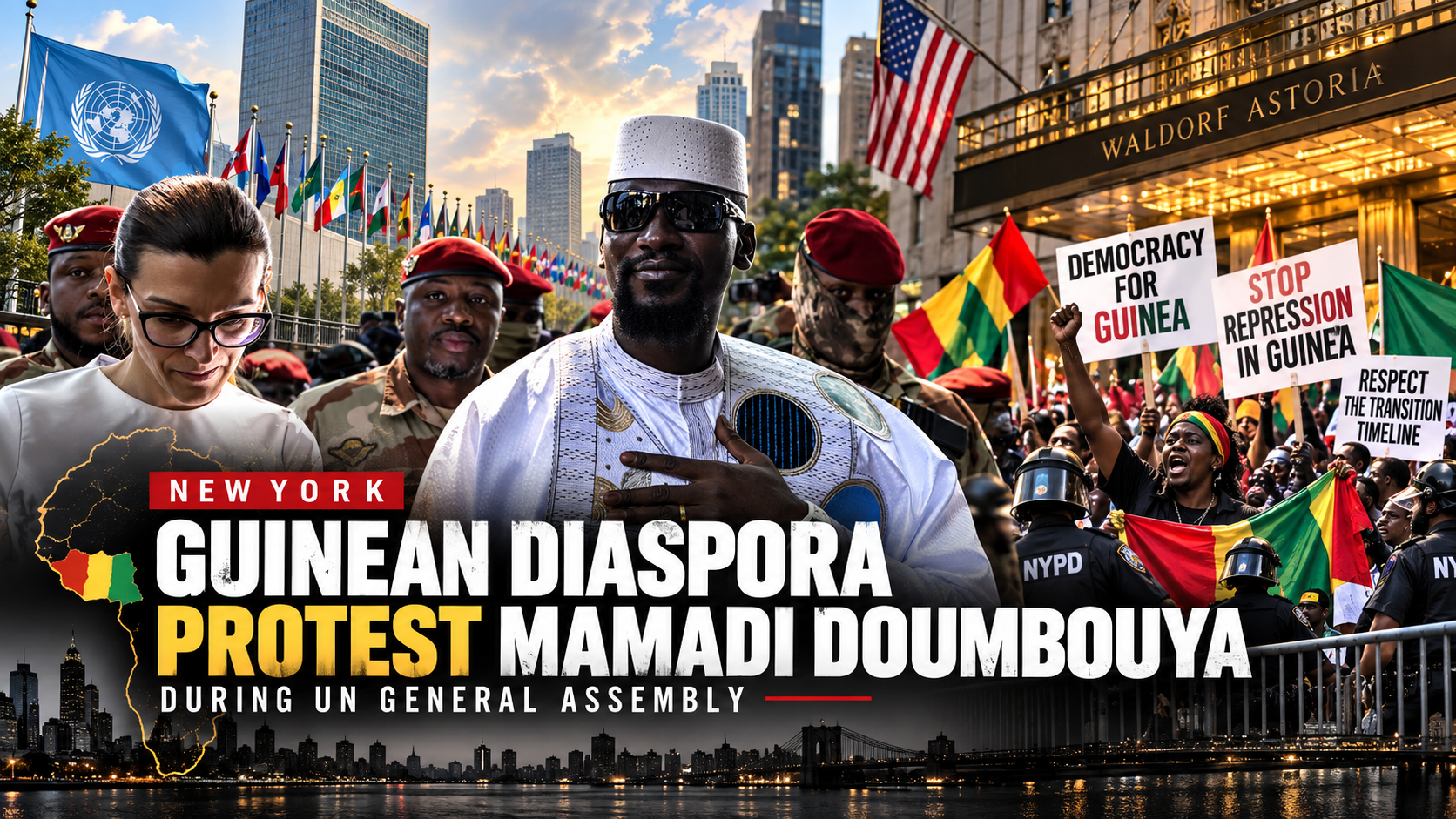
NEW YORK — September 25, 2026 — The political tensions surrounding Guinea’s transition to civilian rule moved onto the streets of Manhattan this week as members of the Guinean diaspora demonstrated against President Mamadi Doumbouya during the 81st United Nations General Assembly.
The demonstrations unfolded around the United Nations complex and the Waldorf Astoria in Midtown Manhattan, where Doumbouya stayed during his New York visit. Reuters documented members of the Guinean diaspora protesting at Dag Hammarskjold Plaza on September 23, with demonstrators raising allegations concerning political repression and killings in Guinea. (Reuters Connect)
The demonstrations brought a highly visible domestic political dispute into the international spotlight. While Guinea’s delegation participated in the diplomatic proceedings of the UN General Assembly, opponents of the military-led political transition used the presence of the country’s leader in New York as an opportunity to voice their demands.
Protest Meets Diplomacy
Doumbouya arrived in New York on September 21 for the 81st session of the UN General Assembly. The Guinean government presented his visit as part of a broader diplomatic program focused on Guinea’s international relationships, institutional development, security, economic transformation and the country’s natural-resource potential. (Presidence Guinea)
On September 23, Doumbouya addressed the General Assembly. The Guinean presidency described the appearance as an opportunity to present what it characterized as a sovereign and internationally engaged Guinea, while emphasizing institutional consolidation, inclusion, anti-corruption efforts and economic development. (Presidence Guinea)
Outside the diplomatic venues, however, sections of the Guinean diaspora presented a sharply different picture.
Protesters criticized the military-led transition and called for a return to constitutional civilian government. Reports from New York described demonstrations both near the UN and around the Waldorf Astoria, creating a striking contrast between the formal diplomacy taking place inside the UN system and the political confrontation unfolding on Manhattan’s streets. (24 News Agency)
A Divided Guinean Diaspora
The demonstrations also highlighted divisions within Guinea’s overseas community.
While opponents gathered to protest Doumbouya’s leadership, supporters of the Guinean president were also present in New York. Reporting from the demonstrations describes competing mobilizations among Guineans in the United States, reflecting the wider political divisions surrounding the country’s transition. (Exclusif.net, la vérité)
That division was already visible when Doumbouya arrived at the Waldorf Astoria on September 21. Supporters of the president organized an enthusiastic reception involving Guineans from different parts of the United States. (Journal Horoya)
Days later, the atmosphere around the hotel was substantially more confrontational.
Security Tightened Around the Waldorf Astoria

New York police maintained a significant security presence around the demonstrations as crowds gathered near the hotel and surrounding streets.
According to Guinean media reports, tensions escalated at one point on September 23 as protesters followed a vehicle while NYPD officers attempted to control the situation. Reports and video footage cited by local media also indicated that objects were thrown toward the vehicle. (24 News Agency)
The demonstrations occurred during one of the busiest diplomatic weeks of the year in New York, when heads of state and government officials from around the world converged on Manhattan for the General Assembly.
The United Nations’ 81st session officially opened on September 8 and runs through September 2027, with the high-level general debate taking place during the September diplomatic gathering. The theme of the session is focused on restoring trust and managing transformation through the United Nations. (United Nations)
For Guinea’s diaspora, the appearance of Doumbouya in the heart of New York provided an international stage for competing visions of the country’s political future.
Guinea’s Transition Remains at the Center of the Dispute
Doumbouya came to power following the September 2021 military coup that removed President Alpha Condé. His government subsequently pledged a transition toward constitutional government, but disagreements over the transition timetable and Doumbouya’s political future have remained central to opposition criticism.
The demonstrations in New York reflect that unresolved dispute.
Opposition activists and diaspora organizations have accused the authorities of restricting political activity and suppressing dissent. Those allegations are contested by the Guinean government, which has presented its transition program as an effort to rebuild state institutions and establish a new political framework.
The Guinean presidency has emphasized institutional reform, governance, economic development and the transformation of the country’s considerable natural resources. During his New York diplomatic engagements, Doumbouya highlighted the Simandou 2040 development program and sought continued international cooperation for Guinea’s institutional and economic agenda. (Presidence Guinea)
The competing narratives illustrate the political divide surrounding Guinea: supporters emphasize sovereignty, development and institutional reconstruction, while opponents focus on constitutional governance, political freedoms and the transition to civilian rule.
New York Becomes Another Front in Guinea’s Political Debate
The events in Manhattan demonstrate how Guinea’s political debate has extended far beyond Conakry.
For the Guinean diaspora, particularly communities based in the United States and Europe, international gatherings can provide opportunities to draw attention to political developments at home. The presence of Guinea’s leadership at the United Nations created precisely such an opportunity.
At the same time, the competing demonstrations demonstrate that Guinea’s diaspora is not politically unified.
The images from New York — protesters outside the United Nations, competing groups of Guineans displaying support and opposition, and police surrounding diplomatic movements — offered a highly visible snapshot of the country’s unresolved political tensions.
Doumbouya’s UN appearance therefore unfolded on two different stages: inside the General Assembly, where Guinea’s government presented its vision for the country’s future to the international community, and outside in the streets of Manhattan, where members of the Guinean diaspora demanded a different political trajectory.
As Guinea continues to navigate its transition, the confrontation in New York underscores how closely the country’s domestic political future is being watched by Guineans living both at home and abroad.
Leave a Reply