
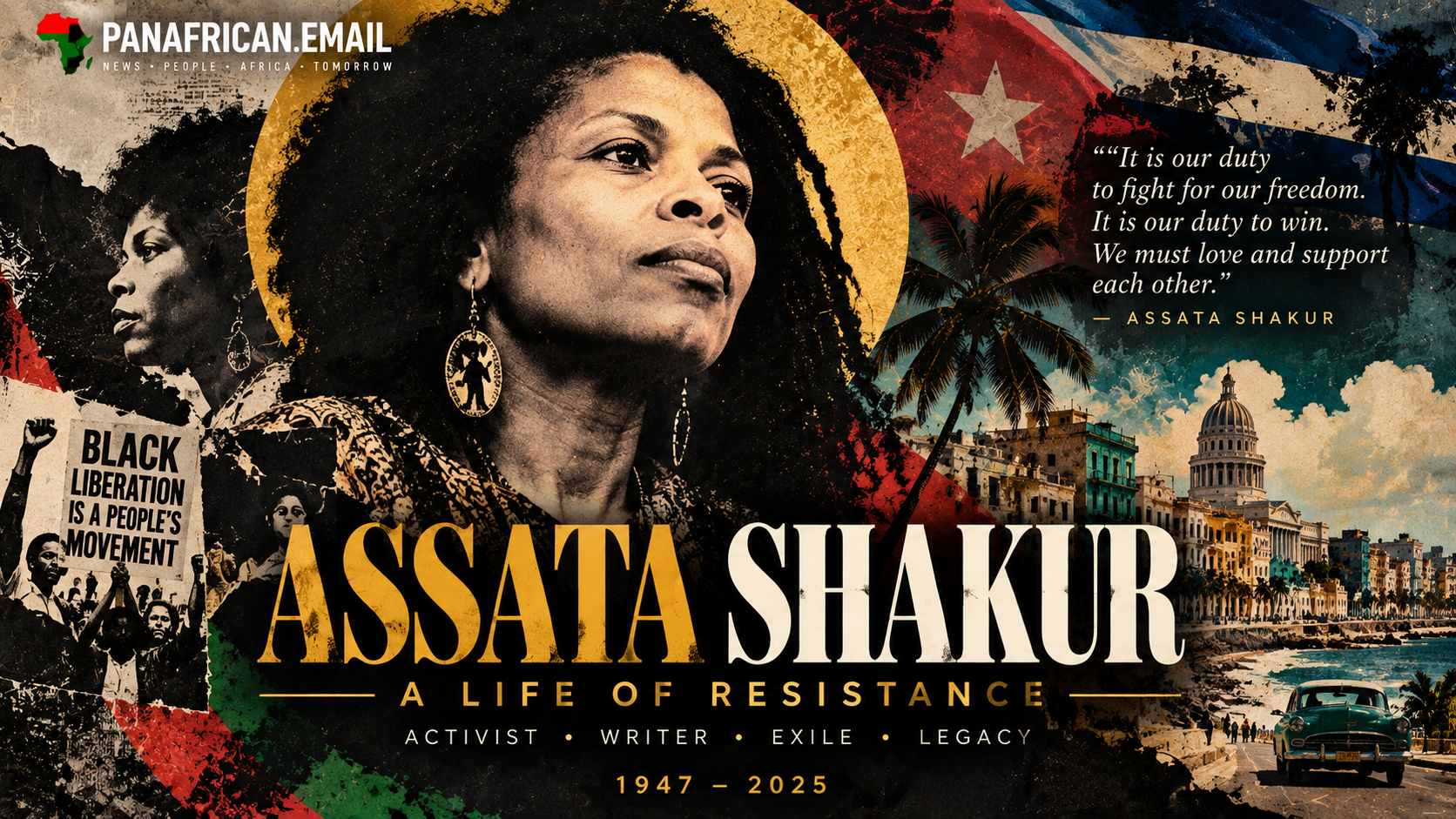
HAVANA, Cuba — September 26, 2025: Assata Shakur, the Black liberation activist whose life became intertwined with the political struggles of the United States, the history of the Black Liberation Army and Cuba’s relationship with Washington, has died in Havana at the age of 78.
Shakur died on September 25, 2025, according to Cuba’s Ministry of Foreign Affairs, which attributed her death to health conditions and advanced age. Her daughter, Kakuya Shakur, also confirmed her mother’s death publicly. (PBS)
Her death brings to a close more than four decades of life in Cuba, where she lived after escaping from a New Jersey prison in 1979 and later receiving political asylum.
From JoAnne Deborah Byron to Assata Shakur
Born JoAnne Deborah Byron in Queens, New York, in 1947, Shakur became politically active during a period of profound racial and social upheaval in the United States.
She became involved with Black political organizations and eventually joined the Black Liberation Army (BLA). During the late 1960s and early 1970s, the BLA was associated with armed resistance against the U.S. government and law-enforcement institutions.
Shakur’s political identity evolved alongside the broader Black liberation movement. She adopted the name Assata Olugbala Shakur and became increasingly prominent among activists challenging racism, policing and the American political system.
Her life would change dramatically following a 1973 confrontation with New Jersey State Police.
The New Jersey Turnpike shooting
On May 2, 1973, Shakur and two men associated with the BLA were stopped by New Jersey State Police on the New Jersey Turnpike. A gunfight followed.
State Trooper Werner Foerster was killed, another officer was wounded, and Shakur was seriously injured during the confrontation.
Shakur was subsequently prosecuted and, in 1977, convicted of first-degree murder and other offenses connected with Foerster’s death. She was sentenced to life imprisonment.
Shakur consistently maintained that she had not killed Foerster and disputed the prosecution’s account of the shooting. Contemporary accounts of the case note that she had been wounded during the confrontation and that questions surrounding the circumstances remained part of the controversy surrounding her case. (Reuters)
The U.S. government’s position, however, remained that Shakur was responsible for the trooper’s killing.
Escape and exile in Cuba
In November 1979, Shakur escaped from the Clinton Correctional Facility for Women in New Jersey with assistance from supporters.
She eventually made her way to Cuba, where she was granted political asylum. By the 1980s, she had established a life in Havana and remained there for decades.
Her presence in Cuba became a persistent issue in U.S.-Cuban relations. American authorities repeatedly sought her return to the United States, while Cuba continued to provide her refuge. (MPR News)
Shakur’s case became particularly prominent in 2013, when the FBI added her to its Most Wanted Terrorists list. She became the first woman placed on that list, and U.S. authorities offered a substantial reward for information leading to her capture. (AP News)

A symbol to different movements
Few figures from the American Black liberation era have generated such sharply different interpretations.
To U.S. law-enforcement authorities, Shakur remained a fugitive convicted in the killing of a police officer.
To generations of Black activists and supporters, she became a symbol of resistance, political exile and opposition to racial injustice. Her writings, particularly her 1987 autobiography Assata: An Autobiography, became influential among activists, artists and scholars examining Black political history.
Her story also entered popular culture. Artists including Public Enemy and Common referenced Shakur in their work, while her relationship with rapper Tupac Shakur, who regarded her as his godmother, brought her name to an even wider audience. (Pitchfork)
Four decades in Havana
Unlike many political fugitives whose stories ended with arrest or extradition, Shakur spent more than four decades living outside the United States.
Cuba’s decision to grant her asylum ensured that her case remained a recurring point of tension between Havana and Washington.
For Shakur, Cuba became more than a place of refuge. It became the country in which she spent the final decades of her life, raised her daughter and continued to write and engage with questions of Black identity, political struggle and liberation.
Her death therefore resonates beyond the circumstances of the 1973 shooting or her escape from prison. It also marks the passing of one of the last prominent figures directly associated with the radical Black liberation movements of the 1960s and 1970s.
A contested legacy
Assata Shakur leaves behind a legacy that remains deeply contested.
The legal record includes her conviction for the killing of Trooper Werner Foerster, while Shakur herself maintained that she was innocent. Supporters have described her as a political prisoner and liberation figure, while U.S. authorities continued to regard her as a fugitive wanted for a serious violent crime. (Reuters)
Those competing interpretations are likely to remain part of the historical debate surrounding her life.
What is not disputed is the extraordinary trajectory of her story: from a young Black woman growing up in the United States during the civil-rights era, to a participant in radical political movements, a convicted prisoner, an escaped inmate and ultimately a longtime resident of revolutionary Cuba.
Her daughter, Kakuya Shakur, confirmed that her mother died in Havana on September 25, 2025.
Assata Shakur was 78.
Her life—and the political questions surrounding it—will continue to be examined as part of the history of Black America, the African diaspora, U.S.-Cuba relations and the global struggle over race, justice and political power.
PanAfrican.email will continue to explore the histories of African and diasporic figures whose lives shaped the political, cultural and intellectual landscape of the modern world.
Leave a Reply