
NEW YORK — Spirit Airlines stopped flying in May. But the company’s digital memory may have just found a new life inside one of the world’s most powerful artificial-intelligence companies.
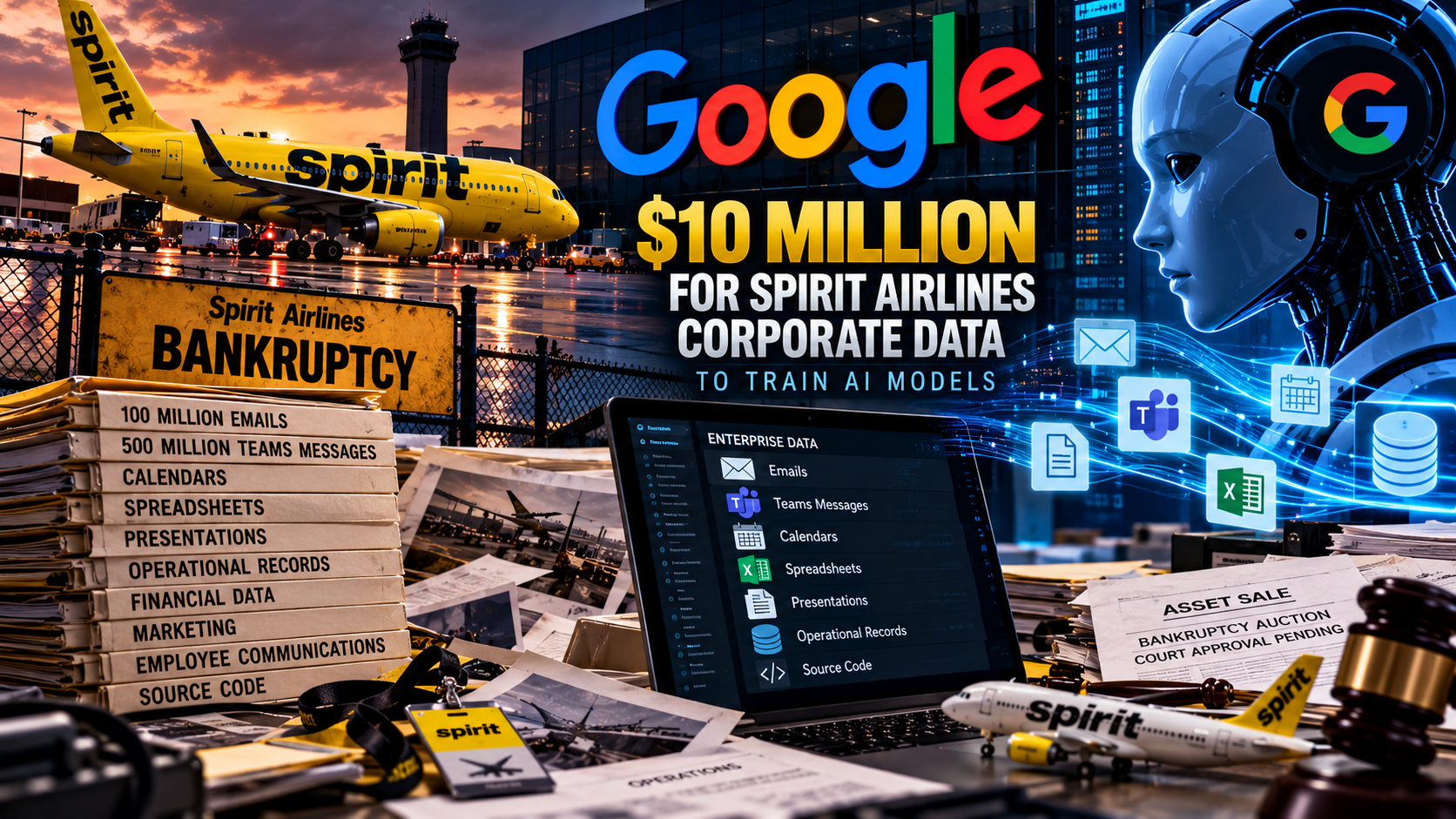
Google has agreed to pay $10 million for a massive collection of Spirit Airlines’ internal corporate data, including emails, Microsoft Teams communications, spreadsheets, calendars, operational records and software code.
The prize is not the aircraft.
It is the information generated by the people who operated them.
And that makes the deal one of the clearest examples yet of a new market emerging around artificial intelligence: the buying and selling of corporate history as training material for machines. (Axios)
The $10 Million Data Auction
Google won a bankruptcy auction for the Spirit data after beating AI-data company Mercor, which reportedly bid $7.5 million.
The dataset reportedly contains approximately 100 million emails and 500 million Microsoft Teams messages, along with calendars, spreadsheets, presentations and records covering areas such as aircraft operations, revenue, marketing, employee productivity, audits and fraud. (Bloomberg Law)
Google says the information can help improve its products and AI models.
That may sound like a straightforward technology acquisition.
It isn’t.
The transaction opens a much larger question:
What happens to a company’s accumulated institutional knowledge after the company itself disappears?
The Corporate Memory Machine
For decades, Spirit employees generated information simply by doing their jobs.
Emails were written.
Meetings were scheduled.
Problems were documented.
Aircraft operations were recorded.
Revenue decisions were analyzed.
Marketing campaigns were planned.
Software was developed.
Managers communicated through Teams.
Employees created spreadsheets and presentations.
None of those activities were originally designed to train an artificial intelligence system.
Now they may become exactly that.
The AI industry increasingly needs enormous quantities of real-world examples showing how organizations actually operate.
Spirit’s archive offers something different from conventional internet data.
It contains the workflow of a real company.
That could potentially help AI systems understand how people manage operations, coordinate teams, analyze problems and make business decisions. (Fast Company)
The Privacy Fault Line
Google says the data it receives will be de-identified by a third party before transfer.
The company has also said it will not receive personally identifiable information, and passenger profiles and loyalty information are excluded from the acquisition. (Axios)
But that assurance has not ended the controversy.
More than 120 U.S. lawmakers have raised concerns about the proposed transaction, particularly regarding information involving Spirit’s employees.
Their concern is different from the question of passenger privacy.
Even when names and obvious identifiers are removed, internal corporate communications can contain enough contextual information to potentially identify individuals or reveal sensitive workplace information.
Labor unions have therefore questioned whether the protections designed for customers go far enough to protect employees. (Reuters)
100 Million Emails. 500 Million Messages.
Those numbers are what make the transaction extraordinary.
Google isn’t simply buying a collection of documents.
It is acquiring a digital snapshot of how a major airline functioned.
Inside hundreds of millions of communications could be patterns about:
- airline operations
- management decisions
- revenue strategies
- employee productivity
- marketing
- project management
- financial controls
- audits
- fraud investigations
- software development
For an AI company, the value may not be any individual email.
The value could be the relationships between thousands of decisions made over years.
That is potentially far more useful for training sophisticated business-oriented AI systems.
The Bankruptcy Creates a New Market
Spirit’s collapse has produced an unusual situation.
The airline’s physical assets can be sold.
Aircraft can be returned or auctioned.
Airport slots can change hands.
But the company’s digital assets can also be monetized.
That means bankruptcy proceedings are beginning to reveal another category of corporate property:
machine-readable institutional knowledge.
A company can disappear while its accumulated information remains valuable.
And the AI industry is willing to pay for it.
Google Says It Wants the Data — Not the People

Google has emphasized that it is not seeking personal information.
The company says the dataset will undergo rigorous third-party processing to remove personally identifiable information before Google receives it. It has also agreed not to attempt to re-identify individuals from the dataset. (Axios)
That distinction will be crucial.
Because the future AI economy may increasingly depend on datasets created by people who never agreed that their everyday work would eventually become training material for artificial intelligence.
The question is therefore moving beyond traditional privacy law.
It becomes a question of data ownership, worker rights and digital inheritance.
The AI Gold Rush Is Moving Inside Companies
The Spirit transaction is part of a much broader race.
AI companies once concentrated on scraping publicly available information.
Now the valuable frontier may be private enterprise data.
Companies possess years — sometimes decades — of records showing how real organizations operate.
That information can potentially teach AI systems things that ordinary internet text cannot.
How does an airline respond when flights are disrupted?
How does a revenue team react to changing prices?
How do executives communicate during a crisis?
How does an operations department coordinate thousands of moving parts?
Those are not merely facts.
They are patterns of human decision-making.
And those patterns may be worth millions.
The Courtroom Question
There is still a legal checkpoint.
The proposed transaction requires approval through Spirit’s bankruptcy proceedings, and a court hearing is scheduled for October 14. Lawmakers and labor representatives have raised objections over privacy protections, particularly concerning employees. (Reuters)
So the $10 million purchase is not simply a technology story.
It is a test case.
If approved, Google’s Spirit acquisition could become a precedent for future bankruptcy auctions involving corporate datasets.
A failed company may leave behind something more valuable than its buildings, equipment or intellectual property:
the accumulated behavior of its workforce.
And Silicon Valley is beginning to put a price on it.
The Bigger Question
Spirit Airlines is gone.
Its planes have stopped flying.
Its corporate infrastructure is being dismantled.
But its digital ghost remains.
Hundreds of millions of messages, documents and records could soon be transformed into fuel for artificial intelligence.
The next generation of AI may therefore learn not only from books, websites and public databases.
It may learn from the digital remains of companies that no longer exist.
The Spirit Airlines auction suggests that a new commodity has entered the AI economy.
Corporate memory.
And Google just bid $10 million for a piece of it.
Leave a Reply