
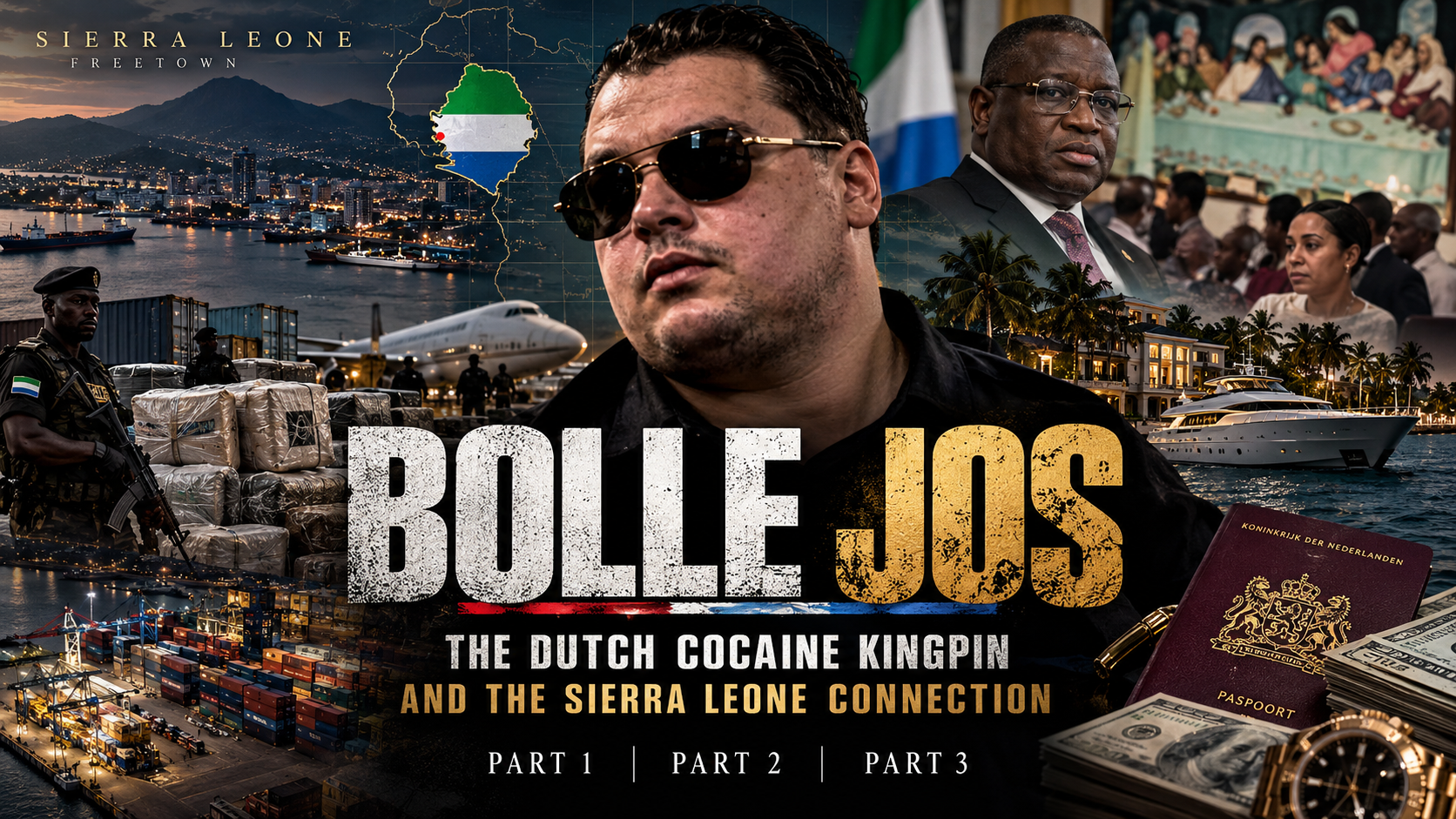
PART ONE — THE FUGITIVE WHO DISAPPEARED INTO WEST AFRICA
From Breda to the international cocaine trade
His name is Jos Leijdekkers. Known in criminal circles as “Bolle Jos,” the Dutch national became one of Europe’s most wanted fugitives after building a reputation in the international cocaine trade.
According to Dutch police, Leijdekkers was sentenced by the Rotterdam District Court on June 25, 2024, to 24 years in prison for six cocaine shipments totaling more than 7,000 kilograms, a violent robbery in Finland and ordering a murder. A Belgian court separately convicted him for drug trafficking and assault. Dutch authorities also continue to investigate his possible involvement in other serious crimes. (Politie)
The Dutch Public Prosecution Service placed a €200,000 reward on information leading to his arrest.
But Leijdekkers was already gone.
For years, investigators traced him through different international locations. Turkey became one of the places associated with his movements. Then, sometime before the beginning of 2025, investigators confirmed something that dramatically changed the story:
Jos Leijdekkers was in Sierra Leone.
In January 2025, Dutch police publicly confirmed that they had been certain for more than six months that Leijdekkers was residing in the West African country. (Politie)
That discovery transformed what had previously been a European manhunt into a much larger West African security and governance story.
Why Sierra Leone?
Sierra Leone occupies an important geographic position along the Atlantic coast of West Africa. International organized-crime researchers have identified the country as a significant logistics and redistribution point for cocaine moving toward Europe. Maritime routes, the Gulf of Guinea and Europe’s major ports form part of a much larger trafficking network. (OC Index)
The emergence of a major European cocaine trafficker inside Sierra Leone therefore raised an obvious question:
Was he hiding — or was he building a new operating base?
That question remains at the center of international investigations.
PART TWO — THE SIERRA LEONE CONNECTION
The photographs that changed the story

The international controversy exploded after photographs and videos emerged showing Leijdekkers in Sierra Leone.
One of the most widely circulated images came from a January 1, 2025 church service in Tihun, where a man identified as Leijdekkers appeared among members of President Julius Maada Bio’s family.
Reuters reported that the images showed the man sitting near the president’s daughter, Agnes Bio. Reuters also reported sources’ claims about their relationship, while noting that the relationship itself was not independently confirmed at the time. (euronews)
Investigative reporting subsequently documented other appearances involving Sierra Leonean officials and members of the country’s elite.
In March 2025, Follow the Money reported that Leijdekkers appeared at a birthday celebration for Alusine Kanneh, then head of Sierra Leone’s immigration service. Video reportedly showed Leijdekkers handing Kanneh a gift while senior officials, including the head of the country’s anti-drug agency, were present. (Follow The Money)
The episode had consequences.
The Guardian reported that Kanneh was dismissed after footage surfaced showing him with the fugitive drug trafficker. (The Guardian)
The photographs therefore became more than celebrity-style social-media images. They became evidence in a much larger debate over state institutions, organized crime and political influence.
Allegations of protection
European investigators and journalists have raised serious allegations that Leijdekkers developed relationships with influential figures in Sierra Leone that helped shield him from arrest.
Those allegations must be treated carefully.
There is a major difference between:
documented contact with officials
and
proof that government officials knowingly protected a criminal organization.
The latter requires evidence.
Investigative organizations including Follow the Money have reported allegations that Leijdekkers developed access to infrastructure and security networks inside Sierra Leone. Other international reporting has described him as increasingly embedded within political and business circles. (Follow The Money)
Sierra Leone’s government has disputed aspects of the reporting and has maintained that judicial cooperation must proceed according to Sierra Leonean law.
That distinction matters.
The controversy is not simply about one fugitive.
It is about whether an international criminal network can exploit relationships, wealth and institutional weaknesses inside a sovereign state.
PART THREE — SIERRA LEONE, EUROPE AND THE FIGHT FOR EXTRADITION
The man Europe wants back
The Netherlands has repeatedly sought Leijdekkers’ return.
Dutch authorities say he remains one of their most wanted fugitives and have described bringing him back to the Netherlands as a top priority. (Politie)
By October 2026, the dispute had become an international diplomatic issue.
A Dutch government document dated October 2, 2026 states that the Netherlands has repeatedly requested Leijdekkers’ extradition from Sierra Leone since February 2025 and that those efforts had not yet produced the desired result. (ikregeer.nl)
Reports also emerged of growing European pressure on Freetown.
Reuters reported on October 1 that Dutch Justice Minister David van Weel said the European Commission had suspended financial aid to Sierra Leone because of its failure to cooperate in the arrest and extradition of Leijdekkers. (Reuters)
But Sierra Leone’s government disputes that interpretation.
According to a government response reported on October 1, the European Commission’s decision concerned the timing and administrative requirements of a financing agreement rather than punishment connected to a particular individual. Sierra Leone specifically rejected the characterization that EU development cooperation had been suspended because of the Leijdekkers case. (Sierra Leone Monitor)
The disagreement illustrates how far the Bolle Jos case has now travelled beyond the world of organized crime.
It has become a question of diplomacy, sovereignty, development assistance and international justice.
A larger African security question
The Leijdekkers case should not be interpreted as evidence that Sierra Leone itself is a criminal state.
Nor should the actions of one international trafficker be used to stigmatize Sierra Leoneans.
The deeper issue is the vulnerability of West African states to transnational criminal networks.
Cocaine produced in Latin America can travel across the Atlantic, enter West African logistical networks and ultimately reach European markets. The enormous profits generated by that trade create incentives for corruption, money laundering, intimidation and political influence.
The Organized Crime Index has identified Sierra Leone as a significant cocaine trafficking logistics and redistribution hub, with maritime routes playing an important role. (OC Index)
That means the Bolle Jos story is ultimately larger than Bolle Jos.
It is about the Atlantic cocaine economy.
It is about the ports, ships, financiers, brokers, corrupt officials, criminal networks and European consumers that make the trade profitable.
And it raises an uncomfortable question for Africa and Europe alike:
If a fugitive can move billions of dollars of criminal value across continents, establish relationships with powerful people and remain beyond the reach of multiple European justice systems, where exactly does the power of the modern state end?
The manhunt continues
As of October 2026, Dutch authorities still say Leijdekkers is in Sierra Leone and are continuing diplomatic efforts to secure his return. (ikregeer.nl)
The Dutch police continue to list him as wanted and maintain the €200,000 reward for information leading to his arrest. (Politie)
The case therefore remains unresolved.
For Sierra Leone, it is a test of institutional independence and international cooperation.
For Europe, it is a test of whether a convicted trafficker can be brought back to face his sentences.
For West Africa, it is a warning about the enormous financial and political power generated by transnational cocaine trafficking.
And for the international community, the Bolle Jos affair demonstrates something increasingly difficult to ignore:
Organized crime is no longer confined to the streets, ports or hidden warehouses. It can move through the same social, economic and political networks as legitimate power.
Leave a Reply