
Publication date: 15 October 2026
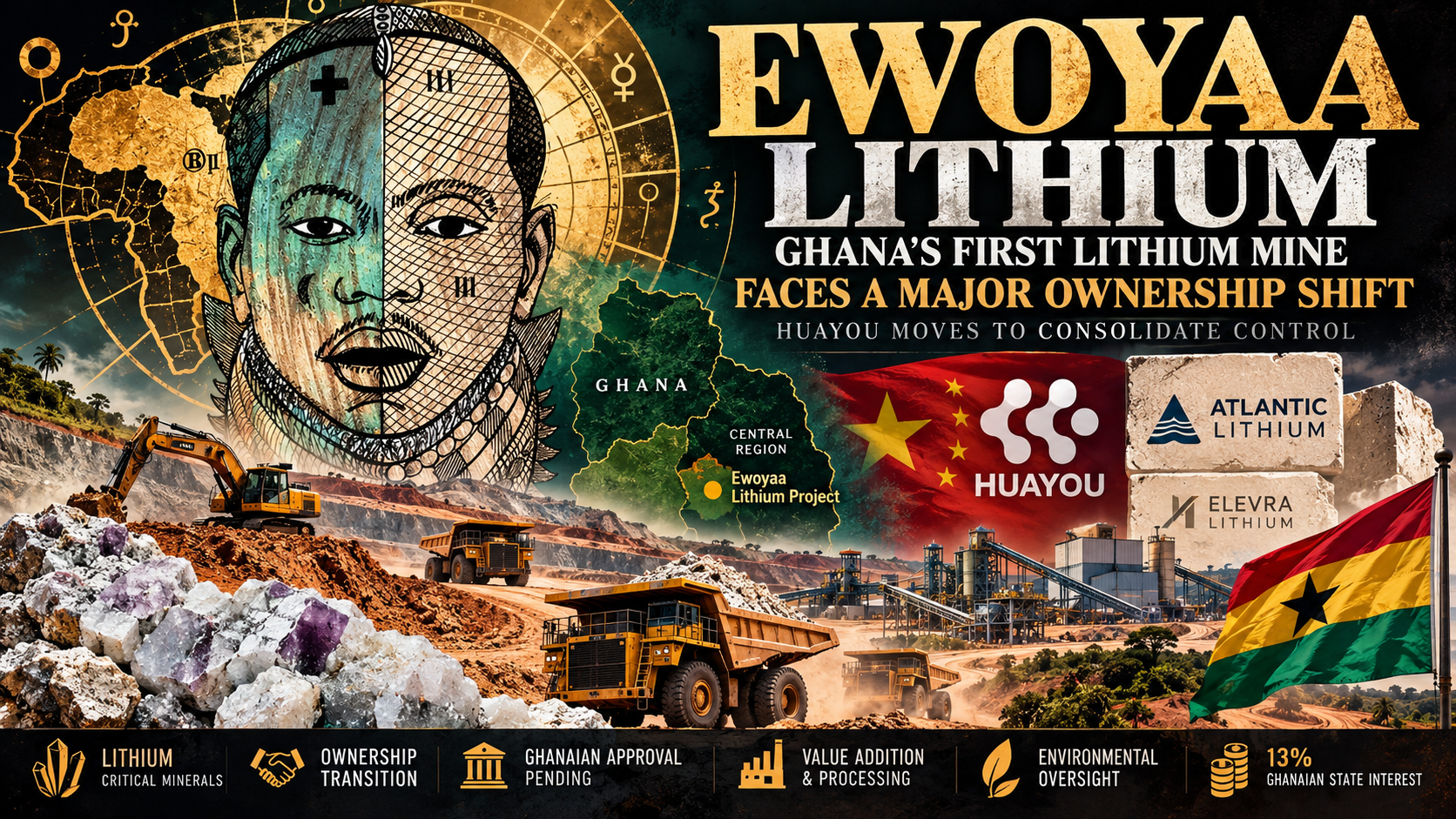
Ghana’s emerging lithium industry is approaching a potentially decisive moment as Chinese battery-materials giant Zhejiang Huayou Cobalt moves to consolidate control of the Ewoyaa Lithium Project in the Central Region.
Ewoyaa is positioned to become Ghana’s first lithium-producing mine, following the ratification of its mining lease by Parliament in March 2026. But while the project has cleared an important domestic regulatory milestone, its ownership structure is now being reshaped through two separate proposed transactions involving Huayou, Atlantic Lithium and Elevra Lithium.
If both transactions are completed, Huayou could emerge with approximately 87% of Ewoyaa, while the Ghanaian state would retain a 13% free-carried interest under the proposed structure. (Wansom AI)
The transactions, however, are not yet fully completed. That distinction is critical.
From Ghanaian lithium ambition to a change in ownership
Ewoyaa is being developed by Atlantic Lithium through its Ghanaian subsidiary, Barari DV Ghana Limited. The project covers approximately 42.63 square kilometres in the Mfantseman Municipality of Ghana’s Central Region.
In March, Ghana’s Parliament ratified the project’s mining lease, marking a major milestone for the country’s ambition to enter the lithium-producing nations. Atlantic Lithium describes the lease as the first mining lease granted and ratified for lithium in Ghana. (Atlantic Lithium Ltd)
The project is based on spodumene-bearing pegmatites and is intended to produce a spodumene concentrate that can ultimately enter the lithium-ion battery supply chain.
Atlantic Lithium’s reported resource base stands at approximately 36.8 million tonnes at 1.24% lithium oxide, with reported ore reserves of 25.6 million tonnes at 1.22% lithium oxide. These are company-reported resource and reserve figures, rather than independent estimates produced for this article. (Atlantic Lithium Ltd)
The strategic importance of Ewoyaa therefore extends beyond Ghana’s first lithium mine.
It potentially gives Ghana a position inside a global supply chain increasingly dominated by competition over critical minerals.
Huayou’s two-pronged strategy
The emerging ownership structure comes through two separate transactions.
On 7 May 2026, Huayou agreed to acquire Atlantic Lithium itself through a proposed scheme of arrangement. The reported transaction value is approximately US$210 million. (Wansom AI)
Two days later, on 11 May, Elevra Lithium agreed to sell its rights and interests associated with Ewoyaa to Huayou for approximately US$71 million, including its associated offtake rights. (Securities and Exchange Commission)
Together, the transactions would substantially consolidate the private-sector interests surrounding Ewoyaa under Huayou.
But they should not be treated as one transaction.
They have separate contractual structures and separate regulatory conditions.
That distinction has become particularly important as Ghana considers whether to approve the transfer of Elevra’s interests.
Ghanaian approval remains outstanding
The latest formal disclosure from Elevra, dated 1 October 2026, provides the clearest picture of where the process stands.
Elevra said the proposed US$71 million transfer of its Ewoyaa interests to Huayou remained subject to Ghanaian government approval.
At the same time, Huayou had received approval from Australia’s Foreign Investment Review Board for its separate proposed acquisition of Atlantic Lithium. (Securities and Exchange Commission)
The Australian approval therefore represents progress for the Atlantic takeover, but it does not constitute Ghanaian approval for the separate transfer of Elevra’s Ewoyaa interests.
Under the terms disclosed by Elevra, if the necessary Ghanaian approvals have not been obtained by 30 October 2026, Huayou can elect either to complete the transaction and pay the approximately US$71 million consideration or terminate the agreement and pay a US$5 million break fee.
If Ghana formally rejects the application on or before that date, the break-fee provision does not apply. (Securities and Exchange Commission)
That makes the second half of October an important period for Ghana’s lithium sector.
The proposed 87% Huayou position
According to the ownership structure reported by Briefly and reflected in the project’s broader corporate arrangements, completion of both transactions could leave Huayou with approximately 87% of Ewoyaa, while Ghana would retain a 13% free-carried interest. (Wansom AI)
The Ghanaian state’s free-carried interest is strategically significant because it gives Ghana participation in the project without requiring the state to finance its share of development costs in the same way as a conventional paid equity investment.
But ownership percentages tell only part of the story.
The more important questions are:
- Where will Ewoyaa’s spodumene be processed?
- Where will the highest-value stages of the lithium supply chain occur?
- How much revenue will remain in Ghana?
- What employment and supplier opportunities will be created?
- What obligations will the mining company have toward Ghanaian businesses?
- What environmental guarantees will accompany development?
- How will Ghana’s free-carried interest translate into actual economic benefits?
These questions will determine whether Ghana merely becomes a producer of lithium-bearing ore or establishes a more substantial position in the battery-materials economy.
A Chinese-controlled project would change the strategic equation
Huayou is a major Chinese battery-materials company, and its proposed consolidation of Ewoyaa would place the Ghanaian project within a company with extensive interests across the global lithium and battery-materials supply chain.
This is strategically significant because China occupies a dominant position in much of the global battery-processing ecosystem.
For Ghana, that presents both an opportunity and a challenge.
On one hand, Huayou’s experience and access to capital could accelerate project development.
On the other, Ghana must ensure that the arrival of a major foreign investor does not simply reproduce the traditional African minerals model:
resource extraction in Africa → export of raw or semi-processed material → high-value processing elsewhere.
That question is especially relevant because Ghana has increasingly emphasized domestic mineral value addition.
The bigger battle is over value, not ownership alone
Ghana’s government has repeatedly promoted policies intended to move the country beyond the export of raw minerals.
Gold is already being pushed toward greater domestic refining, while government policy has increasingly emphasized processing manganese, bauxite, iron ore and other minerals within Ghana.
Lithium therefore arrives at a critical moment.
The country has an opportunity to establish an early position in a mineral supply chain that is expected to remain strategically important for electric vehicles, energy storage and advanced manufacturing.
But lithium mining alone does not automatically create a lithium industry.
Mining produces the feedstock.
The greater economic value can arise further downstream through concentration, chemical conversion, cathode materials, battery manufacturing, technology, logistics and associated industrial services.
That is where Ghana’s negotiating position becomes important.
Parliament’s lease decision remains an important foundation
The Ewoyaa mining lease was ratified by Ghana’s Parliament in March 2026.
That decision provided a major regulatory foundation for the project, but it did not mean that the mine had entered commercial production. Atlantic Lithium continues to describe Ewoyaa as a project being advanced toward Ghana’s first lithium production. (Atlantic Lithium Ltd)
This distinction matters because public discussion can sometimes blur the difference between:
lease approval → ownership transaction → development → construction → production.
They are separate stages.
Ewoyaa has made substantial progress, but the project is not yet equivalent to an operating Ghanaian lithium mine.
October 30 becomes an important date
The most immediate event to watch is the 30 October 2026 contractual decision point associated with Elevra’s proposed sale to Huayou.
If Ghanaian approval arrives, the transaction could proceed toward completion.
If approval remains outstanding, Huayou will have the contractual options disclosed by Elevra.
Separately, Huayou’s proposed acquisition of Atlantic Lithium continues through its own scheme process. Atlantic’s reported timetable points toward further shareholder, court and regulatory steps before the proposed takeover can become effective. (Investegate)
The two processes should therefore continue to be tracked independently.
What Ghana should be watching
The Ewoyaa story should not be reduced to the question of whether Huayou becomes the owner.
For Ghana, the more consequential questions concern sovereignty, value addition and industrial development.
The government will need to determine whether the proposed ownership structure is consistent with the country’s broader critical-minerals strategy.
It will also need to protect the public interest through environmental enforcement, transparent reporting, local participation and effective implementation of the conditions attached to the mining lease.
The Ghanaian state’s 13% free-carried interest could ultimately become valuable—but only if the project reaches production and generates sustainable returns.
Similarly, local employment requirements and Ghanaian participation in the supply chain will matter far more than headline ownership percentages if Ghana wants Ewoyaa to become a catalyst for industrial development.
The African lithium question
Ewoyaa represents something larger than a single Ghanaian mining project.
Across Africa, governments are increasingly confronting the same question:
Will the continent remain primarily the source of critical minerals, or will African countries capture a meaningful share of the processing, manufacturing and technological value created from those resources?
Ghana has an opportunity to make Ewoyaa an answer to that question.
The country already possesses a relatively sophisticated mining sector, established financial institutions, ports, roads, regulatory institutions and a growing policy focus on mineral value addition.
The challenge is turning those advantages into an integrated lithium industry.
That means negotiating not only for royalties and equity, but also for processing, skills transfer, research, supplier development, infrastructure, technology and long-term industrial capacity.
What is fact—and what remains a claim
Established/reported facts:
- Ghana’s Parliament ratified the Ewoyaa mining lease in March 2026. (Atlantic Lithium Ltd)
- Huayou agreed to acquire Atlantic Lithium for approximately US$210 million. (TradingView)
- Elevra agreed to sell its Ewoyaa interests to Huayou for approximately US$71 million. (Securities and Exchange Commission)
- Australia’s FIRB approved Huayou’s proposed Atlantic Lithium acquisition in September. (London South East)
- Elevra reported on 1 October that Ghanaian approval for its separate transaction remained outstanding. (Securities and Exchange Commission)
- The Elevra transaction has a 30 October contractual decision point if approvals remain outstanding. (Securities and Exchange Commission)
Conditional/prospective:
- Huayou owning approximately 87% of Ewoyaa.
- Ghana retaining a 13% free-carried interest under the proposed structure.
- Completion of both transactions.
- The timing of commercial production.
These outcomes depend on the completion of the relevant transactions and approvals. They should therefore not be presented as completed facts.
A strategic test for Ghana
Ewoyaa is now becoming a test of Ghana’s mineral strategy.
The country has spent decades exporting gold and other mineral resources while attempting to increase the amount of value captured domestically.
Lithium gives Ghana another chance to change that equation.
The immediate question is whether Huayou will gain control.
The bigger question is what Ghana gains from Huayou’s control.
If the project delivers jobs, tax revenue, state participation, Ghanaian suppliers, environmental protection, infrastructure and progressively greater domestic processing, Ewoyaa could become a model for responsible critical-mineral development.
If Ghana simply exports another mineral concentrate while the highest-value stages occur elsewhere, the country risks repeating an old extractive pattern with a new commodity.
The next few weeks—and particularly the regulatory decisions surrounding the proposed transactions—will help determine which path Ewoyaa takes.
Ewoyaa is not merely Ghana’s potential first lithium mine. It is an early test of whether Africa can negotiate a larger share of the critical-minerals economy.
Tags
Ghana lithium, Ewoyaa Lithium, Atlantic Lithium, Elevra Lithium, Zhejiang Huayou Cobalt, Ghana mining, critical minerals, lithium mining, Central Region Ghana, mineral resources, mining leases, Ghana Parliament, MIIF, mineral value addition, battery minerals, African mining, China Africa minerals, Ghana economy
Leave a Reply