By Panafrican Intelligence Desk
A social-media post circulating online has renewed attention on the legal dispute involving former Kenyan content moderators and Meta, the parent company of Facebook.
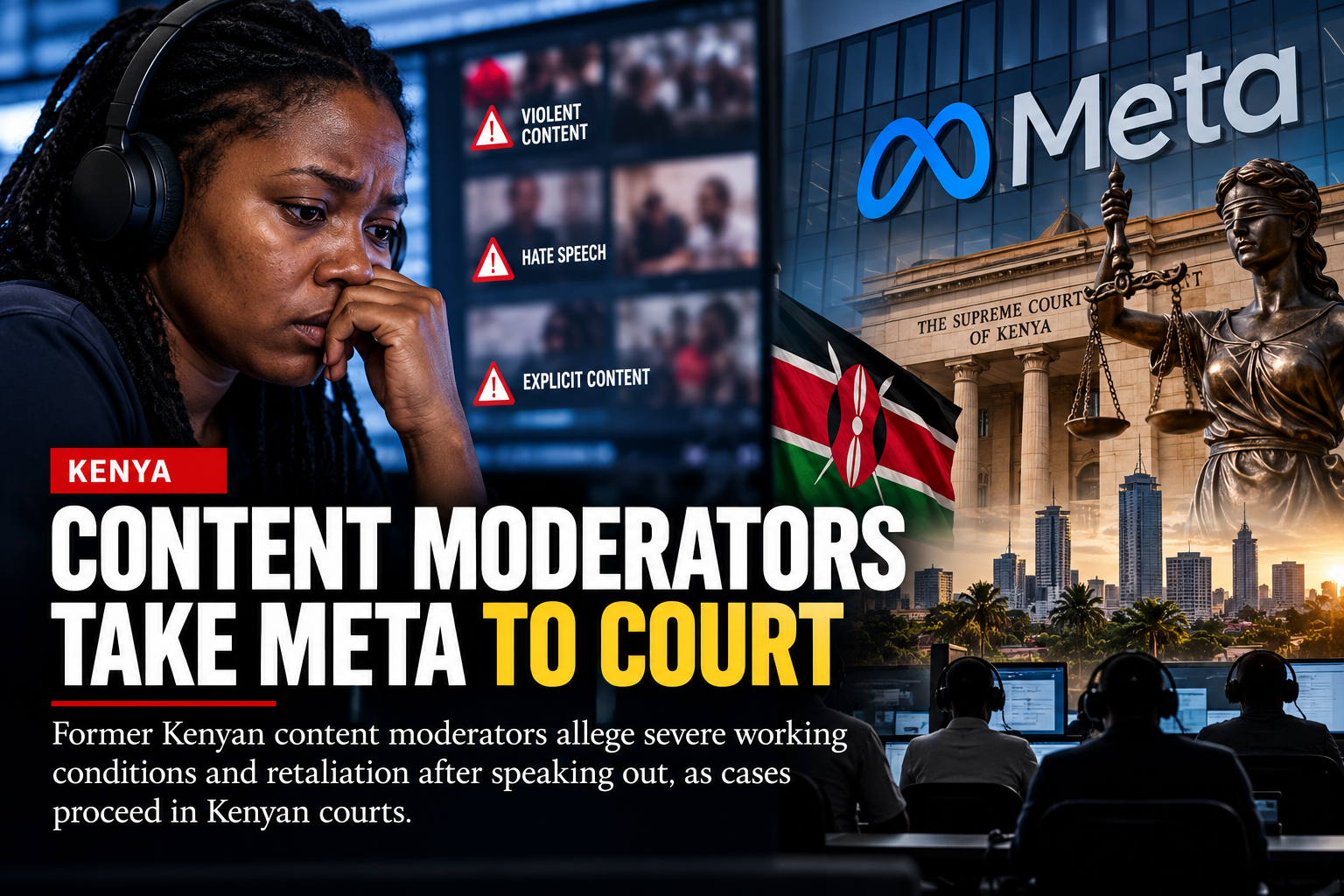
The post alleges that former content moderators working in Kenya experienced severe working conditions and were subsequently dismissed after speaking publicly about their experiences. It also references ongoing court proceedings in Kenya involving the workers and Meta.
The screenshot shows a video discussing the dispute and claims that Kenyan courts are currently hearing cases involving former moderators. A comment accompanying the post says the parties were due back in court and refers to human-trafficking cases headed toward trial.
The wider dispute
Kenya has become an important location in the global debate over the conditions faced by workers who moderate social-media content.
Content moderators are responsible for reviewing material that platforms may remove or restrict, including graphic, violent, sexually explicit or otherwise disturbing material. The work can expose employees to substantial psychological and emotional pressures.
Former moderators in Kenya have previously brought legal actions involving working conditions, employment practices and the outsourcing arrangements surrounding Facebook’s content-moderation operations.
The dispute has consequently become part of a much larger question: who bears responsibility for the human cost of keeping global social-media platforms safe?
Why Kenya matters
Kenya’s role in the technology sector extends beyond software development and startups. The country has also become part of the global infrastructure supporting major digital platforms, including outsourced trust-and-safety operations.
For workers performing this role, however, the relationship between technology companies and outsourced employees can be complicated.
Questions raised by the ongoing litigation include employment protections, access to legal remedies, workplace conditions and the responsibilities of multinational technology companies toward workers performing essential platform functions.
Allegations require judicial scrutiny
The claims circulating with the video should be treated as allegations rather than established findings.
The social-media post itself is not sufficient evidence to independently establish that every allegation made against Meta or other parties is true. The courts remain the appropriate forum for determining disputed facts and legal responsibility.
The case nevertheless deserves attention because it highlights a growing African labor issue: the people who make the global digital economy function are not always located in the countries where the technology companies are headquartered.
The human cost of content moderation
Behind every social-media platform is a workforce responsible for deciding what billions of users can see.
That work is often invisible.
When moderators encounter traumatic material repeatedly, the consequences can extend well beyond the workplace. The debate over compensation, psychological support, employment protections and accountability therefore has implications for the entire technology industry.
Kenya’s legal battles could ultimately contribute to a broader precedent for how multinational technology companies structure and supervise outsourced digital labor across Africa.
Kenya • Technology • Labor • Human Rights
META
IN KENYA
A legal-intelligence examination of the litigation involving
former Kenyan content moderators, Meta and outsourcing companies.
STATUS: ACTIVE
JURISDICTION: KENYA
RISK: HIGH
PRECEDENT POTENTIAL: VERY HIGH
Case Architecture
Two major litigation tracks
Motaung v. Sama & Meta
ELRC Petition E071 of 2022
Allegations concerning working conditions, psychological harm,
labor rights and alleged human trafficking or forced labor.
Arendse & Others v. Meta
ELRC Petition E052 of 2023
Litigation involving former moderators and allegations concerning
termination, redundancy, blacklisting and workplace conditions.
INTELLIGENCE NOTE
The two proceedings became closely connected and were subsequently
consolidated for purposes of the broader litigation.
Core Legal Question
Who is responsible for the worker?
01 — Platform
Meta operates the global platform and determines the requirements
surrounding content moderation.
02 — Contractor
Outsourcing companies such as Sama employed moderators performing
moderation work connected to Meta.
03 — Worker
Moderators performed the actual review of online material,
frequently under demanding operational conditions.
KEY QUESTION
How far can a multinational technology platform’s legal responsibility
extend when essential platform operations are performed by workers
employed through contractors?
Jurisdiction Battle
Can Meta be sued in Kenya?
Meta challenged the jurisdiction of Kenyan courts. The jurisdiction
question became one of the most important procedural battles in the case.
20 September 2024
Kenya’s Court of Appeal rejected Meta’s jurisdictional appeals,
allowing the litigation to continue within the Kenyan judicial system.
LEGAL INTELLIGENCE
The jurisdictional defense was substantially weakened. The focus
therefore shifts toward the substantive claims and the question of
potential liability.
Worker Protection
The human dimension
Psychological Exposure
Moderators may repeatedly encounter graphic, violent, hateful or
otherwise disturbing material as part of platform safety operations.
Working Conditions
The litigation raises allegations concerning workload, pay,
workplace protections and mental-health support.
Termination
Former moderators challenge aspects of employment termination and
the transition between outsourcing arrangements.
Blacklisting Allegations
Workers have raised allegations concerning their ability to obtain
comparable employment following changes in the contractor structure.
Case Timeline
From employment dispute to global precedent
2022
Daniel Motaung files Petition E071 of 2022 in Kenya.
2023
The Employment and Labour Relations Court proceedings expand,
including the Arendse litigation.
2024
Kenya’s Court of Appeal rejects Meta’s jurisdictional appeals.
2025
The litigation proceeds in consolidated form with multiple
participating parties and interested institutions.
2026
Proceedings remain active, with further court directions and
substantive issues still under consideration.
Panafrican Risk Matrix
Legal exposure
Kenyan jurisdiction
HIGH
Court of Appeal rejected jurisdictional appeals.
Employer liability
HIGH
Potential significance of Meta’s operational role.
Unfair termination
HIGH
Core area of the employment litigation.
Psychological injury
HIGH
Claims concern exposure to traumatic moderation material.
Human trafficking / forced labor
VERY HIGH
Serious allegations whose merits remain unresolved.
Outsourcing precedent
VERY HIGH
Potential implications for African digital labor.
Panafrican Intelligence Assessment
The bigger question
The Kenyan litigation could become an important test of corporate
accountability in Africa’s digital economy.
CONFIDENCE
HIGH
The existence of the principal litigation and the jurisdictional
proceedings is documented in Kenyan judicial records.
MERITS
PENDING
Allegations concerning trafficking, retaliation, psychological harm
and unlawful employment practices should not be treated as established
findings until determined by the courts.
STRATEGIC QUESTION
If a platform relies on outsourced African workers to perform essential
digital operations, where does the platform’s responsibility begin —
and where does it end?
Editorial Safeguard
Allegation ≠ finding
LEGAL DISCLAIMER
This presentation is an intelligence and media-analysis product.
Allegations described in the underlying litigation are presented as
allegations and should not be interpreted as judicial findings of
wrongdoing. The ultimate merits of disputed claims remain subject to
determination by the Kenyan courts.
Prepared for: Panafrican.email
Legal Intelligence • Technology • Labor • Africa
Panafrican Intelligence Assessment: The circulating post highlights an ongoing legal and labor controversy involving Kenyan content moderators and Meta. The specific claims contained in the social-media post should be independently verified against court records and official statements as proceedings continue.

Leave a Reply