
By Panafrican.email News Desk
October 29, 2026
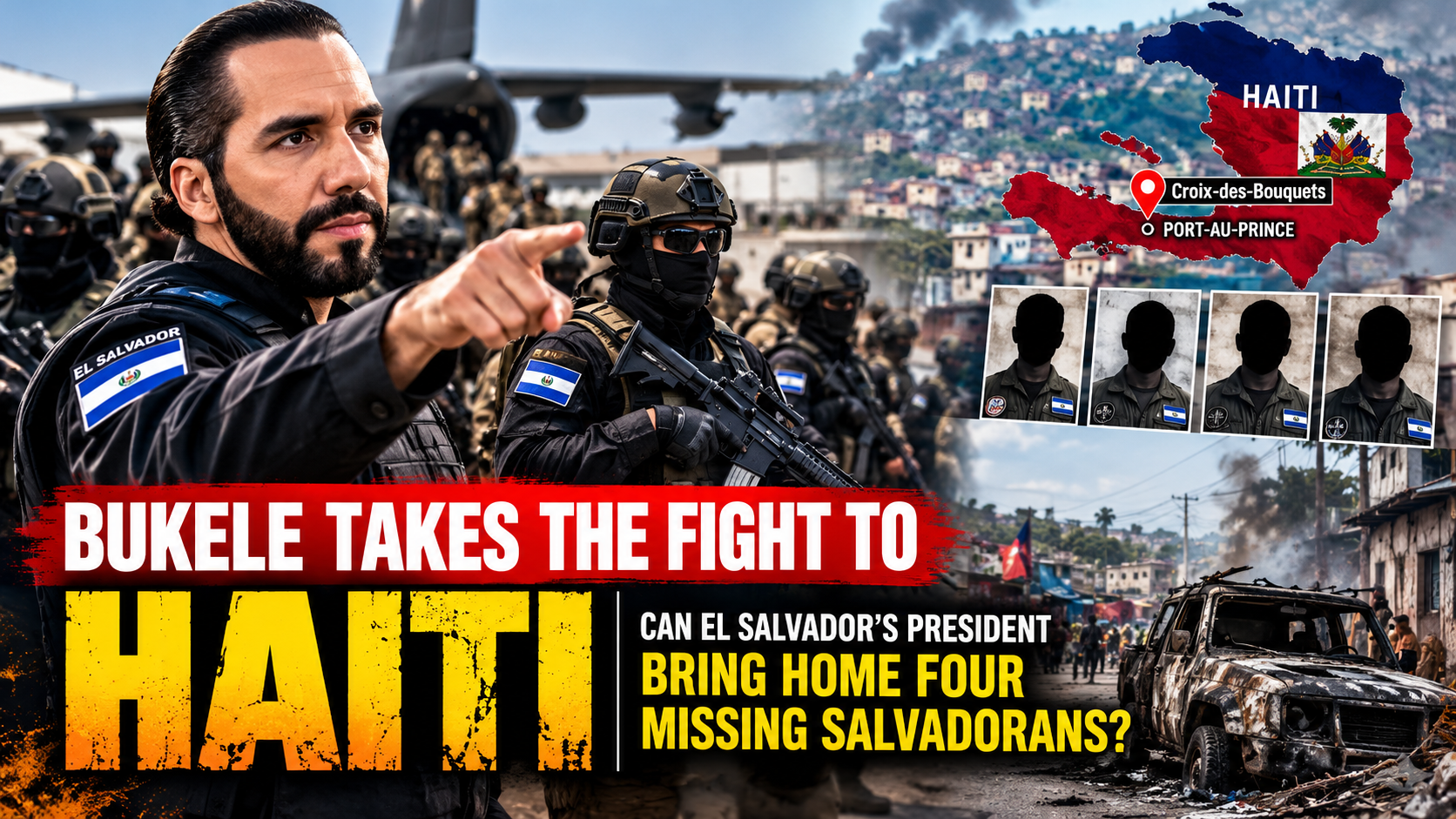
PORT-AU-PRINCE — El Salvador is preparing to dramatically expand its military presence in Haiti as President Nayib Bukele demands the safe return of four Salvadoran aviation technicians who disappeared after their armored vehicle was attacked by heavily armed gangs near Port-au-Prince.
The crisis has transformed what was initially a limited Salvadoran contribution to Haiti’s international security operation into a potentially much larger military intervention.
El Salvador’s government announced that more than 2,000 Salvadoran soldiers will be deployed to Haiti to assist with the search for the missing personnel and support operations against armed gangs. Bukele has already sent hundreds of troops, but the precise command structure, duration and operational mandate of the expanded deployment remain unclear. (Reuters)
The escalation comes after four Salvadoran aviation technicians serving with the United Nations-backed Gang Suppression Force (GSF) disappeared following an attack in the Croix-des-Bouquets area outside Haiti’s capital.
For Bukele, the mission is personal, political and strategic.
He has made the destruction of criminal gangs the defining feature of his presidency in El Salvador.
Now he is attempting to confront Haiti’s heavily armed gangs on their own territory.
Four Salvadorans disappear in Haiti
The four Salvadoran personnel were traveling in an armored vehicle in the Santo area of Croix-des-Bouquets when armed men attacked.
According to reports, the attackers used firearms and explosives, setting the vehicle ablaze.
The four technicians escaped the burning vehicle but subsequently disappeared.
The incident became the first major attack on Salvadoran personnel participating in Haiti’s international security mission. The United Nations condemned the attack and called for the immediate and safe return of the four Salvadorans. (Las Naciones Unidas en El Salvador)
The men were not primarily deployed as infantry combat troops.
Bukele has emphasized that the Salvadoran contingent included aviation personnel whose duties included medical evacuation and supporting the mission’s aviation requirements.
That distinction has become important to the Salvadoran president’s argument.
His message to Haiti’s gangs has effectively been:
These men came to Haiti to save lives — not to fight your war.
Bukele issues a warning
Following the disappearance, Bukele issued a direct warning to the gangs responsible.
The Salvadoran president said the initial military response would be only the beginning if the four men were not returned alive and unharmed. (Anadolu Agency)
The language was unmistakably Bukele.
For years, he has built his political identity around an uncompromising campaign against gangs inside El Salvador.
His government imprisoned tens of thousands of suspected gang members under the country’s state of exception, dramatically reducing reported homicide levels while drawing severe criticism from human-rights organizations over mass arrests, due-process concerns and prison conditions.
Now that model of political authority is being tested outside El Salvador.
The question is no longer simply whether Bukele can suppress gangs.
It is whether his government can conduct a targeted hostage-recovery operation inside another sovereign country without triggering a much larger conflict.
The scale of Haiti’s gang crisis
Haiti is not El Salvador.
That may be the biggest challenge facing Bukele.
Haiti’s armed groups operate within an environment where state institutions have been severely weakened, political authority is fragmented and large portions of the capital are controlled or contested by gangs.
The humanitarian consequences are enormous.
The United Nations reported that more than 5,700 people were killed or injured by gangs or during anti-gang operations between January and mid-September 2026, while more than 230 people were kidnapped. Nearly 1.5 million people have been displaced by the broader crisis. (The Washington Post)
The security situation has also undermined Haiti’s political transition.
Haiti’s electoral authorities have now postponed elections again, with the first round scheduled for July 18, 2027, followed by a second round and local elections in October. (Reuters)
That means the Salvadoran rescue operation is unfolding against the backdrop of a country struggling to rebuild both security and democratic institutions.
Enter the Gang Suppression Force
The Salvadorans are part of the wider international effort known as the Gang Suppression Force.
The mission was established to support Haitian authorities in confronting heavily armed criminal organizations and creating conditions for the restoration of security and eventual elections.
The force includes personnel from several countries, including African, Caribbean and Latin American states.
El Salvador’s contribution was initially focused heavily on aviation and technical capabilities.
But the disappearance of four Salvadorans has changed the equation.
Hundreds of Salvadoran special-forces personnel have already arrived to assist with the search, according to reporting, while the government now says the overall deployment will exceed 2,000 soldiers. (The Washington Post)
That is a substantial escalation.
Who controls the territory?
One of the greatest challenges confronting Salvadoran forces is geography.
The four men disappeared in an area where armed gangs have significant influence.
The attack reportedly occurred in territory associated with groups including 400 Mawozo and Chen Mechan, among other armed organizations.
The gangs have demonstrated an ability to use heavy weapons, ambush security forces and exploit urban terrain.
They also operate within communities where civilians are trapped between competing armed actors.
That creates a fundamentally different battlefield from the one Bukele confronted in El Salvador.
In Haiti, identifying the enemy is not always straightforward.
A gang fighter can disappear into an urban neighborhood.
A weapons shipment can move through informal networks.
Hostages can potentially be moved between territories controlled by different armed organizations.
And intelligence is difficult to obtain.
Analyst Romain Le Cour of the Global Initiative Against Transnational Organized Crime told The Washington Post that the crisis highlights a fundamental intelligence problem facing international forces in Haiti: reliable information and the ability to protect and share it securely. (The Washington Post)

Can Bukele reproduce the “El Salvador model” in Haiti?
This is where the comparison becomes complicated.
Bukele’s government has achieved a dramatic reduction in reported homicide rates in El Salvador.
That success has made him one of the most influential political figures in Latin America.
But Haiti’s crisis is structurally different.
El Salvador possesses a functioning national government, established security institutions, a relatively centralized territory and a population of approximately 6 million.
Haiti has approximately 12 million people and has suffered years of political instability, institutional breakdown and territorial fragmentation.
Gangs do not simply exist alongside the state.
In significant areas, they have effectively become competing centers of power.
The challenge is therefore not simply:
Find the gangs.
It is:
Rebuild enough state authority that gangs cannot continuously replace the state.
That requires policing, intelligence, courts, prisons, economic development, political legitimacy and control of borders and weapons.
A military offensive can disrupt armed groups.
It cannot by itself construct a functioning state.
The hostage question
For the Salvadoran government, however, the immediate objective is much narrower.
Find the four men.
Their whereabouts remain unknown.
At one point, reports circulated that bodies recovered in Haiti might belong to the missing Salvadorans.
Bukele rejected those reports, saying the remains did not belong to his personnel. (situation.mto.sh)
That leaves the central question unanswered:
Are the four Salvadorans alive?
Neither the Salvadoran government nor international authorities have publicly established their current location.
That uncertainty makes the military operation particularly dangerous.
A rescue operation based on reliable intelligence is one thing.
A large-scale offensive conducted without confirmation of the hostages’ location is something very different.
The danger of escalation
There is another problem.
Bukele’s threat could force Haitian gangs into a strategic decision.
They can release the four men.
Or they can attempt to use the hostages as leverage.
Or they could kill them.
Or they could move them deeper into territory controlled by allied groups.
The gangs may also decide that confronting El Salvador provides an opportunity to demonstrate strength.
One Haitian gang leader has already publicly challenged Bukele.
Wilson Joseph, associated with 400 Mawozo, appeared in a video displaying ammunition and indicating that his forces were prepared to fight. (AnadoluJet)
That rhetoric creates the possibility of an escalating confrontation between Salvadoran forces and Haitian armed groups.
And the battlefield is a densely populated civilian environment.
Haiti’s sovereignty matters
The deployment also raises a difficult legal and diplomatic question:
Who commands the Salvadoran troops?
The Haitian government and El Salvador have agreed to strengthen cooperation through the international security framework, but reports indicate that the exact relationship between the expanded Salvadoran contingent and the existing international force remains unclear. (Reuters)
That distinction is important.
A multinational force operates under an agreed mandate.
A unilateral foreign military operation is something else.
The larger the Salvadoran deployment becomes, the more important command-and-control arrangements will be.
There must be clarity over:
- Who authorizes operations?
- Who provides intelligence?
- Who controls air assets?
- Who determines rules of engagement?
- Who is responsible for civilian protection?
- Who negotiates with Haitian authorities?
- Who determines when the operation ends?
Without clear answers, a rescue mission could become a broader military campaign.
Africa is watching
There is also an important African dimension to the crisis.
The international force operating in Haiti includes African personnel, and the wider international response reflects the growing role of African states in global security operations.
For African governments and military planners, Haiti provides another case study in the challenges of multinational peace and security missions.
The situation also raises broader questions about how international forces should operate when the host state’s security institutions are overwhelmed.
Should foreign forces pursue gangs directly?
Should they concentrate on protecting critical infrastructure?
Should they prioritize intelligence and hostage recovery?
Or should the international community focus on rebuilding Haitian police and state institutions first?
The answer may ultimately determine whether Haiti’s international mission succeeds.
Can Bukele bring the four men home?
The short answer is:
He may have the military capability to mount a major search operation, but military power alone does not guarantee a successful hostage recovery.
The most important asset may not be the 2,000 soldiers being sent to Haiti.
It may be intelligence.
If Salvadoran, Haitian and international agencies can determine where the four men are being held, a targeted rescue or negotiated release becomes possible.
If their location remains unknown, thousands of soldiers could search large areas without finding them.
And every additional operation increases the risk to civilians and the missing personnel themselves.
The most successful outcome would therefore be one in which military pressure is combined with intelligence, local cooperation and negotiations.
A defining moment for Bukele
The Haiti operation could become one of the most important tests of Bukele’s presidency.
In El Salvador, his political brand was built around the proposition that governments should confront criminal organizations with overwhelming force.
Haiti now presents him with the ultimate international version of that challenge.
There is no doubt about his determination.
There is no doubt that El Salvador is willing to commit significant military resources.
But Haiti is not El Salvador.
The country’s gangs are deeply embedded in a political, economic and humanitarian crisis that cannot be solved through arrests and military raids alone.
For now, however, the mission has one overriding objective.
Bring the four Salvadorans home.
Until that happens, the deployment will remain one of the most closely watched military operations in the Caribbean.
And if the four men are recovered alive, Bukele will have demonstrated that El Salvador can project security power beyond its borders.
If they are not, the Haitian operation could instead become a warning about the limits of exporting the Salvadoran model.
The world is watching.
And four families are waiting for their loved ones to come home.
Leave a Reply