
Tunisia | Mining & Critical Minerals | Investment | Agriculture
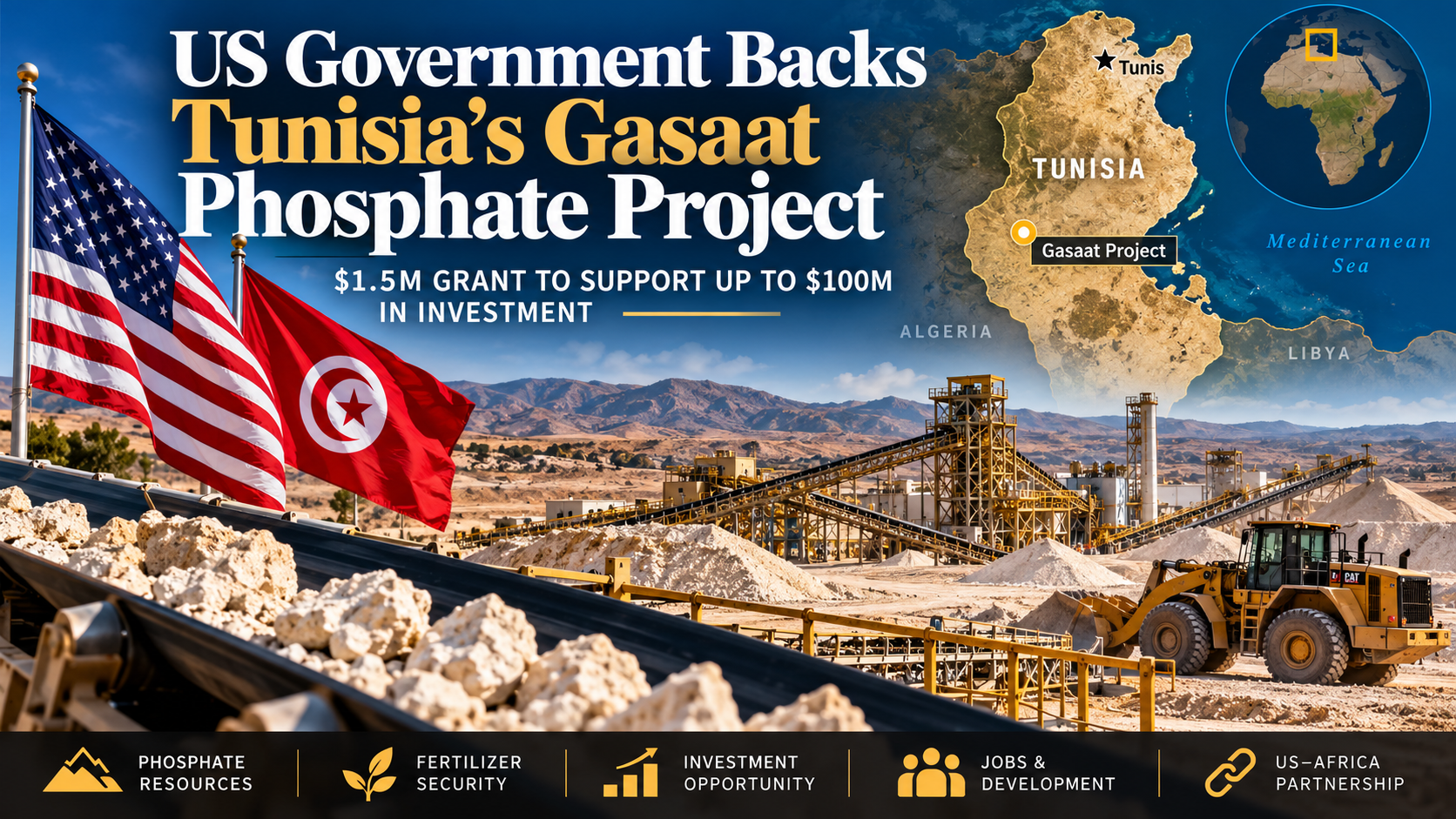
The United States government is backing a new initiative designed to accelerate the development of Tunisia’s phosphate sector, with a $1.5 million grant to investment and advisory firm CrossBoundary Group supporting efforts to connect Australian-listed PhosCo’s Gasaat phosphate project with US investors, commercial partners and technical expertise.
The programme could help mobilise up to $100 million in private investment for the Gasaat project, positioning Tunisia’s phosphate resources within a broader US strategy focused on strengthening critical-mineral and fertilizer supply chains.
The initiative was announced after the US Department of State, through its Bureau of Near Eastern Affairs and the US Embassy in Tunis, selected CrossBoundary to lead the programme under its “Safeguarding U.S. Critical Minerals Supply Chains – Tunisia” initiative. (Mining Weekly)
A strategic bet on Tunisia’s phosphate potential
Gasaat is part of PhosCo’s plans to develop an integrated phosphate hub in north-western Tunisia. The project is located in the Kasserine region and forms part of the company’s wider exploration and development portfolio in the country’s Northwest Mineral Basin.
According to reporting from Tunisia’s La Presse, PhosCo’s exploration permit at Gasaat covers approximately 112 square kilometres, with reported resources of about 166.6 million tonnes of phosphate ore grading an estimated 20.6% P₂O₅. The company has described the project as having potential to support a large-scale mining and fertilizer-production operation. (La Presse de Tunisie)
The project’s strategic significance extends beyond the mine itself. Phosphate is a fundamental input for fertilizer production, making access to reliable phosphate resources important to agricultural supply chains and food security.
For Tunisia, successful development of Gasaat could therefore represent an opportunity to expand domestic mineral production, create employment and attract international capital and technology.
The $1.5 million is not direct mine financing
An important distinction is that the US government is not giving PhosCo $1.5 million to build the Gasaat mine.
The grant has been awarded to CrossBoundary, which will use the programme to facilitate investment, commercial partnerships and technical cooperation around the project.
The original US funding opportunity contemplated a single award between $1 million and approximately $1.536 million, with an expected performance period of 18 to 24 months. The programme was designed to support private-sector-led phosphate development, downstream processing and stronger trade and investment links between Tunisia and trusted international partners. (Simpler Grants)
PhosCo has also stressed that it is not a party to the grant award and will not directly receive the grant funds. No investment, financing or binding offtake agreement has yet been created as a result of the programme. Any future transaction remains subject to due diligence, negotiations and the required approvals. (Mining Weekly)
That distinction matters because the announcement represents an effort to mobilise capital, rather than confirmation that the targeted $100 million has already been raised.
CrossBoundary becomes the bridge to US capital
CrossBoundary will lead the investor-engagement programme and connect PhosCo with potential American investors and companies.
The programme is expected to draw on expertise in engineering, phosphate processing and Tunisian law while complementing the technical work already being undertaken by PhosCo and its existing partners.
Three major areas of activity have been identified:
- Private capital mobilisation for the Gasaat project.
- Supply-chain and commercial agreements, including potential long-term offtake relationships.
- Technical assessment of downstream phosphate by-products and processing opportunities.
The programme will also consider environmental, social and governance requirements relevant to international investors and development-finance institutions. (Mining Weekly)
Why Washington is interested in African minerals
The initiative reflects a larger transformation in the geopolitics of African mineral resources.
Governments and companies around the world are increasingly seeking secure access to strategic minerals and industrial inputs. Africa has become a major focus of that competition because of its geological endowment and its potential to supply resources needed by global manufacturing, energy and agricultural systems.
In Tunisia’s case, the focus is phosphate rather than a conventional battery mineral such as lithium or cobalt.
That makes the Gasaat project particularly interesting.
Phosphate is directly connected to the global fertilizer industry. Securing diversified sources of phosphate can therefore have implications not only for mining companies but also for agriculture, food production and international trade.
The US funding programme explicitly links phosphate development in Tunisia with supply-chain security, private investment, downstream processing and stronger commercial relationships. (HigherGov)
Potential economic impact for Tunisia
For Tunisia, the attraction is potentially significant.
A successful Gasaat development could bring additional international investment into the country’s mining sector while supporting jobs, infrastructure development and regional economic activity.
The US Embassy’s programme is also intended to increase commercial connections between Tunisian and American companies.
If investment ultimately materialises, opportunities could extend beyond extraction into engineering, mineral processing, transportation, logistics, equipment supply and fertilizer production.
This could allow Tunisia to capture more value from its phosphate resources rather than relying exclusively on the export of raw mineral material.
The $100 million target
PhosCo says the programme is designed to help attract up to $100 million in investment for Gasaat.
Other reporting has placed the broader capital target at roughly US$100 million, while emphasizing that this remains a target rather than committed financing. (Mining.com.au)
The distinction is critical for investors and policymakers.
The US government-backed programme can create a pathway toward investment, but it does not guarantee that the targeted capital will be secured.
Potential investors would still need to evaluate the project’s geological data, economics, permitting, infrastructure requirements, environmental considerations and development timetable.
A potential phosphate hub
PhosCo’s longer-term vision is for Gasaat to contribute to an integrated phosphate hub in north-western Tunisia.
That vision could involve more than mining.
An integrated phosphate industry can potentially encompass extraction, beneficiation, processing, fertilizer manufacturing, logistics and downstream products.
Such integration could increase the economic value generated locally and potentially create a broader industrial ecosystem around the mineral resource.
The project is located approximately 210 kilometres southwest of Tunis, according to Tunisian reporting, and is positioned near transport infrastructure that could potentially support future development. (La Presse de Tunisie)
Africa’s mineral intelligence question
The Gasaat story illustrates an increasingly important question for Africa: Who finances the development of Africa’s resources, who controls the supply chains, and where is the value ultimately captured?
International capital can provide technology, infrastructure and expertise that accelerate development.
But the long-term economic impact depends on the structure of investment, local participation, processing capacity, employment, taxation, infrastructure commitments and the degree of downstream value addition.
For Tunisia, the challenge will be to convert international interest into durable domestic economic benefits.
For the United States, the programme offers a potential route toward a more diversified phosphate supply chain and stronger commercial relationships in North Africa.
For PhosCo, the immediate objective is to turn geological potential into bankable development opportunities.
What happens next?
Over the coming two years, CrossBoundary and its partners are expected to engage potential US investors and commercial partners while examining technical and financing opportunities for Gasaat.
PhosCo will simultaneously continue its exploration, technical studies and project-development activities.
The critical milestones will be whether the programme succeeds in attracting committed capital, whether commercial offtake arrangements emerge and whether technical studies support the economic development of the project.
Until those steps are completed, the Gasaat project remains a development opportunity rather than an operating phosphate mine.
But the involvement of the US government gives the project a new strategic dimension.
A relatively small public grant could become the catalyst for substantially larger private investment—if CrossBoundary and PhosCo can translate diplomatic and commercial engagement into actual financing and contracts.
For Tunisia, that could mean a new chapter in its phosphate industry.
For Washington, it is another move toward securing strategic mineral and fertilizer supply chains.
And for Africa, it is another example of how the continent’s mineral resources are becoming central to the emerging competition for industrial security, agricultural resilience and economic influence.
Panafrican.email Intelligence Assessment: MEDIUM-HIGH SIGNIFICANCE / DEVELOPMENT STAGE
Status: Investment mobilisation programme announced
US programme funding: Approximately $1.5 million
Targeted private investment: Up to $100 million
Project: Gasaat Phosphate Project
Country: Tunisia
Region: Kasserine / Northwest Mineral Basin
Lead programme partner: CrossBoundary Group
Project developer: PhosCo
Important caveat: The US grant is awarded to CrossBoundary, not directly to PhosCo, and does not guarantee future investment or offtake agreements.
Leave a Reply