
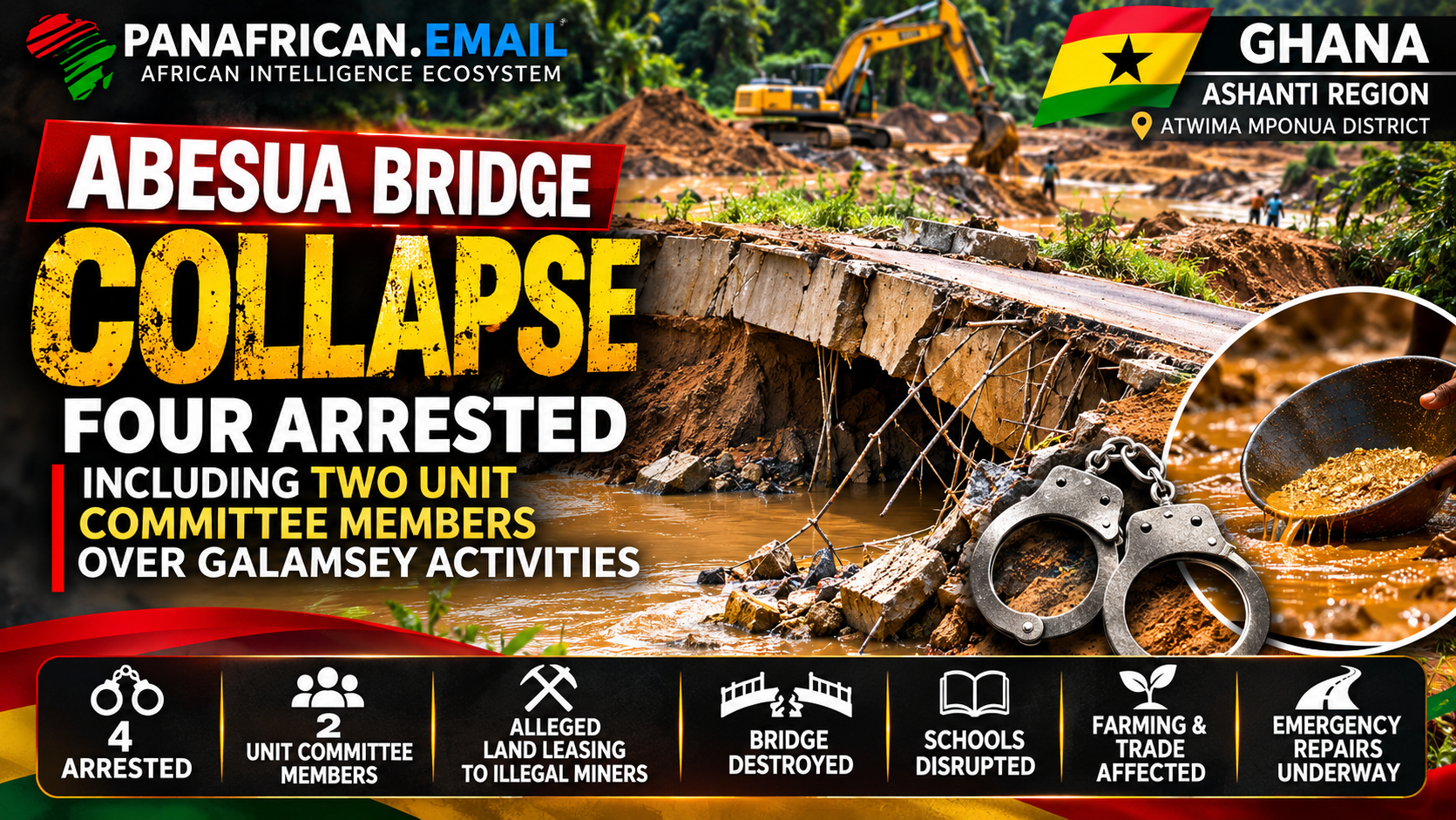
Two Unit Committee members among four suspects arrested after illegal mining activities damaged River Kukubu crossing and cut off communities in Ghana’s Ashanti Region
ABESUA, ASHANTI REGION, GHANA — The collapse of a critical bridge over the River Kukubu in Ghana’s Ashanti Region has triggered arrests and emergency intervention after illegal mining activities allegedly degraded the surrounding land, disrupted the river channel and effectively cut off several communities from major roads, schools, markets and health services.
Four people have been arrested in connection with the destruction of the infrastructure, including two Unit Committee members who authorities allege leased land around the bridge and river buffer zone to illegal mining operators.
The arrests follow an investigation sparked by reporting from JoyNews on the deteriorating conditions in the Abesua Electoral Area of the Atwima Mponua District.
According to the District Chief Executive for Atwima Mponua, Ibrahim Issahak, preliminary investigations indicate that the two Unit Committee members allegedly received money from illegal miners and facilitated access to parcels of land near the bridge.
The four suspects — the two local committee members and two alleged illegal miners — were in police custody assisting with investigations.
Authorities indicated that the suspects would face court proceedings over allegations connected to illegal mining and damage to public infrastructure.
A Bridge Destroyed by Environmental Pressure
The bridge over the River Kukubu served as a vital access point for residents of Abesua No. 1, Abesua No. 2, Nyamebekyere, Abrokyire and surrounding communities.
The communities rely on the route to connect with the main road toward Serebuoso and Mankranso.
The collapse followed extensive excavation and degradation of land along the riverbanks attributed to illegal mining operations.
As mining activity altered the surrounding terrain and affected the river channel, water overflowed onto the road, eventually leaving the crossing severely damaged and effectively impassable.
JoyNews reported that the bridge had completely caved in during its October 25 visit to the area.
The consequences extended far beyond transportation.
Farmers struggled to move produce to markets. Traders faced difficulty receiving food and other essential supplies. Teachers and pupils encountered dangerous conditions on their journeys to school, while residents needing medical care faced additional obstacles reaching health facilities.
The crisis therefore became a broader question of community access, public safety and environmental governance.
Children Among Those Paying the Price
Perhaps the most immediate consequence has been felt by schoolchildren.
Pupils from the affected communities attend schools outside their immediate settlements, including Atwima Asamang Basic School. When rainfall increases the river’s flow and makes the damaged crossing more dangerous, some children have been unable to attend classes.
Residents told JoyNews that younger children have sometimes fallen into the river while attempting to cross.
Parents have consequently had to divert time from farming and other income-generating activities to escort their children.
Teachers have also reported being unable to reach the school when road conditions deteriorate.
The disruption illustrates one of the less visible costs of illegal mining: environmental damage can quickly become educational disruption, particularly in rural communities where alternative roads and public transportation are limited.
Trade and Farming Disrupted
The damage has also affected the local economy.
Traders say access to markets has become increasingly difficult, while transportation costs have risen sharply.
Some motorcycle operators have reportedly charged substantially higher fares to travel the damaged route, with some refusing to cross the most dangerous sections.
Farmers face another layer of difficulty because the same roads and crossings are essential for transporting crops from farms to markets.
The destruction of access infrastructure therefore threatens both sides of the rural economy: production and distribution.
Residents have also complained about the broader destruction of farmland associated with illegal mining.
Allegations of Local Facilitation

The arrests of the two Unit Committee members have introduced another dimension into Ghana’s long-running struggle against illegal mining.
The issue is no longer simply about miners operating illegally.
Authorities are investigating allegations that local actors may have helped create the conditions under which illegal mining could occur.
The Atwima Mponua DCE said preliminary investigations point to allegations that the Unit Committee members accepted money and leased land to miners around the bridge and river buffer zone.
The allegations remain subject to investigation and due process.
But the case raises an important governance question: how effectively can Ghana combat illegal mining if land access is facilitated or tolerated by people within affected communities?
That question is increasingly important as the environmental consequences of galamsey move beyond contaminated waterways and damaged farmland into the destruction of roads and other public infrastructure.
Emergency Repairs Underway
Following public pressure and intervention by government authorities, emergency repair work has begun.
The Ashanti Regional Minister, Dr. Frank Amoakohene, and the Atwima Mponua District Assembly have responded to the situation.
Authorities have drained water from the affected road section, cleared the blocked bridge culvert and begun reinforcement work using boulders, chippings and gravel.
The immediate objective is to restore basic access while a more permanent reconstruction plan is developed.
Residents have welcomed the intervention but continue to call for a permanent bridge rather than a temporary solution.
That distinction matters because repairing the physical structure without addressing the environmental conditions that contributed to its failure could leave the community vulnerable to another collapse.
The Larger Galamsey Problem
Ghana has spent years attempting to confront illegal and environmentally destructive small-scale mining, commonly referred to as galamsey.
The debate has often focused on polluted rivers, forest degradation, mercury contamination, farmland destruction and the loss of agricultural livelihoods.
The Abesua case demonstrates another consequence: the destruction of the physical infrastructure that connects communities to the national economy and public services.
When a bridge collapses, the impact can cascade through an entire community.
Children lose access to school.
Farmers lose access to markets.
Traders lose customers and suppliers.
Patients face longer journeys to healthcare.
Transport operators face increased risks.
And government is ultimately required to spend public resources repairing infrastructure damaged by activities that may themselves have generated private profits.
From Enforcement to Accountability
The arrests could therefore become an important test of Ghana’s broader approach to illegal mining.
Residents have reportedly raised concerns about intimidation by people associated with mining operations and have accused local actors of failing to prevent the destruction.
Authorities now face pressure to establish not only who physically carried out the mining but who authorized, facilitated, financed or benefited from the activity.
That distinction is critical.
Effective enforcement requires more than removing excavators from a mining site. It requires identifying the networks that provide land, financing, equipment, protection and access.
The investigation into the Abesua bridge collapse could consequently provide authorities with an opportunity to examine the local governance structures surrounding illegal mining.
A Warning Beyond Abesua
The River Kukubu crossing is a local story, but the underlying issue is national.
Infrastructure is often designed around environmental conditions that remain relatively stable. Intensive excavation, river diversion and land degradation can fundamentally change those conditions.
Where mining operations alter riverbanks, drainage channels and road foundations, the consequences can eventually reach infrastructure that was never intended to withstand those changes.
The Abesua experience is therefore a warning for other communities located near mining areas.
Environmental protection and infrastructure protection cannot be treated as separate policy questions.
A damaged watershed can become a damaged road.
A damaged road can become an education crisis.
An education crisis can become an economic crisis.
And an economic crisis can deepen the vulnerability that drives communities toward informal and environmentally destructive activities in the first place.
What Happens Next?
The four arrests represent the beginning rather than the conclusion of the case.
Investigators will need to establish the precise roles of the suspects, determine how land was made available to mining operators and assess the full extent of damage to the bridge, riverbanks, roads and surrounding farmland.
The Atwima Mponua District Assembly has also indicated that the temporary road intervention is not a substitute for permanent reconstruction.
For residents, the immediate priority is simple: safe and reliable access.
But the longer-term question is more difficult.
Can authorities restore the bridge while simultaneously stopping the mining activity that contributed to its destruction?
That will determine whether Abesua receives a lasting solution or simply another temporary repair.
For Ghana’s fight against galamsey, the answer could be significant.
The collapse of the River Kukubu bridge has transformed an environmental problem into a highly visible public-infrastructure crisis. The arrests now put local accountability under scrutiny — while the damaged bridge stands as a physical reminder that the cost of illegal mining is ultimately carried not only by the environment, but by the communities living around it.
Panafrican.email Intelligence Brief
REGION: Ghana — Ashanti Region
LOCATION: Abesua Electoral Area, Atwima Mponua District
CATEGORY: Environment / Illegal Mining / Infrastructure
STATUS: Reported — arrests confirmed
INTELLIGENCE LEVEL: Medium-High
SOURCE: JoyNews / MyJoyOnline
DEVELOPMENT: Four arrests; emergency road and bridge-area repairs underway
KEY ISSUE: Alleged local facilitation of illegal mining and resulting infrastructure damage
Leave a Reply