
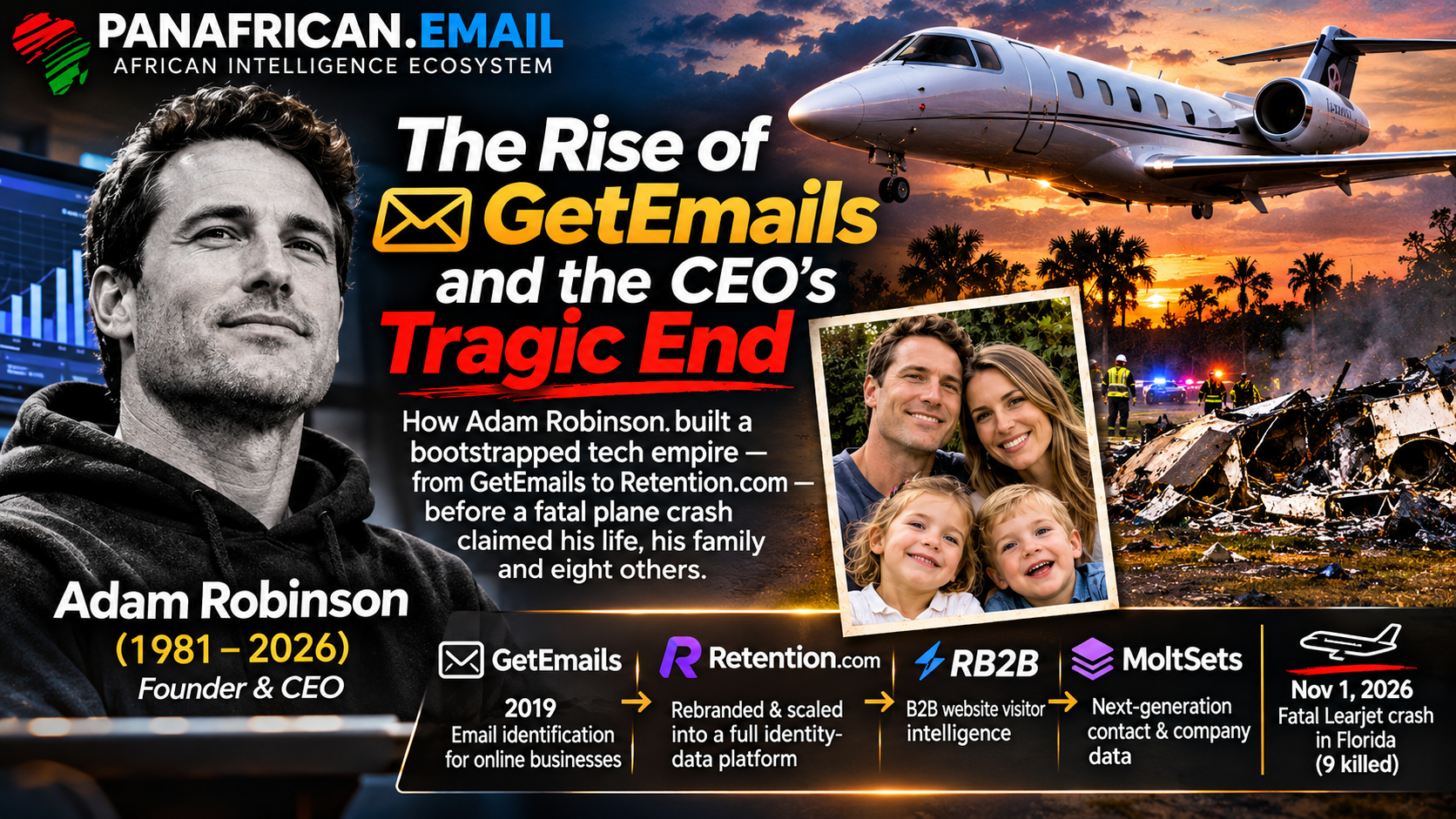
How Adam Robinson turned an overlooked email-identification feature into a multimillion-dollar technology business — before his life and entrepreneurial journey ended in a Florida plane crash
AUSTIN, TEXAS — In the world of technology entrepreneurship, some companies are born from billion-dollar venture rounds, sprawling engineering teams and years of institutional backing.
Adam Robinson built his differently.
His story began on Wall Street, moved through the difficult early years of a bootstrapped email-marketing company, and eventually produced GetEmails, a startup that would evolve into Retention.com and become the foundation for a broader identity-data technology business.
Robinson’s story ended abruptly on November 1, 2026, when the Learjet 60 carrying him, his wife, their two young children, their nanny, friends and two pilots crashed near Greenacres in Palm Beach County, Florida. All nine people aboard were killed. The National Transportation Safety Board is investigating the crash, and authorities have not yet determined its probable cause. (Inc.com)
The tragedy came at a particularly striking moment in Robinson’s career.
On the same day as the crash, Robinson had been publicly discussing the growth of his latest businesses, including RB2B and MoltSets. His entrepreneurial machine was still running — and his philosophy of building profitable companies without venture capital had become part of his public identity.
From Lehman Brothers to Entrepreneurship
Before GetEmails, Robinson was a finance professional.
He worked in credit trading at Lehman Brothers and later Barclays Capital before leaving Wall Street to pursue technology entrepreneurship. His transition came after the 2008 financial crisis, when the world of high finance had been fundamentally shaken. Robinson subsequently entered the startup world and began building software businesses. (Adam Robinson)
His first major venture was Robly Email Marketing.
The company focused on email marketing and automation and was built largely through bootstrapping rather than the traditional venture-capital model. Robinson later said the business eventually reached an eight-figure exit. (Adam Robinson)
But Robly was also where the technological seed for his next company emerged.
An identity-resolution feature designed around identifying email addresses associated with website visitors attracted significant customer interest.
That feature became the basis for something much bigger.
The Birth of GetEmails
In 2019, Robinson and his co-founders launched GetEmails.
According to the current Retention.com company history, GetEmails was designed to identify previously anonymous website visitors and turn that traffic into actionable email audiences. The company describes the product as one of the early platforms built around identifying anonymous website visitors for marketing purposes. (Retention)
The business model was remarkably simple in concept:
A consumer could visit an online store, browse products and leave without filling out a form.
Traditional marketing systems would lose that visitor.
GetEmails attempted to resolve that anonymous traffic into an identifiable email audience, allowing merchants to pursue additional marketing and retention opportunities.
Robinson himself later described the underlying approach as “email laundering” and openly discussed the privacy and regulatory questions surrounding the technology. (Practical Ecommerce)
That controversial but commercially powerful proposition became the engine of the company.
And it grew extraordinarily quickly.
The Bootstrapped Growth Machine
Robinson’s personal account of GetEmails’ growth is one of the most remarkable parts of the story.
In a later breakdown, he said GetEmails went from zero to $1 million in annual recurring revenue in approximately 27 weeks, with a team of only six people.
He contrasted that performance with Robly, which had taken considerably longer and required a much larger staff to reach the same milestone. (LinkedIn)
The numbers became a central part of Robinson’s entrepreneurial philosophy.
He wasn’t simply interested in creating a valuable technology company.
He wanted to demonstrate that a small, disciplined team could build a highly profitable software business without surrendering ownership to outside investors.
A later profile of his approach described Retention.com as being built without venture capital, with Robinson emphasizing capital efficiency, profitability and founder control. (Product Market Fit Show)
That became his signature.
GetEmails Becomes Retention.com
The original GetEmails product eventually grew beyond email identification.
The company renamed itself Retention.com, expanding from a single application into a broader identity-data platform.
The company’s own history describes the transition as moving from a single product into an identity-data company capable of helping businesses identify, enrich and activate consumer and professional identity data at scale. (Retention)
Robinson later reported that Retention.com reached approximately $22 million in annual recurring revenue within four years, without venture funding. His own biography says he built the company from zero to $22 million ARR in four years. (Adam Robinson)
A September 2026 founder profile reported an even higher trajectory, putting the company around the $21 million–$25 million ARR range and describing Robinson’s estimate of roughly $14 million in annual profit for the year. (Product Market Fit Show)
The important point was not simply the size of the numbers.
It was how few people Robinson claimed were required to generate them.
At one point, the company reportedly remained at a six-person team even after crossing $12 million ARR.
That was the business model Robinson wanted other founders to study.
The Philosophy: Build Without Permission
Robinson became increasingly vocal about bootstrapping.
His argument was straightforward: founders did not necessarily need venture capital to build substantial technology companies.
Instead, he advocated:
- small teams;
- high-value software;
- strong product-market fit;
- disciplined spending;
- recurring revenue;
- profitability;
- direct founder involvement;
- and maintaining ownership.
His personal website describes his approach as building “lean, capital-efficient, high-growth, and highly profitable bootstrapped SaaS businesses.” (Adam Robinson)
That philosophy resonated with a generation of founders increasingly skeptical of the traditional venture-capital cycle.
Rather than raising millions to hire hundreds of employees, Robinson demonstrated a different proposition:
What if the company could become large before it became large?
In other words, revenue could scale faster than headcount.
The Expansion Into RB2B
Robinson did not stop with Retention.com.
He applied the same underlying identity technology to business-to-business sales through RB2B.
Where Retention.com focused heavily on ecommerce and consumer identity, RB2B was designed to help businesses identify the people and companies visiting their websites and route those signals into sales and marketing systems.
The company’s own description says RB2B turns anonymous website traffic into pipeline, providing information such as names, LinkedIn profiles, business emails and company data to connected sales and marketing tools. (RB2B)
By 2026, RB2B had become another significant component of Robinson’s entrepreneurial portfolio.
The company’s newsletter described Robinson as founder and CEO of both Retention.com and RB2B and said he had bootstrapped Retention.com to roughly $22 million ARR in four years. (The RB2B Newsletter)
Then Came MoltSets
Robinson’s final chapter in entrepreneurship was not about slowing down.
It was about building again.
MoltSets emerged as another identity-data venture, positioned around contact and company information and designed for integration into sales and AI workflows.
By October 2026, Robinson was publicly promoting the new company and discussing its competition with established sales-data platforms.
His online activity suggested that he was still deep in the founder’s cycle:
Build.
Launch.
Measure.
Compete.
Build again.
The Final Day
Then came November 1.
Robinson, 45, was traveling aboard a Learjet 60 that departed Austin, Texas, bound for North Eleuthera in the Bahamas.
The aircraft crashed near Greenacres in Palm Beach County, Florida.
Nine people died.
Among them were Robinson; his wife, Helen Sharp; their four-year-old daughter, Emma; their two-year-old son, Charlie; their children’s caregiver, Anita Maria Cetina; friends Rachael Reed and Charmi Fehr; and pilots Jeff Gregory and 20-year-old Nathalia Gadelha Filgueiras. (AP News)
The aircraft was operating as a private charter flight.
The NTSB has begun investigating the circumstances surrounding the accident. Officials have cautioned against premature conclusions about what caused the crash. (Inc.com)
That distinction matters.
While early reports have examined weather conditions and flight data, the official cause of the crash has not been established.
A Family Lost With the Founder
The tragedy was therefore much larger than the death of a technology CEO.
Robinson’s wife, Helen Sharp, was herself an entrepreneur and public-relations professional. The couple’s two young children were also aboard.
Family members described Adam and Helen as devoted parents and their children as the center of their lives. (Inc.com)
For the technology community, Robinson represented an entrepreneurial archetype.
For his family and friends, he was something much more personal.
The two dimensions now exist side by side in the public record: the founder who built companies worth millions of dollars and the husband and father whose life ended alongside his family.
The Strange Timing of His Final Posts
The timing has added another layer to the story.
Robinson remained active publicly immediately before the crash.
He had been sharing company metrics and discussing the performance of his businesses. Reports indicate that RB2B had reached approximately $10 million in annual recurring revenue while MoltSets was approaching the $1 million mark. (Business Insider)
In other words, the entrepreneur was still doing what he had spent years doing:
building in public.

His online presence had become part of his business strategy.
He shared experiments, failures, revenue milestones and operating philosophy with an audience of founders and technology professionals.
That public record now serves as an unexpected archive of his final period as an entrepreneur.
What Adam Robinson Leaves Behind
The easiest way to measure Robinson’s legacy is in revenue.
But that would miss the more consequential part of his story.
GetEmails demonstrated that an unusual product could emerge from a struggling business.
Retention.com demonstrated that a software company could scale dramatically without venture capital.
RB2B demonstrated that the underlying technology could be repurposed for an entirely different market.
And Robinson’s public writing demonstrated that the mechanics of building those companies could become content in their own right.
He effectively turned entrepreneurship into part product, part media and part education.
The company ecosystem was the business.
The founder himself became the distribution channel.
The Complicated Legacy of Identity Technology
There is also a more complicated dimension to Robinson’s legacy.
The technology behind GetEmails and Retention.com operates in a sensitive area: identifying people behind supposedly anonymous digital activity.
That creates obvious commercial opportunities.
It also raises questions about consent, privacy, data protection and the boundaries between anonymous browsing and identifiable marketing.
Robinson discussed those questions publicly, including privacy and spam concerns surrounding the technology. (Practical Ecommerce)
That debate will continue independently of his death.
Indeed, it may become an even more important part of the historical assessment of the companies he helped build.
The technology industry has repeatedly demonstrated that the ability to identify, track and predict human behavior can be commercially transformative.
But the same capability can create profound questions about who controls information about individuals.
Robinson operated directly at that intersection.
From GetEmails to a Larger Idea
GetEmails was never simply an email company.
Its deeper innovation was the idea that anonymous digital behavior could become a business signal.
That concept became the foundation for Retention.com.
Then it extended into B2B visitor intelligence through RB2B.
And by the time of Robinson’s death, his companies were exploring increasingly sophisticated identity and data products.
The evolution tells a larger story about modern internet commerce.
The value is no longer only in knowing what a customer purchased.
It is in knowing who visited, what they viewed, when they arrived, what they might want and how quickly a business can act on that signal.
Robinson saw that shift early.
A Sudden End to a Very Public Entrepreneurial Journey
Adam Robinson’s story began with Wall Street and ended in a Florida crash.
Between those points were failed experiments, financial pressure, a bootstrapped email company, an eight-figure exit, GetEmails, Retention.com, RB2B and a succession of increasingly ambitious identity-data businesses.
He built companies without the traditional venture playbook.
He shared the process publicly.
And he became an advocate for founders who wanted to retain ownership while building meaningful businesses.
His final chapter was not a planned exit, acquisition or retirement.
It was a tragedy.
For the companies he leaves behind, the immediate question will be one of continuity: how his leadership philosophy, technology businesses and teams evolve without the founder who had become so closely associated with them.
For the technology community, the broader lesson is harder.
Entrepreneurship encourages people to think in decades.
Build this company.
Launch the next product.
Reach the next revenue milestone.
Create the next category.
But Robinson’s death is a stark reminder that the people behind those long-term plans remain mortal.
The companies can continue.
The products can evolve.
The revenue numbers can grow.
But the person who imagined them cannot be replaced by a dashboard.
Adam Robinson built GetEmails into something much larger than its original name suggested. His final legacy may ultimately be measured not only by the companies he created, but by the founders who saw his journey and concluded that they, too, could build something significant without waiting for permission.
PANAFRICAN.EMAIL INTELLIGENCE BRIEF
SUBJECT: Adam Robinson / GetEmails / Retention.com
REGION: United States
LOCATION: Austin, Texas / Greenacres, Florida
CATEGORY: Technology / Entrepreneurship / Aviation
STATUS: Confirmed death; crash investigation ongoing
DATE OF CRASH: November 1, 2026
AGE: 45
COMPANIES: GetEmails → Retention.com; RB2B; MoltSets; Robly
BUSINESS MODEL: Bootstrapped SaaS / Identity Data
KEY DEVELOPMENT: Robinson and eight others killed in Learjet 60 crash
INVESTIGATION: NTSB investigation underway; probable cause not yet established
Leave a Reply