
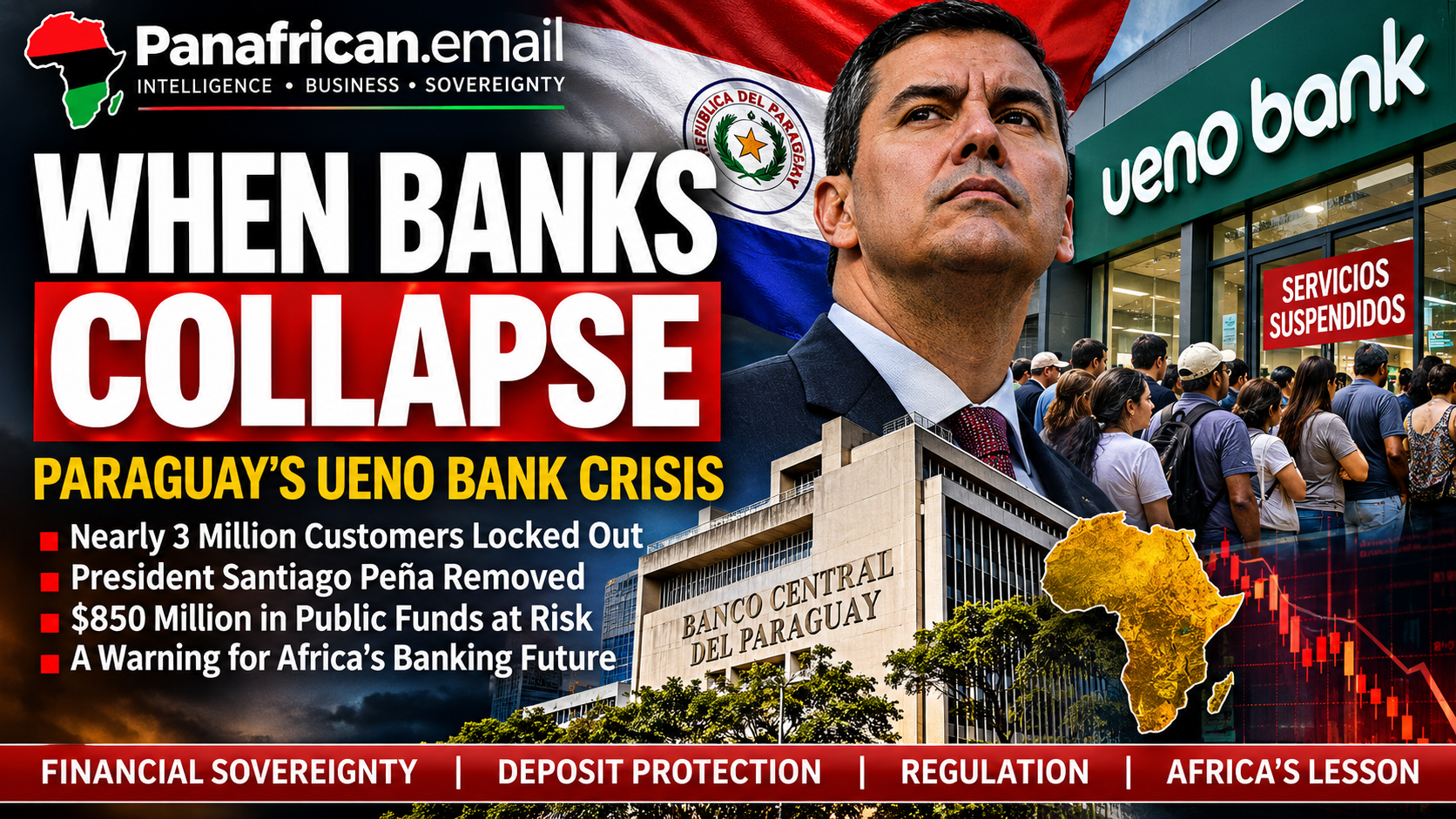
The collapse of Ueno Bank, the freezing of nearly three million customer accounts and the removal of President Santiago Peña expose the dangerous intersection of banking regulation, political influence and public trust.
KRLD 1080 AM
Dallas–Fort Worth News Radio
LISTEN LIVE
Live news, talk radio and breaking developments from Dallas–Fort Worth.
Broadcast provided by Audacy. Playback and availability are subject to Audacy’s service and regional restrictions.
THE STORY
A dramatic banking crisis in Paraguay has shaken the country’s financial system and brought down its president, raising urgent questions about the relationship between financial institutions, government power and the protection of ordinary citizens.
In November 2026, Paraguay’s Central Bank initiated a resolution process against Ueno Bank, a major digital lender serving approximately 2.94 million customers. The decision followed findings that the bank’s solvency ratio had fallen below half the legally required minimum.
The consequences were immediate. Customers lost access to deposits, payment cards and banking services as the institution’s operations were suspended. Businesses faced interruptions, families struggled to access their savings, and public institutions discovered that significant funds had been held within the troubled banking institution.

The crisis rapidly developed beyond the banking sector.
On November 6, President Santiago Peña was removed from office following an impeachment process. Forty-four of the 45 Senate seats were represented in the final vote, with all 44 senators present voting for his removal. Vice-President Pedro Alliana subsequently assumed the presidency.
Peña was also placed under house arrest while prosecutors investigated allegations of breach of trust, influence peddling and the misuse of public office. He has denied wrongdoing.
What began as a financial regulatory intervention had become one of Paraguay’s most significant political crises in decades.
1. HOW UENO BANK’S COLLAPSE UNFOLDED
Ueno Bank had established itself as a major digital banking institution, attracting millions of customers through accessible financial services and aggressive expansion.
Its customer base reportedly represented approximately 60% of Paraguay’s adult population.
On November 2, the Central Bank’s board unanimously approved the initiation of a resolution procedure. The decision was publicly announced on November 3.
According to the Central Bank, adjustments to Ueno’s financial statements revealed a serious capital adequacy problem. Its solvency ratio had fallen below 50% of the minimum legally required level.
The authorities initiated the procedure under Paraguay’s deposit-guarantee and financial-institution resolution legislation.
This distinction matters: the intervention was not simply a routine bank closure. Resolution procedures are designed to manage failing institutions, preserve recoverable assets and protect depositors while regulators determine how obligations will be handled.

Nevertheless, the suspension of Ueno’s services left millions of customers unable to use their accounts.
The episode demonstrated how quickly a highly digital financial institution can become a source of nationwide disruption when its underlying financial stability fails.
2. THREE MILLION CUSTOMERS AND THE PROBLEM OF DEPOSIT PROTECTION
One of the most disturbing aspects of the crisis was its reach.
Approximately 2.94 million people had accounts with Ueno. For many, the institution represented their first experience of formal banking.
When its services were suspended, customers lost immediate access to money used for groceries, transport, household expenses and business transactions.
The Central Bank’s deposit-guarantee framework provides protection up to 75 monthly minimum wages, equivalent at the time of the intervention to 228.3 million Paraguayan guaraníes per depositor, per institution.
The authorities subsequently indicated that the insurance arrangements covered approximately 97% of Ueno’s customers.
However, coverage does not necessarily mean immediate access to every deposited amount. Depositors with balances above the insurance ceiling may face additional recovery uncertainty.
The distinction between insured deposits, uninsured balances and actual repayment timelines is essential.

A banking system can have a deposit-insurance mechanism and still experience a severe public confidence crisis.
For customers, the fundamental question is not simply whether their money is insured. It is whether they can access it when they need it.
3. WHEN BANKING REGULATION BECOMES A POLITICAL QUESTION
The collapse became particularly controversial because of allegations concerning the relationship between Ueno Bank and the country’s political leadership.
Investigators and lawmakers raised questions about public-sector funds deposited with the institution, alleged insider lending and potential conflicts of interest.
Peña had previously held an investment interest in a company associated with Ueno’s parent group, disposing of his shares in April 2025.
He had also appointed Carlos Carvallo, a former Ueno executive, to lead the Central Bank.
These relationships became central to allegations that political influence and regulatory oversight had not been sufficiently separated.
Lawmakers accused the administration of favouring the institution and allowing questionable financial practices to continue.
Peña denies wrongdoing. The allegations remain subject to investigation and should not be confused with a final judicial determination of criminal responsibility.
Nevertheless, the political consequences were extraordinary.
On November 5, Paraguay’s Chamber of Deputies approved the initiation of impeachment proceedings by 78 votes.
The Senate subsequently removed Peña on November 6, with 44 senators voting in favour.
Pedro Alliana assumed the presidency as the country confronted the financial and institutional consequences of the crisis.
4. THE PUBLIC MONEY QUESTION: WHO WAS RESPONSIBLE FOR THE RISK?
The most important question extends beyond individual account holders.
Ueno reportedly held approximately $800 million to $850 million in public-sector deposits, including funds associated with government institutions and public financial programmes.
Reports have also identified substantial pension-related funds held at the institution.
These figures raise an important question for every country: how should governments manage public money when placing it in commercial financial institutions?
Public funds are not ordinary private deposits. They represent resources intended to support public services, pensions, infrastructure, salaries and national development.
When these resources become concentrated in a financially vulnerable institution, the consequences can spread throughout the wider economy.
The crisis has therefore exposed the importance of:
- Independent banking supervision.
- Transparent public-sector deposit policies.
- Strict limits on institutional concentration risk.
- Effective monitoring of related-party lending.
- Independent audits of pension and public investment funds.
- Clear accountability when financial institutions fail.
A government cannot treat public financial reserves as an extension of political relationships.
The integrity of public money requires independent oversight.

5. WHY THIS MATTERS TO AFRICA
For African countries, Paraguay’s banking crisis deserves particular attention.
Across the continent, financial inclusion is expanding through mobile banking, fintech companies, digital wallets, microfinance institutions and technology-driven commercial banks.
These developments create opportunities for millions of people who have historically been excluded from formal financial services.
However, financial inclusion must be accompanied by financial protection.
A population can become digitally banked without necessarily becoming financially secure.
If millions of customers depend on a single institution or interconnected financial network, the failure of that institution can disrupt economic activity on a national scale.
African regulators, central banks and governments should examine the lessons emerging from Paraguay.
First: financial inclusion requires institutional resilience.
Opening millions of accounts is not sufficient. Financial institutions must maintain adequate capital, liquidity, operational security and credible governance.
Second: public deposits require independent oversight.
Governments should establish transparent procedures for selecting banks that manage public funds. Political relationships must never substitute for financial due diligence.
Third: deposit insurance must be credible and accessible.
Citizens should understand the limits of their protection, how compensation works and how quickly insured deposits can be recovered.
Fourth: digital banking requires contingency planning.
Financial institutions must have tested procedures for restoring payments, accessing customer records and transferring deposits when operations are interrupted.
Fifth: regulators must be independent.
The people responsible for supervising financial institutions should be protected from conflicts of interest and political interference.
These are not merely technical banking issues. They are questions of economic sovereignty and public accountability.
6. THE LESSON FOR AFRICAN FINANCIAL SOVEREIGNTY
Africa’s economic transformation requires stronger financial infrastructure.
The continent needs institutions capable of mobilising domestic savings, financing industrial development, supporting small businesses and facilitating cross-border trade.
But financial sovereignty cannot be achieved simply by establishing more banks or launching digital payment applications.
It requires institutions that citizens can trust.
A bank that cannot protect deposits undermines the very financial inclusion it was created to deliver.
A regulator that cannot act independently undermines the credibility of the entire banking system.
And a government that fails to protect public resources risks transferring the consequences of institutional failure to ordinary citizens.
Paraguay’s experience demonstrates that the relationship between finance and political accountability is inseparable.
The future of African banking must therefore be built around strong regulation, transparent ownership, independent supervision and protection of depositors.
7. COULD THIS HAPPEN TO AN AFRICAN BANK?
The question raised by WorldWire’s report is relevant far beyond Paraguay.
Could a major African bank experience a similar crisis?
No banking system is entirely immune to institutional failure. However, the consequences depend on the quality of regulation, the strength of deposit-protection arrangements, the diversification of financial institutions and the preparedness of national authorities.
African central banks should use this moment to evaluate whether their existing frameworks can respond effectively to a major institutional failure.
Citizens should also understand the difference between commercial bank deposits, mobile-money balances, investment products and government-backed savings arrangements.
These products do not necessarily have identical legal protections.
The responsibility for financial stability cannot rest exclusively on customers. Regulators, bank directors, auditors and governments must ensure that institutions operate within the law and manage risks responsibly.
CONCLUSION: PUBLIC TRUST IS THE FOUNDATION OF BANKING
Paraguay’s Ueno Bank crisis is a warning about the dangers of financial concentration, weak institutional accountability and the potential consequences of political relationships within the banking sector.
Nearly three million customers experienced the disruption of access to their money. Public funds were placed under scrutiny. A president was removed from office, and the country’s financial authorities were forced to manage an extraordinary institutional failure.
The full legal and financial consequences will take time to establish.
For Africa, the lesson is clear: financial inclusion without financial protection is incomplete.
The next generation of African financial institutions must be judged not only by how many customers they attract, how quickly they process payments or how widely their digital platforms operate.
They must be judged by their ability to protect people’s savings, maintain institutional integrity and remain accountable to the public.
The collapse of Ueno Bank, the political crisis surrounding President Santiago Peña and the battle over public accountability.
Paraguay’s congressional response to the banking crisis. Second report: the developments surrounding the impeachment.
What happens when banking institutions become intertwined with political power? Paraguay’s crisis raises important questions about public deposits, independent regulation, financial accountability and the protection of ordinary citizens.
FINANCIAL SOVEREIGNTY • BANKING ACCOUNTABILITY • AFRICA’S FUTURE
PARAGUAY: THE IMPEACHMENT
01 — IMPEACHMENT PROCEEDINGS
02 — THE POLITICAL CRISIS
THE AFRICAN CONNECTION
INTELLIGENCE. BUSINESS. SOVEREIGNTY.
When a bank fails, the consequences are never limited to its balance sheet. They reach households, businesses, governments and the credibility of the entire financial system.
Panafrican.email — Intelligence, economics and the future of African sovereignty.
SOURCES AND FURTHER READING
- Central Bank of Paraguay — Official announcement initiating the Ueno Bank resolution process, November 3, 2026.
- Associated Press — Paraguay’s ousted president placed under house arrest after bank collapse.
- The Guardian — Paraguay banking crisis and the removal of Santiago Peña.
- Deutsche Welle — Paraguay’s president under house arrest over bank crisis.
- AFP — Crisis-hit Paraguay impeaches Peña and replaces him with Vice-President Alliana.
Leave a Reply