
A Pan African Mining Intelligence Report
TSX-listed Imperial Metals Corporation has reported a significant decline in third-quarter earnings, highlighting the financial pressures and changing operating conditions facing mining companies in an increasingly complex global commodities market.
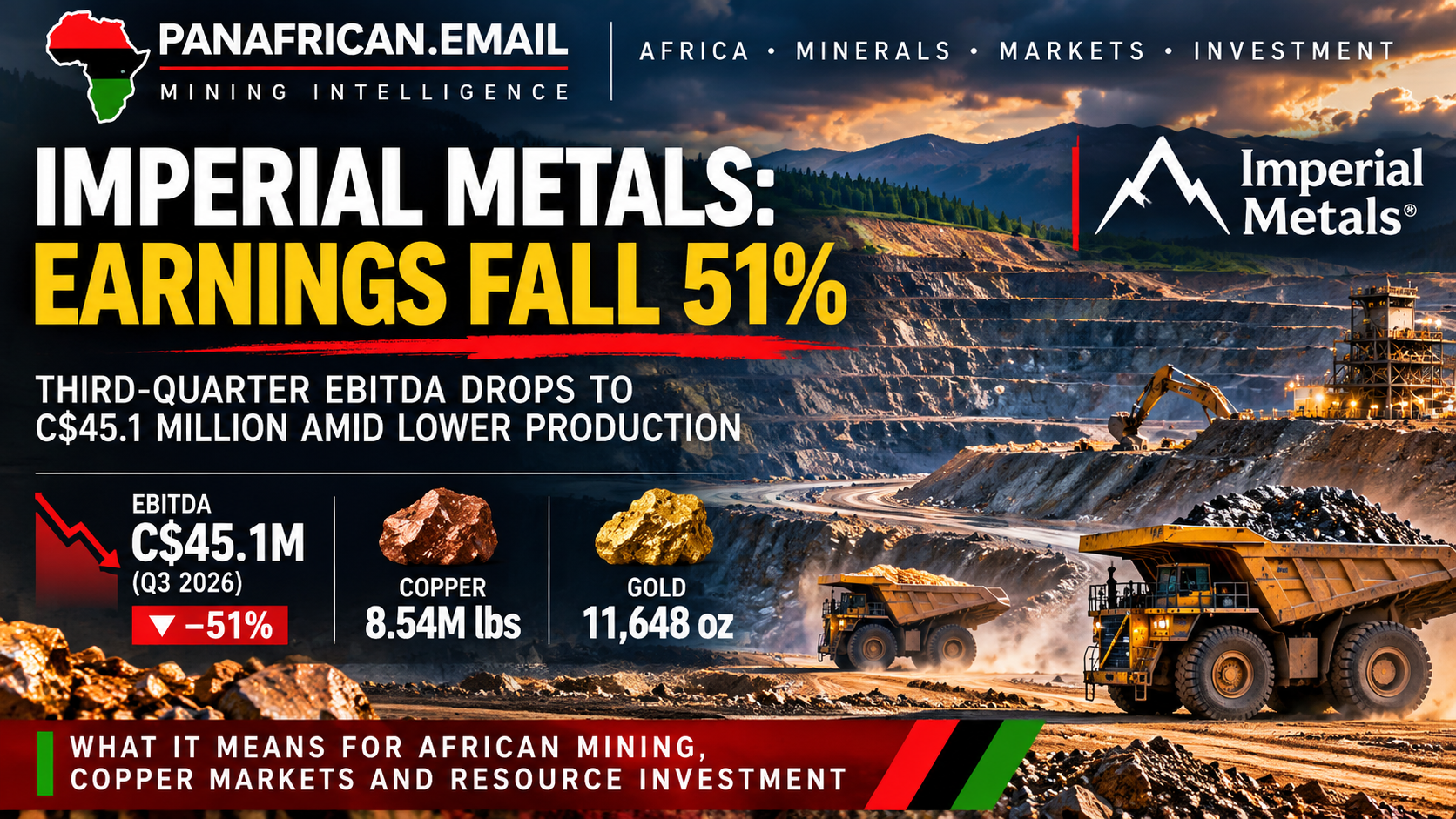
The company’s earnings before interest, taxes, depreciation and amortisation (EBITDA) fell to C$45.1 million for the quarter ended September 30, 2026, compared with C$92.5 million in the corresponding quarter of 2025, according to the figures presented in the supplied Mining Weekly intelligence assessment.
The decline represents a substantial reduction in quarterly operating earnings and raises important questions about production economics, commodity prices, operating costs and the financial performance of copper and gold producers.
Despite the earnings contraction, Imperial Metals reported quarterly production of approximately 8.54 million pounds of copper and 11,648 ounces of gold.
For the wider mining industry, the results offer an opportunity to examine a central issue facing resource-producing economies: strong mineral production does not automatically translate into stronger financial performance.
Lower ore grades and metal recoveries at Mount Polley and Red Chris
contributed to reduced copper and gold production. Higher average
international metal prices did not prevent the decline in earnings.
Copper and gold average market prices increased year-on-year. Lower grades and recoveries affected metal output. Long-term underground development remains a major growth opportunity, subject to investment approval.
African copper and gold producers can draw lessons from Imperial Metals:
commodity prices alone do not determine profitability. Ore quality,
recovery rates, processing efficiency, energy infrastructure and
capital allocation are critical to mining competitiveness.
IMPERIAL METALS
Reporting period: September 30, 2026
01 / Financial Performance Comparison
02 / Mineral Production Comparison
03 / Intelligence Assessment
The reported EBITDA reduction amounts to approximately 51.2% compared with the previous year’s third quarter.
This is a significant movement for a mining company operating in the copper and gold sectors. However, EBITDA is not the same as net profit or operating cash flow. It measures earnings before interest, taxation, depreciation and amortisation, and therefore provides only one perspective on financial performance.
The production figures also need to be considered alongside realised commodity prices, production costs, sales volumes and other financial disclosures before the underlying causes of the decline can be established.
2. Copper Remains Central to the Global Industrial Economy
Copper is one of the most strategically important industrial minerals in the modern economy.
Its applications extend across electrical infrastructure, renewable energy, electric vehicles, telecommunications, construction, manufacturing and advanced computing.
As governments and companies invest in energy transition infrastructure, electricity networks and digital technologies, copper remains a critical component of long-term industrial development.
For African mining economies, the performance of international copper producers matters because it provides insight into the commercial environment in which African copper projects must compete.
The Democratic Republic of Congo and Zambia, in particular, occupy important positions in the global copper supply chain. Their production capacity, investment environment, infrastructure development and mineral-processing strategies have implications for the future of the global copper market.
The question is not simply how much copper a mining company produces. It is how efficiently that production is converted into revenue, operating earnings, investment and long-term shareholder value.
3. What the Results Mean for African Mining Investors
Imperial Metals’ earnings decline offers several important considerations for investors evaluating African mineral assets.
Production versus profitability: Higher or stable production does not necessarily guarantee higher earnings. Mining companies must manage operating expenditure, energy costs, labour, transportation and processing expenses.
Commodity-price exposure: Copper and gold producers remain exposed to changes in international market prices. Even a productive operation can experience weaker financial performance when realised prices or sales conditions deteriorate.
Operational resilience: Investors increasingly need to understand the relationship between mine planning, equipment performance, ore grades, recovery rates and operating costs.
Capital allocation: Mining companies must balance exploration, mine development, infrastructure expenditure, debt obligations and shareholder returns.
These factors are particularly important when assessing projects across Africa, where infrastructure availability, electricity reliability, transport corridors and access to financing can materially influence the economics of mineral production.
RED CHRIS: THE FUTURE OF COPPER-GOLD MINING
4. Africa’s Strategic Position in the Copper Economy
Africa’s copper industry is becoming increasingly important to discussions about global industrial security.
The Copperbelt, extending across parts of the Democratic Republic of Congo and Zambia, contains some of the continent’s most strategically important copper-producing assets.
<PRIVATE_PERSON> The region’s importance extends beyond extraction. Its long-term economic potential depends on the development of local processing capacity, industrial infrastructure, technical skills and regional supply-chain integration.
For African governments, the objective should be to move beyond the traditional export of unprocessed mineral resources.
Copper-producing countries have opportunities to develop stronger domestic industrial ecosystems through:
- Local mineral beneficiation and refining.
- Copper fabrication and electrical-component manufacturing.
- Regional transport and energy infrastructure.
- Technical education and mining engineering.
- African participation in mineral trading and financing.
- Greater transparency in mining contracts and revenue management.
These priorities could help African economies capture more value from the growing demand for strategic minerals.
5. The Importance of Financial Intelligence in Mining
The Imperial Metals results also demonstrate why investors and policymakers need to monitor more than production announcements.
A comprehensive mining intelligence assessment should examine several interconnected indicators:
- Quarterly and annual EBITDA.
- Copper and gold production volumes.
- Realised commodity prices.
- All-in sustaining costs where applicable.
- Cash flow and liquidity.
- Debt and financing commitments.
- Capital expenditure.
- Mineral reserves and resource development.
- Operational guidance and future production targets.
- Regulatory and geopolitical exposure.
For African investors, this type of analysis is essential when comparing established international producers with emerging mining companies and exploration projects.
An intelligence-driven approach makes it possible to distinguish between a company experiencing temporary financial pressure and one facing deeper structural operating challenges.
6. The Bigger Picture: Mineral Wealth Must Translate into Economic Power
Africa’s mineral resources are central to the future of global manufacturing, electrification and technological development.
However, possessing significant mineral deposits is only the beginning of the economic equation.
The continent must continue strengthening its ability to finance, process, manufacture, trade and strategically manage its mineral resources.
The performance of international producers such as Imperial Metals provides useful reference points for understanding the financial realities of the mining business.
For African mining stakeholders, the lesson is clear: production figures alone cannot measure the strength of a mining economy. Profitability, operational efficiency, infrastructure, local value addition and financial transparency are equally important.
As the global competition for copper and other strategic minerals intensifies, Africa’s opportunity lies in building an integrated mineral economy that transforms geological wealth into industrial capacity and sustainable prosperity.
Conclusion
Imperial Metals’ reported third-quarter EBITDA decline from $92.5 million to $45.1 million is a significant development worth monitoring across the international mining sector.
The company’s reported production of 8.54 million pounds of copper and 11,648 ounces of gold demonstrates continued mineral output, while the earnings contraction underlines the importance of understanding the financial conditions behind mining operations.
For Africa, the broader message is that mineral production must be supported by efficient operations, competitive infrastructure, sound financial management and strategic industrial development.
The future of African mining will not be determined by the volume of minerals extracted alone, but by the economic value African countries retain and the industries they build around their natural resources.
PANAFRICAN.EMAIL | MINING INTELLIGENCE
Tracking Africa’s mineral economy, global mining companies, strategic commodities, investment movements and the industrial future of the continent.
Editorial note: Financial figures in this report are based on the supplied Mining Weekly intelligence assessment. The underlying company filing and comparative production figures should be consulted before making investment decisions.
Leave a Reply