
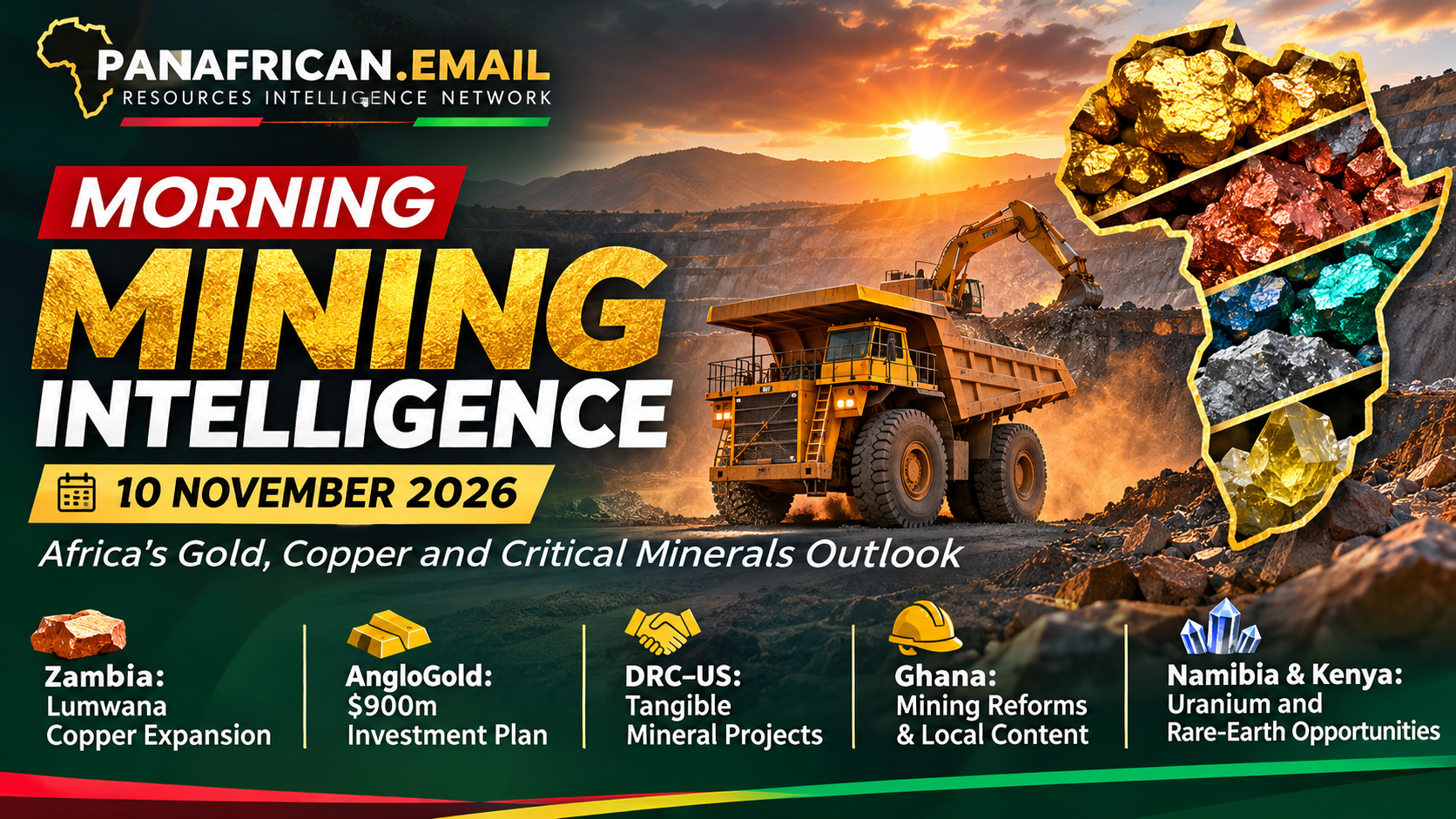
MORNING
MINING INTELLIGENCE
Africa’s mineral economy enters another decisive
week as gold producers expand capacity, Zambia
advances copper infrastructure, the DRC demands
tangible returns from international mineral
partnerships, and governments accelerate
resource-industrialisation strategies.
ZAMBIA COPPER EXPANSION |
GHANA GOLD INVESTMENT |
DRC–US MINERALS PARTNERSHIP |
NAMIBIA URANIUM EXPLORATION
Five developments shaping the sector
Barrick advances Lumwana expansion
Construction of a copper mill associated
with Barrick’s Lumwana expansion is
progressing toward its fourth-quarter
2026 completion target, according to
Mining Weekly reporting dated 9 November.
Intelligence assessment:
Increased processing capacity could
strengthen Zambia’s position in global
copper supply, although commissioning
and production performance remain
critical milestones.
Mining Weekly — 9 Nov 2026
AngloGold outlines $900m growth plan
AngloGold Ashanti announced an investment
programme of approximately US$900 million
aimed at increasing annual production by
at least 400,000 ounces by the end of
the decade.
Expansion activity includes Geita in
Tanzania and Siguiri in Guinea, alongside
the ramp-up at Ghana’s Obuasi operation
and investment in Brazil.
Reuters — 5 Nov 2026
Kinshasa calls for real investment
The Democratic Republic of Congo has
urged the United States to judge their
strategic minerals partnership by
completed projects rather than agreements.
Congolese priorities include local
processing, electricity access,
infrastructure and greater economic
value from copper and cobalt resources.
Reuters — 6 Nov 2026
Local-content reforms face labour test
Ghana has instructed its mining regulator
to standardise wages and employment
conditions as the country advances
contractor localisation requirements.
Implementation proposals are due by
30 November. The central challenge is
ensuring that local participation
expands without reducing worker
compensation or protections.
Reuters — 22 Oct 2026
Exploration remains on the radar
Mining Weekly reported on 9 November
that Arkle’s second-phase drilling
programme in Namibia had started
on schedule.
Namibia remains a significant country
to monitor for uranium exploration,
permitting, development economics
and future nuclear-fuel supply.
Mining Weekly — 9 Nov 2026
Mrima Hill raises community questions
Kenya is evaluating bids involving
the mineral resources at Mrima Hill,
including niobium and rare earths.
Residents have raised concerns about
consultation, farmland, cultural
heritage and environmental impacts.
Project development will require
credible community engagement.
Associated Press — 5 Nov 2026
Investment and production indicators
AngloGold Ashanti’s approximate
multi-country expansion programme
Target additional annual gold ounces
by decade-end
Approximate share deployed of IFC’s
initial $100m Appian commitment
AngloGold: selected project allocations
Announced investment ranges and estimates,
US$ millions.
Bar lengths use the upper end of each
reported allocation, scaled to $580m.
The allocations are project estimates,
not actual spending or stock performance.
Source: Reuters, 5 November 2026.
African mining intelligence matrix
| Country | Commodity | Project / Issue | Intelligence focus |
|---|---|---|---|
| Zambia | Copper | Lumwana | Mill construction and commissioning |
| Ghana | Gold | Obuasi | Production ramp-up |
| Guinea | Gold | Siguiri | Expansion capital and output |
| DR Congo | Copper / Cobalt | US minerals partnership | Funded projects and processing |
| Namibia | Uranium | Exploration drilling | Results and resource potential |
| Kenya | Rare earths / Niobium | Mrima Hill | Community consent and tender process |
| Mali | Lithium | Bougouni | Production and regional expansion |
Mining sector watchlist
Editorial classifications only.
These are qualitative monitoring
priorities, not independently
calculated financial risk ratings.
Beyond extraction: Africa’s value chain
Conceptual value-chain diagram,
not a quantitative estimate.
Africa’s mineral wealth creates an
opportunity to develop refining,
industrial infrastructure, engineering
services and manufacturing. But moving
downstream requires reliable power,
skilled labour, finance, transport and
commercially viable markets.
The strategic question
Who captures the value of Africa’s minerals?
The defining question for African
mining is increasingly not simply
how much mineral production grows,
but how much lasting economic value
remains in producing countries.
The developments in Zambia, Ghana,
Guinea and the DRC show different
dimensions of this challenge:
production expansion, domestic
participation, processing capacity
and infrastructure investment.
Mining policy should be assessed
through measurable outcomes:
employment quality, local procurement,
public revenue, environmental
performance, community benefit
and industrial capability.
PANAFRICAN.EMAIL INTELLIGENCE POSITION:
Resource development should be
evaluated by both commercial
performance and the economic
opportunities it creates across Africa.
Leave a Reply