
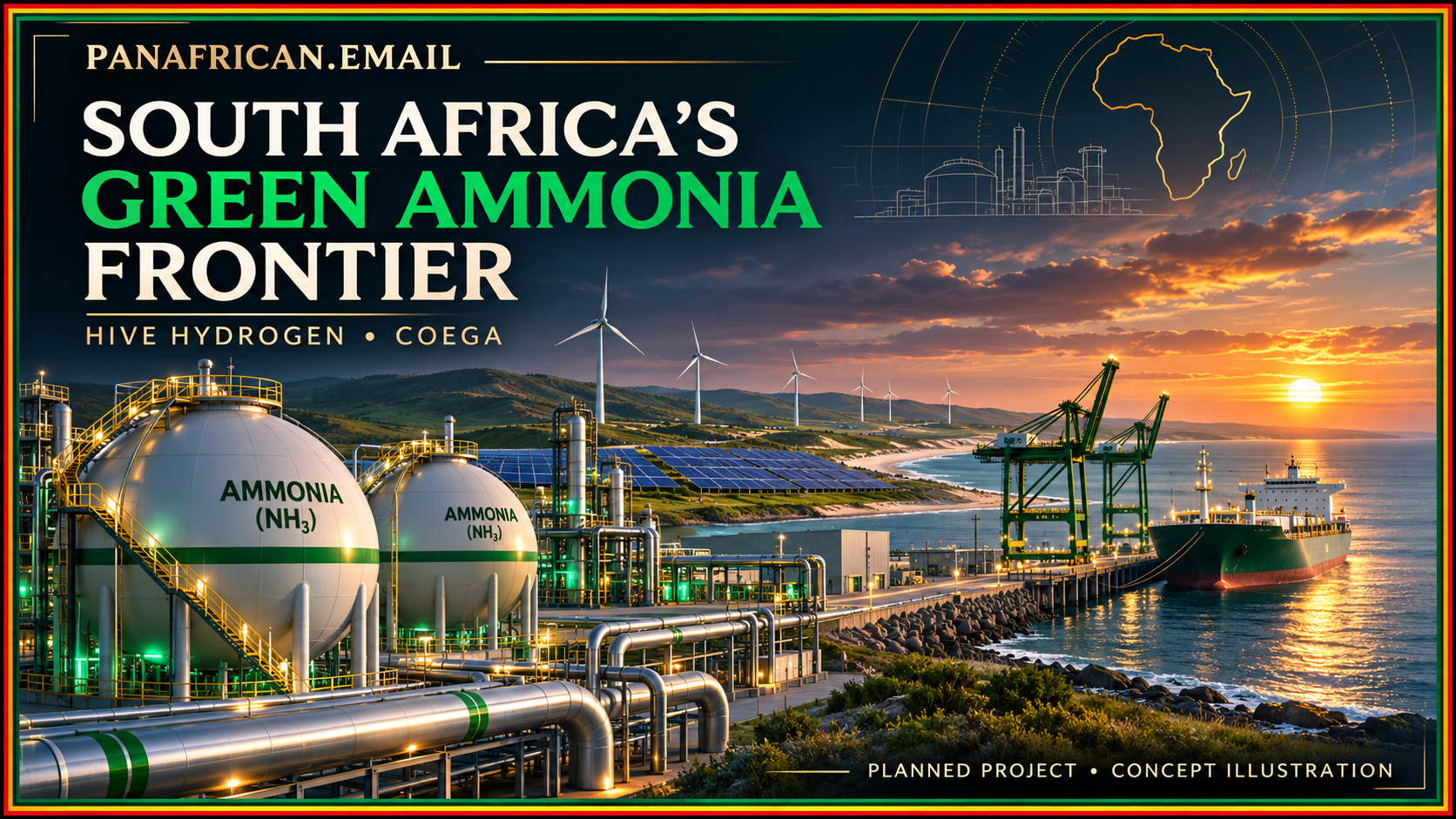
Green ammonia.
A new export frontier.
Hive Hydrogen’s Coega project puts South Africa at the junction of renewable power, industrial feedstocks and future shipping fuels.
DEVELOPMENT STAGE Demand signal: company-reported
Developer capital estimate [2]
Planned green ammonia [2]
Selected SOEC configuration [2]
Developer expectation, May 2026 [2]
Interest is a signal. Bankable commitments are the test.
Mining Weekly reported on 13 November that Hive Hydrogen had seen stronger interest in green ammonia supply. The proposed production hub sits at Coega beside the Port of Ngqura in Nelson Mandela Bay. [1]
Analyst judgment: The strategic opportunity is credible, but increased enquiries do not establish contracted demand, financial close or commercial production. Watch for binding offtake agreements, committed capital and delivery milestones.
Assessment confidence: moderate for the published project description; limited for the scale of future demand. No numerical confidence score is assigned. The screenshot’s “LOW” label has no stated methodology and is not treated as a project risk rating.
Renewables behind the molecule
Source: May 2026 project update [3]. Nameplate capacity is not continuous delivered power. These figures are plans, not installed capacity.
What a price shift could mean
Illustration only: 1,000,000 t/year × selling price. $650/t FOB is the developer’s target [2]; $500/t and $800/t are editorial scenarios. Gross revenue excludes all costs, taxes, financing, downtime and ramp-up; this is not a profit forecast.
From African renewables to industrial markets
Simplified process diagram. End uses include fertiliser feedstock and potential marine fuel; emissions performance depends on the full production and transport chain.
What is established—and what remains open
| Item | Published position | Intelligence interpretation |
|---|---|---|
| Demand momentum | Company reports increased interest. [1] | Enquiries are not equivalent to signed sales. |
| Engineering | September FEED contract reported at $9m. [1] | Engineering progress; not proof of financial close. |
| Technology | Topsoe solution selected. [2] | Selection does not establish equipment delivery. |
| Sales economics | $650/t FOB target. [2] | Developer estimate, not an observed realised price. |
| Location | Coega / Ngqura, Eastern Cape. [3,4] | Screenshot coordinates −25.748, 28.229 point to Pretoria, not the project. |
| Final investment decision | Q3 2027 target in May announcement. [2] | Await evidence of approval and committed financing. |
Development timeline
2019 · Development begins
Project team active from September. [4]
2021 · Project announcement
Large-scale ammonia plans unveiled. [4]
May 2026 · Technology selection
SOEC and ammonia-loop configuration announced. [2]
September 2026 · FEED award
Engineering contract reported. [1]
Q3 2027 · FID target
Prospective decision, not a completed milestone. [2]
2031 · Operation target
Developer’s expected commercial start. [2]
Where the opportunity meets execution
Capital: Track financing commitments and conditions before treating the full project value as secured investment.
Power: Monitor renewable construction, grid access and electricity delivery arrangements.
Buyers: Seek disclosed volumes, contract duration and creditworthy counterparties.
Local value: Assess procurement, skills transfer and domestic industrial access alongside exports.
Marine demand: Follow vessel orders, bunkering readiness, safety rules and lifecycle emissions certification.
Watchlist and implications are editorial analysis, not quantified risk measurements.
Project film & geographic context
Project film linked on Hive Energy’s project page; GIZ is credited there [4]. Promotional material may reflect an earlier project configuration. Open video if embedding is unavailable.
From Ramme’s pioneering plant to HydrogenPro’s electrolyser
Two views of the green-ammonia value chain: a renewable-powered ammonia facility and the equipment that produces hydrogen from water.

The world’s first dynamic green ammonia plant
Topsoe and its partners describe Ramme as the world’s first dynamic green ammonia production plant. Its process adjusts to variable wind and solar power, linking electrolysis with ammonia synthesis. This is a specific technology claim, rather than a claim to be the first ammonia plant ever powered by renewable energy. [5]
The demonstration facility has a stated capacity of 5,000 tonnes of ammonia annually, supported by 50 MW of solar and 12 MW of wind. These are design figures, not measured annual output. [5]
Inauguration took place in August 2024; the owner reports first production collected on 20 December 2025. Opening ceremonies and production milestones are shown separately. [6,7]

HydrogenPro: the hydrogen-making stage
HydrogenPro develops pressurised alkaline electrolysers. Electricity drives the separation of water into hydrogen and oxygen; hydrogen can subsequently become an input for ammonia synthesis. The electrolyser itself does not make ammonia. [8,9]
In 2022, the company announced a large stack for testing at Herøya, Norway, with a stated expected hydrogen output of 1,100 Nm³/hour, approximately 100 kg/hour. These are the manufacturer’s published specifications for that unit, not a performance measurement derived from this photograph. [8]
Technology distinction: Coega’s May 2026 announcement selects Topsoe’s solid oxide electrolyser cell (SOEC) solution. The HydrogenPro photograph illustrates an alternative alkaline technology; it does not establish HydrogenPro as a Coega supplier. [2,8]
Project and technology comparison
| Reference | Role / status | Published scale | Relevance to Coega |
|---|---|---|---|
| Ramme, Denmark | Dynamic ammonia demonstration; first production reported December 2025 | 5,000 t/year ammonia design capacity | Example of adapting ammonia production to variable renewable power. [5,7] |
| HydrogenPro, Herøya | Alkaline electrolyser test programme described in 2022 | 1,100 Nm³/hour hydrogen expected for the announced unit | Hydrogen equipment benchmark; separate from Coega’s selected SOEC technology. [8,9] |
| Coega, South Africa | Proposed export-scale green ammonia development | More than 1,000,000 t/year ammonia planned | Much larger intended production; operation remains a developer target. [2] |
Scale perspective: Coega’s planned annual ammonia capacity is more than 200 times Ramme’s stated design capacity (1,000,000 ÷ 5,000 = 200). This compares design scales, not actual output or proven operating performance.
Sources & methodology
- Mining Weekly — demand-interest report, 13 November 2026.
- Hive Energy — technology selection and developer targets, 21 May 2026.
- Engineering News — project update, 22 May 2026.
- Hive Energy — Coega project overview and linked film.
- Topsoe — Ramme operations, capacity and renewable inputs.
- Topsoe — Ramme inauguration and project imagery.
- Skovgaard Energy — first production, 22 December 2025 statement.
- HydrogenPro — electrolyser specifications, 5 July 2022.
- Herøya Industripark — HydrogenPro test programme, 27 October 2022.
Prepared 15 November 2026. Public-source desk review; no site inspection, independent demand model or financing audit. Older project pages contain different power and cost configurations; dated 2026 announcements take precedence here. Charts use reported plans or explicitly labelled arithmetic scenarios. No measured demand-growth series is available in the reviewed material.
Leave a Reply