
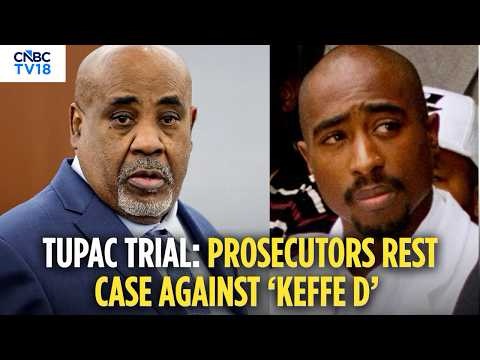
LAS VEGAS — August 27, 2026 — Nearly three decades after Tupac Shakur was gunned down on a Las Vegas street, the long-running mystery surrounding his death has reached one of its most consequential moments.
Prosecutors have rested their case against Duane “Keffe D” Davis, the former South Side Compton Crips leader accused of orchestrating the September 1996 killing of the legendary rapper. After more than a week of testimony, dozens of witnesses and hours of recordings featuring Davis himself, the defense is now preparing to present its case to the jury.
Davis, 63, has pleaded not guilty to one count of murder with a deadly weapon, with an allegation that the crime was committed with the intent to promote, further or assist a criminal gang. Prosecutors do not claim that Davis personally fired the fatal shots. Their central argument is that he organized the retaliation, helped arm the men in the vehicle and was responsible for the shooting under Nevada’s accomplice-liability principles. (apnews.com)
A Case Built Around Davis’ Own Words
The prosecution’s case has revolved heavily around statements Davis made over the years about the night Tupac was killed.
Jurors have heard recordings from interviews with police, filmmakers and others, as well as excerpts from Davis’ 2019 memoir, Compton Street Legend. Prosecutors argue that although Davis has changed portions of his story over time, his repeated accounts consistently place him inside the white Cadillac that pulled alongside the BMW carrying Shakur and Death Row Records co-founder Marion “Suge” Knight.
One of the most significant pieces of evidence came from a 2008 interview with Los Angeles detectives.
In that recording, Davis told investigators that he was in the Cadillac with his nephew, Orlando “Baby Lane” Anderson, and two other men. Davis said he supplied a gun and passed it toward the back seat before Anderson ultimately took the weapon and opened fire.
The recording became a central moment in the prosecution’s presentation because Anderson, who died in 1998, cannot be prosecuted or testify about the events. (theguardian.com, apnews.com)
The prosecution has argued that Davis’ subsequent public statements undermined any claim that his earlier statements were protected by an agreement with investigators.
His defense, however, maintains that Davis was a notorious storyteller who exaggerated his involvement for money, publicity and status.
Defense attorney Michael Sanft has repeatedly characterized the prosecution’s narrative as fiction and argued that investigators knew Davis was unreliable long before his 2023 arrest. (kpbs.org, cbsnews.com)
The Night Tupac Was Killed
The central events of the case remain largely undisputed.
On September 7, 1996, Tupac Shakur and Suge Knight were in Las Vegas to attend a heavyweight boxing match between Mike Tyson and Bruce Seldon at the MGM Grand.
After the fight, an altercation broke out involving Shakur’s entourage and Anderson, Davis’ nephew.
Prosecutors say that confrontation became the motive for the subsequent shooting.
Later that night, Shakur and Knight were traveling in a black BMW when a white Cadillac carrying four men pulled alongside them near the Las Vegas Strip.
Gunfire erupted.
Shakur, who was 25 years old, was struck multiple times. Knight was also wounded but survived. Shakur was transported to the hospital and died six days later.
The shooting became one of the most notorious unsolved murders in American popular culture. No one was charged for nearly three decades.
Davis’ arrest in 2023 dramatically changed that.
The Prosecution’s Retaliation Theory
Prosecutors contend the shooting was an act of retaliation for the MGM Grand fight.
Their theory is that Davis, as a senior figure within the South Side Compton Crips, had the authority and influence to organize the response after Anderson was beaten.
A former gang detective testified that Davis would have been viewed as the leader among the four men in the Cadillac.
Prosecutors have used that testimony to argue that Anderson could not simply have decided independently to attack Shakur while Davis was present.
The state has also presented evidence about the broader gang conflict between groups associated with Death Row Records and the South Side Compton Crips.
One prosecution witness testified that the Shakur shooting contributed to a violent conflict in Compton that lasted approximately 10 days and resulted in three killings and multiple attempted murders. (wtap.com)
But Where Is the Physical Evidence?
This is one of the defense’s most important arguments.
Sanft has repeatedly challenged the prosecution over the lack of physical evidence directly placing Davis at the scene nearly 30 years ago.
A prosecution witness acknowledged that investigators did not have physical evidence independently proving Davis was in Las Vegas on the night of September 7, 1996. There was also no phone record presented showing Davis ordering the shooting.
Instead, prosecutors have relied heavily on Davis’ own statements and accounts from people connected to the investigation.
That creates a fundamental question for the jury: Are Davis’ repeated admissions evidence of his guilt, or are they the exaggerated stories of a man who spent years cultivating a reputation?
The defense intends to make that distinction central to its case.
The 2008 Police Interview
Perhaps the most dramatic evidence heard during the trial has been the lengthy 2008 police interview.
Davis originally became the subject of questioning in connection with the killing of Christopher Wallace, better known as The Notorious B.I.G., who was murdered in Los Angeles in 1997.
During that interview, investigators discussed the Wallace case with Davis before the conversation turned toward Tupac.
Davis then described his alleged involvement in the Las Vegas shooting.
He said he had been in the Cadillac and explained how the gun moved through the vehicle before Anderson allegedly fired at Shakur and Knight.
The defense has questioned the circumstances surrounding the interview and the assurances investigators gave Davis regarding the use of his statements.
Prosecutors, meanwhile, contend that Davis later effectively surrendered any protection he may have had when he publicly discussed the killing in books, interviews and other media appearances. (theguardian.com, cbsnews.com)
The Final Photograph of Tupac
The trial has also revisited one of the most haunting images in hip-hop history.
Leonard Jefferson testified about taking what has been described as the final known photograph of Tupac Shakur alive.
The photograph shows Shakur and Knight sitting inside the BMW shortly before the shooting.
Jefferson told the court about encountering the rapper in Las Vegas and subsequently witnessing the aftermath of the shooting.
The image has become one of the most recognizable photographs associated with Shakur’s final hours and provided the jury with a visual connection to the events being reconstructed nearly 30 years later. (nbclosangeles.com, washingtonpost.com)
Ballistics Evidence
Another significant development came from testimony concerning the shell casings recovered after the shooting.
Las Vegas Metropolitan Police Department forensic specialist Mark Hatten testified that seven cartridge cases recovered from the scene had characteristics consistent with having been fired from the same firearm.
He said his examination did not indicate the use of a second firearm among those seven casings.
The testimony helps establish the physical circumstances of the shooting, although it does not by itself establish who possessed the weapon or prove that Davis was the person who fired it. (news3lv.com)
That distinction is important because prosecutors have never alleged that Davis personally pulled the trigger.
Their case depends upon proving that he participated in and helped organize the killing.
Witnesses Have Not Always Helped the State
The prosecution has faced an unusual problem throughout the trial: some witnesses connected to the events have been reluctant to provide testimony.
Several witnesses with past gang affiliations were compelled to appear before the court, but some gave prosecutors limited assistance.
The difficulty reflects one of the reasons the Shakur case remained unresolved for so long.
Many people who may have known what happened in 1996 either died, refused to cooperate or were unwilling to publicly accuse members of rival street organizations.
The passage of time has also destroyed much of the potential evidence that would have existed in a conventional homicide investigation.
Suge Knight Remains a Major Figure — But May Not Testify
Marion “Suge” Knight remains one of the most important surviving figures connected to the shooting.
Knight was driving the BMW when Shakur was shot and was himself wounded during the attack.
He is currently serving a 28-year sentence in California for an unrelated voluntary-manslaughter conviction.
Although prosecutors have considered calling Knight as a witness, Knight has publicly expressed opposition to participating in the case.
In an interview before the trial, Knight said the case had nothing to do with him and warned that forcing him into court could hurt whichever side called him.
His potential testimony therefore remains uncertain. (abc7ny.com)
The Diddy Allegations
Another controversial subject surfaced during the proceedings when former Los Angeles police detective Daryn Dupree testified about statements Davis allegedly made concerning Sean “Diddy” Combs.
According to reports of Dupree’s testimony, Davis had claimed that Combs was connected to an alleged attempt to finance an attack against Tupac.
Those allegations have been strongly disputed.
Combs is not a defendant in the Tupac murder trial, and his representatives have denied any involvement in Shakur’s killing.
The testimony therefore does not amount to a finding that Combs participated in the murder. It represents an allegation about statements attributed to Davis and must be treated accordingly. (www1.folha.uol.com.br)
The episode illustrates how the Tupac investigation has accumulated competing theories over the years, many of which have never been established in court.
The Defense Takes Over
With the prosecution now finished, attention turns to Davis’ defense.
Attorney Michael Sanft has indicated that the defense intends to call a detective and two police officers.
The defense is expected to focus on weaknesses in the original investigation, inconsistencies in Davis’ various accounts, the absence of physical evidence independently placing Davis at the shooting and questions surrounding the agreements made during earlier law-enforcement interviews.
Davis has not yet definitively decided whether he will testify himself. (apnews.com)
That decision could become one of the most consequential moments of the trial.
If Davis takes the witness stand, prosecutors would have an opportunity to question him directly about decades of statements concerning Shakur’s death.
If he does not testify, the defense will have to persuade jurors through its witnesses and cross-examination that the prosecution has failed to prove its case beyond a reasonable doubt.
What the Jury Must Ultimately Decide
The jury is not being asked simply to determine whether Davis was a good or bad person, whether he was involved with gangs, or whether he told sensational stories about Tupac Shakur.
The central legal question is whether the prosecution has proved beyond a reasonable doubt that Davis was criminally responsible for Shakur’s murder.
That distinction is especially important because prosecutors acknowledge that Davis was not the gunman.
Their theory is that he helped arrange the attack and provided the weapon, making him legally responsible for the resulting killing.
The defense, meanwhile, wants jurors to see the case differently: as a prosecution built primarily around inconsistent statements from a man who repeatedly exaggerated his past.
A Thirty-Year Wait for Answers
The trial represents an extraordinary moment in American music history.
Tupac Shakur was only 25 when he died, but his influence has continued to expand across generations. His music, political commentary, acting career and public image have transformed him from a successful 1990s rapper into a global cultural figure.
For his family, however, the case is about more than the mythology surrounding Tupac.
It is about finally determining responsibility for a killing that remained officially unresolved for almost 30 years.
Shakur’s relatives have attended the proceedings, sometimes visibly emotional as recordings of Davis discussing the shooting have been played in court.
The trial has also forced a new generation to revisit the violence, rivalries and street politics that surrounded the American hip-hop industry during the 1990s.
What Happens Next?
The defense is expected to begin presenting witnesses as the trial moves into its next phase.
The case could still take several more days or weeks before closing arguments and jury deliberations.
The outcome remains uncertain.
Prosecutors have presented a case centered on Davis’ own words, arguing that his repeated admissions, combined with testimony about gang hierarchy and the circumstances surrounding the shooting, establish his responsibility.
The defense argues that the prosecution has spent decades assembling a narrative around statements that were never independently corroborated and that Davis’ history of embellishment makes those statements unreliable.
For the jury, the challenge will be separating the legend surrounding Tupac Shakur from the evidence presented inside the courtroom.
Nearly 30 years after gunfire ended the life of one of hip-hop’s most influential artists, the question that has haunted music fans, investigators and the Shakur family is finally being tested under the rules of a courtroom:
Who was responsible for Tupac Shakur’s death — and can the state prove it beyond a reasonable doubt?
For now, the prosecution has had its say.
The defense is next.
Editor’s Note: This article reflects information available as of August 27, 2026. Duane “Keffe D” Davis remains presumed innocent unless and until proven guilty in court.
Leave a Reply