
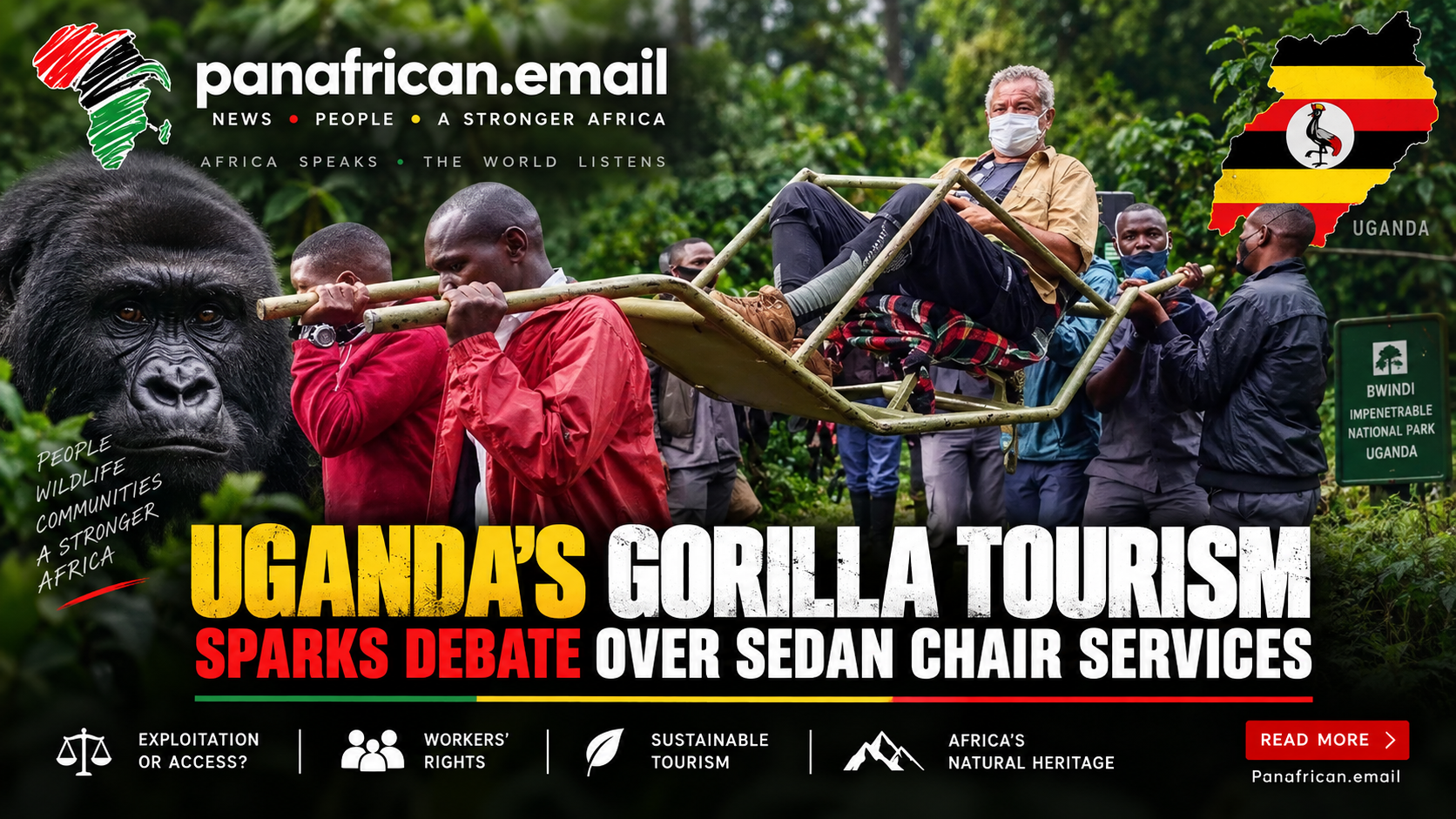
UGANDA — A growing public debate has erupted in Uganda following the circulation of videos appearing to show Western tourists being transported through forest terrain on sedan chairs carried by local tourism workers during gorilla trekking excursions.
The images have triggered strong reactions online, with critics questioning whether the practice is compatible with Uganda’s efforts to promote responsible, ethical and community-based tourism.
Some commentators have described the scenes as resembling modern-day slavery, arguing that the sight of African workers physically carrying wealthy international visitors through the forest creates an uncomfortable image of inequality. Others say the practice risks reinforcing colonial-era perceptions in which local people are portrayed as servants to foreign visitors.
The controversy has also raised questions about working conditions, wages and dignity within Uganda’s tourism industry.
A Service Designed for Visitors With Mobility Challenges
However, the sedan-chair service is not necessarily intended to exploit workers or to provide a luxury experience for able-bodied tourists.
In Uganda’s gorilla tourism sector, specialized carrying services can be arranged for visitors who are elderly, have mobility limitations or are otherwise unable to complete the physically demanding trek on foot. Gorilla trekking can involve steep terrain, muddy paths and long periods of walking through dense forest.
The service therefore provides an opportunity for people who might otherwise be unable to experience the country’s famous mountain gorillas.
Importantly, the workers involved in these services are generally providing a paid tourism service. The existence of the service itself does not establish that forced labor or slavery is taking place.
The Question of Dignity
That distinction, however, has not ended the debate.
Critics argue that even when the service is voluntary and paid, the visual symbolism deserves examination. Images of foreign tourists being carried by African workers can provoke questions about economic inequality and the power relationships embedded within international tourism.
For some Ugandans and African commentators, the concern is less about the physical act of carrying someone and more about how tourism presents African labor and African people to the world.
Supporters of the service counter that dismissing the work as degrading could itself undermine the livelihoods of people employed in Uganda’s tourism economy. Porters, guides and other local workers depend on visitors for income, and specialized services can create additional employment opportunities for communities surrounding national parks.
Tourism, Employment and Local Communities
Gorilla tourism is an important part of Uganda’s international tourism industry. Visitors travel to the country to see endangered mountain gorillas in their natural habitat, particularly in protected areas such as Bwindi Impenetrable National Park and Mgahinga Gorilla National Park.
The industry generates employment for guides, trackers, porters, drivers, accommodation providers, artisans and other workers.
The debate over sedan chairs consequently highlights a larger question: How can African tourism industries provide access to extraordinary natural experiences while ensuring that local workers are treated with dignity and fairly compensated?
Rather than judging the practice solely from the images circulating online, questions about wages, voluntary participation, safety standards, working conditions and the treatment of workers are central to assessing whether the service is ethical.
A Conversation Bigger Than One Viral Video
The controversy also illustrates how quickly images from Africa can be interpreted without their full context.
A short video showing a tourist being carried through a forest may appear shocking, but it does not by itself establish whether workers are being exploited, whether they volunteered for the job, how much they are paid or why the visitor required the service.
At the same time, criticism of the practice should not simply be dismissed. Tourism operators have a responsibility to ensure that employment is safe, voluntary and respectful, while visitors should be encouraged to understand the communities and workers who make their experiences possible.
Uganda’s gorilla tourism debate therefore goes beyond sedan chairs. It touches on labor rights, disability access, economic inequality, African dignity and the complicated relationship between international tourism and local communities.
As the videos continue to circulate, the central question is not simply whether tourists should be carried through the forest, but whether the tourism industry can ensure that everyone involved—from the visitor to the worker carrying them—is treated with dignity and respect.
Leave a Reply