
Accra/Kingston — Ghana and Jamaica are moving to turn decades of Pan-African solidarity into a more concrete economic partnership, with bauxite and aluminium, shipping, ports, investment, health, aviation and agriculture emerging as key areas of cooperation.
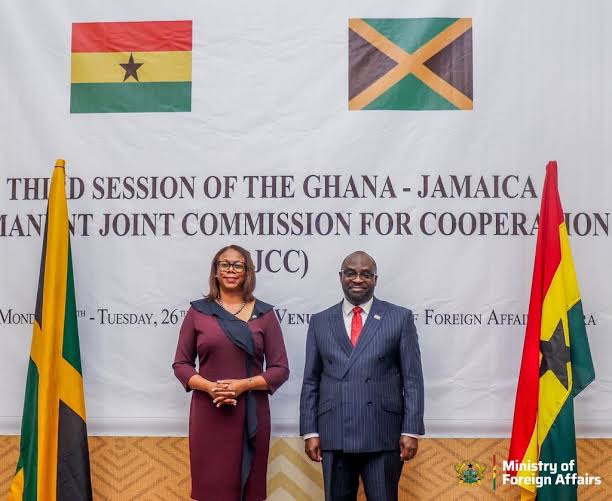
The renewed relationship gained momentum in 2026 following the resumption of the Ghana–Jamaica Permanent Joint Commission for Cooperation (PJCC) after a 21-year hiatus, followed by Ghanaian President John Dramani Mahama’s official state visit to Jamaica in August.
A proposed US$60 million bauxite and alumina trade
One of the most significant developments is the proposed revival of the historical Jamaica–Ghana bauxite and alumina trade, potentially creating an initial commercial opportunity worth approximately US$60 million.
Jamaica Bauxite Mining Limited (JBM) Managing Director Donna Marie Howe said discussions are underway to have Jamaican bauxite refined at the Gramercy alumina facility in Louisiana, United States, with the resulting alumina shipped to Ghana for aluminium production.
The proposal is particularly important because Ghana possesses substantial bauxite resources but does not yet have a commercial-scale alumina refinery capable of supplying its aluminium industry domestically.
Ghana’s Awaso bauxite operation produces roughly 1 million tonnes of bauxite annually, while the country continues to work toward establishing an integrated industry covering mining, refining, smelting and downstream aluminium manufacturing.
Ghana already imports Jamaican alumina
The relationship is not entirely new.
In 2024, Ghana imported approximately 26,250 tonnes of Jamaican alumina valued at US$11.1 million. That compares with approximately 30,900 tonnes worth US$13.1 million imported from Jamaica by Egypt and around 11,600 tonnes worth US$4.1 million imported by Cameroon.
The proposed arrangement therefore represents a potential revival and expansion of an established commercial relationship rather than the creation of an entirely new trade route.
From bauxite to aluminium

For Ghana, the strategic objective goes beyond simply importing alumina.
The country’s long-term ambition is to develop an integrated aluminium value chain in which Ghanaian bauxite is mined, refined into alumina, converted into aluminium and ultimately manufactured into finished products.
That vision dates back to the country’s early industrial development under President Kwame Nkrumah, when the Volta River project and the aluminium industry were conceived as interconnected components of Ghana’s industrial transformation.
Today, the proposed Jamaica arrangement could provide Ghana with an interim source of alumina while the country continues efforts to develop domestic refining capacity.
Ports could become the bridge between Africa and the Caribbean
The bauxite discussions are also taking place against a much larger plan to establish stronger maritime and logistics links between Ghana and Jamaica.
During President Mahama’s August visit, Jamaican Prime Minister Andrew Holness highlighted the strategic importance of Port Kingston, describing it as a major Caribbean transshipment hub.
The Jamaican government sees Jamaica as a potential gateway between the Caribbean and Latin America, while Ghana is positioning itself as a gateway into West Africa.
The proposed concept is effectively a hub-to-hub Atlantic trade corridor connecting the two regions.
Ghana’s own Port of Takoradi is particularly relevant to the mining and commodities component of this strategy. Ghana Ports and Harbours Authority reports that Takoradi handled 36.8% of Ghana’s seaborne traffic in 2024 and 77.4% of the country’s seaborne exports. Bauxite, manganese, cocoa and other bulk commodities are among the major cargoes handled there.
A stronger Ghana–Jamaica maritime connection could therefore create opportunities for more than minerals, including agricultural products, manufactured goods, consumer products and services.
Direct flights also on the agenda
The two governments are simultaneously working toward improved air connectivity.
Ghana and Jamaica agreed to accelerate work on a Bilateral Air Services Agreement, with the goal of eventually enabling direct flights between Accra and Montego Bay.
For businesses, direct aviation links could reduce one of the major barriers to Africa–Caribbean commerce: the cost and complexity of moving people between the two regions.
Trade mission involving 38 Jamaican companies
The commercial push is already moving beyond government discussions.
Jamaica announced that a trade mission involving 38 Jamaican companies would travel to Ghana to explore investment and commercial opportunities with Ghanaian businesses, investors and distribution companies.
The mission is expected to explore opportunities across multiple sectors, rather than focusing exclusively on mining.
Potential areas include:
- Bauxite and alumina
- Aluminium production
- Agriculture and food products
- Cocoa
- Manufacturing
- Tourism
- Logistics
- Construction
- Real estate
- Creative industries
- Health services
- Technology
- Special economic zones
Formal agreements already signed
The renewed relationship is also supported by formal agreements.
At the Third Ghana–Jamaica Permanent Joint Commission in Accra in May 2026, the two countries signed an Agreed Minutes, a Memorandum of Understanding on Defence Cooperation, an amendment concerning arts and culture cooperation, a bilateral agreement concerning the recruitment of Ghanaian health professionals for Jamaica, and a Joint Communiqué.
The agreements came after more than two decades without a formal PJCC meeting, making the 2026 process particularly significant for bilateral relations.
The AfCFTA opportunity
Ghana also offers Jamaica a strategic entry point into the wider African market.
President Mahama highlighted Ghana’s role as host of the African Continental Free Trade Area (AfCFTA) Secretariat, noting that Jamaican companies can potentially use Ghana as a base for reaching a continental market of approximately 1.4 billion people, with combined GDP approaching US$3 trillion.
That makes the Ghana–Jamaica relationship potentially much larger than a bilateral trade arrangement.
Ghana could serve as Jamaica’s West African gateway, while Jamaica could provide Ghanaian and other African companies with a Caribbean and Latin American gateway.
A new Atlantic economic strategy
The emerging Ghana–Jamaica partnership represents an attempt to reconnect two parts of the African diaspora through trade infrastructure rather than symbolism alone.
The immediate US$60 million bauxite opportunity is relatively modest compared with the potential size of the African and Caribbean markets. But the significance lies in the infrastructure being discussed around it: ports, shipping routes, direct flights, investment, industrial processing and business-to-business trade missions.
If the proposed bauxite and alumina arrangement moves from negotiations into a formal commercial agreement, it could become one of the first major building blocks of a broader Africa–Caribbean industrial corridor.
For Ghana, the priority is securing reliable alumina supplies while developing domestic refining capacity. For Jamaica, the opportunity is to expand its role as a Caribbean logistics and commercial hub.
For both countries, the larger question is whether the historic Ghana–Jamaica relationship can evolve into a self-sustaining economic bridge across the Atlantic.
Pan African News Blog will continue to follow the proposed bauxite agreement, port connectivity and emerging Ghana–Jamaica trade opportunities as negotiations develop.
Leave a Reply