
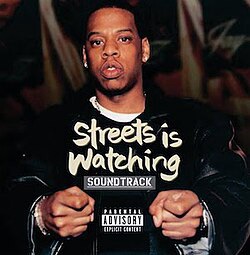
Before the streaming era, before music videos became short films and rappers routinely crossed into Hollywood, Jay-Z and Roc-A-Fella Records created Streets Is Watching—a gritty visual project that blurred the line between hip-hop, street documentary and independent cinema.
Originally released in 1998, Streets Is Watching captures Jay-Z at a pivotal moment: no longer simply an emerging rapper from Brooklyn, but an artist beginning to understand the power of storytelling, mythology and visual culture.
The film brings together Jay-Z, Dame Dash, Sauce Money, Gano Grills and Pain in da Ass, combining music-video sequences with interconnected street narratives. Rather than presenting a polished Hollywood version of urban life, Streets Is Watching operates in the language of the neighborhood—ambition, loyalty, betrayal, money, violence, romance and survival.
The title itself is a statement. The streets are not merely the setting; they are the audience, the judge and the historian.
From Marcy to the World
The opening, “Welcome to Marcy,” establishes the project’s central geography and identity. Brooklyn isn’t treated as background scenery. It becomes part of the character.
Tracks such as “Where I’m From,” “Friend or Foe,” “Streets Is Watching,” “Snakes,” “Imaginary Player,” “You Must Love Me” and “Dead Presidents” reinforce the film’s larger themes.
There is a recurring tension between wanting to escape the streets and remaining connected to the experiences that created you.
That tension would become one of the defining themes of Jay-Z’s career.
More Than a Music Video
What makes Streets Is Watching historically significant is its ambition.
The project arrived at a time when hip-hop was developing its own visual language. Rappers were no longer satisfied with simply performing songs for the camera. They were beginning to create characters, narratives and worlds around their music.
Roc-A-Fella understood this early.
Streets Is Watching therefore feels like an early blueprint for the multimedia hip-hop empire that would follow.
The music supplies the soundtrack, but the visual storytelling gives the songs another dimension.
The African-American Urban Experience
For a Pan-African audience, the film is particularly interesting because it documents an African-American cultural experience within the wider African diaspora.
Brooklyn becomes another point on the African diasporic map—a place where African descendants developed new identities, languages, fashions, music and economic cultures while navigating structural inequality and neighborhood realities.
The film’s clothing, slang, music and entrepreneurial themes are therefore more than period details. They represent a particular moment in the evolution of Black urban culture.
The Soundtrack of Survival
The musical selections remain the project’s strongest asset.
“You Must Love Me” provides one of the most reflective moments, while “Dead Presidents” and “Diamonds in da Rough” reinforce the project’s fascination with wealth, ambition and the price attached to pursuing both.
The progression toward the closing credits feels almost symbolic: the street story ends, but the music continues.
A Time Capsule of 1998
Watching Streets Is Watching today is like opening an audiovisual time capsule.
The fashion, cars, locations, production style and visual aesthetics place the viewer firmly in late-1990s New York.
That rawness is part of its charm.
It isn’t trying to look like a modern blockbuster. Its value lies precisely in the fact that it captures Roc-A-Fella before Roc-A-Fella became a global cultural institution.
Verdict
Rating: ★★★★☆ 4/5
Streets Is Watching is not simply a Jay-Z curiosity. It is an important artifact from the period when hip-hop was transforming from a musical movement into a complete cultural industry.
For longtime hip-hop followers, it is a nostalgic trip into the early Roc-A-Fella era.
For younger viewers, it provides a window into the visual language and street mythology that shaped an entire generation of hip-hop.
And for students of African diasporic culture, it offers something even more valuable: a snapshot of how Black urban communities were documenting themselves before social media gave everyone a camera.
The streets were watching.
And in 1998, Roc-A-Fella decided to turn the camera around.
PanAfrican.email Film Desk
Leave a Reply