
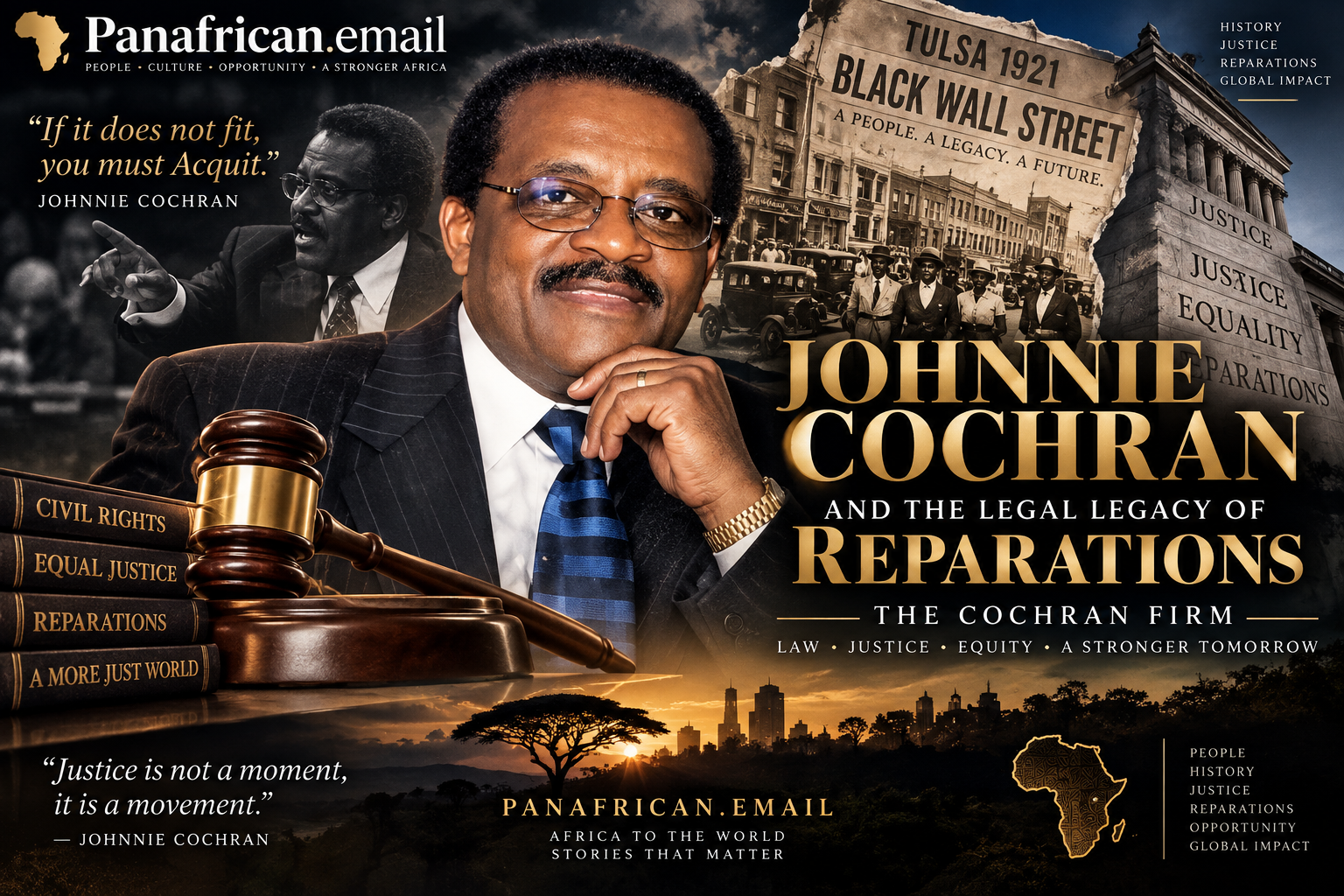
By Panafrican.email
When the name Johnnie L. Cochran Jr. is mentioned, popular memory often goes immediately to the 1995 O.J. Simpson trial. But the deeper history of Cochran’s career lies elsewhere: in his use of litigation as a tool to challenge police abuse, racial discrimination, wrongful imprisonment and the unequal distribution of justice.
His connection to the American reparations movement is particularly significant. In the final years of his career, Cochran joined other prominent civil-rights lawyers in attempting to turn the idea of reparations from a political demand into a courtroom strategy.
From civil rights to reparative justice
Born in Shreveport, Louisiana, in 1937, Cochran grew up in a family whose history was directly connected to the racial order he would later challenge. According to The Cochran Firm, his great-grandparents had been enslaved and his grandfather was a sharecropper. His interest in law was strengthened after witnessing the impact of Brown v. Board of Education and the work of Thurgood Marshall.
Cochran’s early career also exposed him to the consequences of police power in Black communities. After leaving the Los Angeles City Attorney’s Office in the 1960s, he increasingly represented people who alleged police misconduct and racial injustice.
That trajectory became a defining part of his professional identity. The Cochran Firm says its civil-rights practice has continued his work representing victims of excessive force, wrongful arrest, wrongful conviction, discrimination and other constitutional violations.
The reparations movement enters the courtroom
At the beginning of the 21st century, Cochran became part of a much broader legal effort.
In 2000, lawyers and scholars including Harvard professor Charles Ogletree Jr., Johnnie Cochran and others formed what became known as the Reparations Coordinating Committee. Its purpose was to explore legal strategies for addressing the continuing consequences of slavery and racial discrimination. Contemporary reporting described the effort as seeking remedies beyond simply monetary payments.
This distinction is important.
Reparations, in the legal and historical sense, can involve financial compensation, restoration of property, educational programs, institutional reform, memorialization, healthcare, economic development and official recognition.
The question was therefore not simply:
How much money is owed?
It was also:
What legal and institutional remedies can address harm whose consequences continue across generations?
Tulsa: Cochran’s most direct reparations case
The clearest expression of Cochran’s reparations work came in Tulsa, Oklahoma.
The 1921 Tulsa Race Massacre destroyed much of Greenwood, the prosperous Black district commonly known as Black Wall Street. Decades later, an Oklahoma commission investigated the massacre and in 2001 recommended reparative measures for survivors and descendants.
In 2003, Cochran joined Charles Ogletree and other attorneys representing more than 200 survivors and descendants in Alexander v. Oklahoma.
The lawsuit sought restitution and repair for the destruction suffered by Greenwood residents and argued that government authorities had violated constitutional rights. The Smithsonian’s National Museum of African American History and Culture documents Cochran and Ogletree as leaders of the legal team.
The case ultimately failed—not because the historical destruction was disputed, but because the courts concluded that the claims were barred by the statute of limitations. The federal district court dismissed the case in 2004, the Tenth Circuit affirmed, and the Supreme Court declined review in 2005.
That distinction became an important lesson for the reparations movement: establishing historical wrongdoing and establishing a legally actionable claim are two different battles.
The Cochran Firm and the idea of economic justice
Cochran’s professional legacy therefore reaches beyond criminal defense.
The firm he founded presents its continuing mission around representing injured people, families and communities confronting powerful institutions. Its civil-rights practice reports major recoveries involving police misconduct, discrimination and wrongful imprisonment, while also emphasizing policy reform and institutional accountability.
This creates a useful way of understanding Cochran’s legacy:
Civil rights → accountability → compensation → institutional reform → reparative justice.
Not every civil-rights settlement is legally a “reparations case.” But the underlying principle can overlap: an institution accused of causing serious harm is required to provide a remedy rather than simply acknowledge that the harm occurred.
The Cochran Firm itself says its civil-rights work has produced compensation for families, policy reforms, releases of wrongfully imprisoned people and other forms of relief.
A legacy larger than the O.J. Simpson courtroom
Cochran became one of the most recognizable lawyers in the world through the Simpson trial. Yet his professional identity was formed much earlier through civil-rights litigation.
His representation of Geronimo Pratt, for example, ultimately contributed to the 1997 vacation of Pratt’s conviction after he had spent 27 years imprisoned. The Cochran Firm identifies Pratt’s case as one of the defining examples of Cochran’s commitment to wrongful-conviction work.
His work involving police abuse, discrimination and wrongful imprisonment demonstrated another philosophy: law could be used not merely to defend individuals, but to force institutions to confront the consequences of their conduct.
That philosophy is particularly relevant to contemporary reparations debates.
The unfinished question
Johnnie Cochran died in 2005, shortly after the Supreme Court declined to hear the Tulsa reparations appeal. His death did not end the legal debate.
The Tulsa case became part of a much larger American conversation about whether courts, legislatures, corporations and public institutions can provide remedies for historic racial harm.
Today, reparations advocates continue to debate the appropriate remedy: direct payments, community investment, scholarships, healthcare, land and property restoration, economic-development programs, memorialization or combinations of these approaches.
Cochran’s contribution was to help demonstrate that reparations could be approached not only as a moral or political question, but also as a legal question involving evidence, constitutional rights, governmental responsibility and remedies.
That may ultimately be one of his most enduring contributions.
Johnnie Cochran did not win the Tulsa reparations case. But his participation helped place reparative justice inside the American courtroom—and helped establish a legal lineage connecting civil-rights litigation with today’s continuing struggle over historical accountability.
Sources
- The Cochran Firm — Johnnie Cochran Legacy
- The Cochran Firm — Civil Rights Practice
- Smithsonian — Tulsa Race Massacre Oral History Collection
- Human Rights Watch — The Case for Reparations in Tulsa
- Oklahoma Bar Association — Tulsa Race Massacre history and litigation
Leave a Reply