A celebrity’s foray into international diplomacy
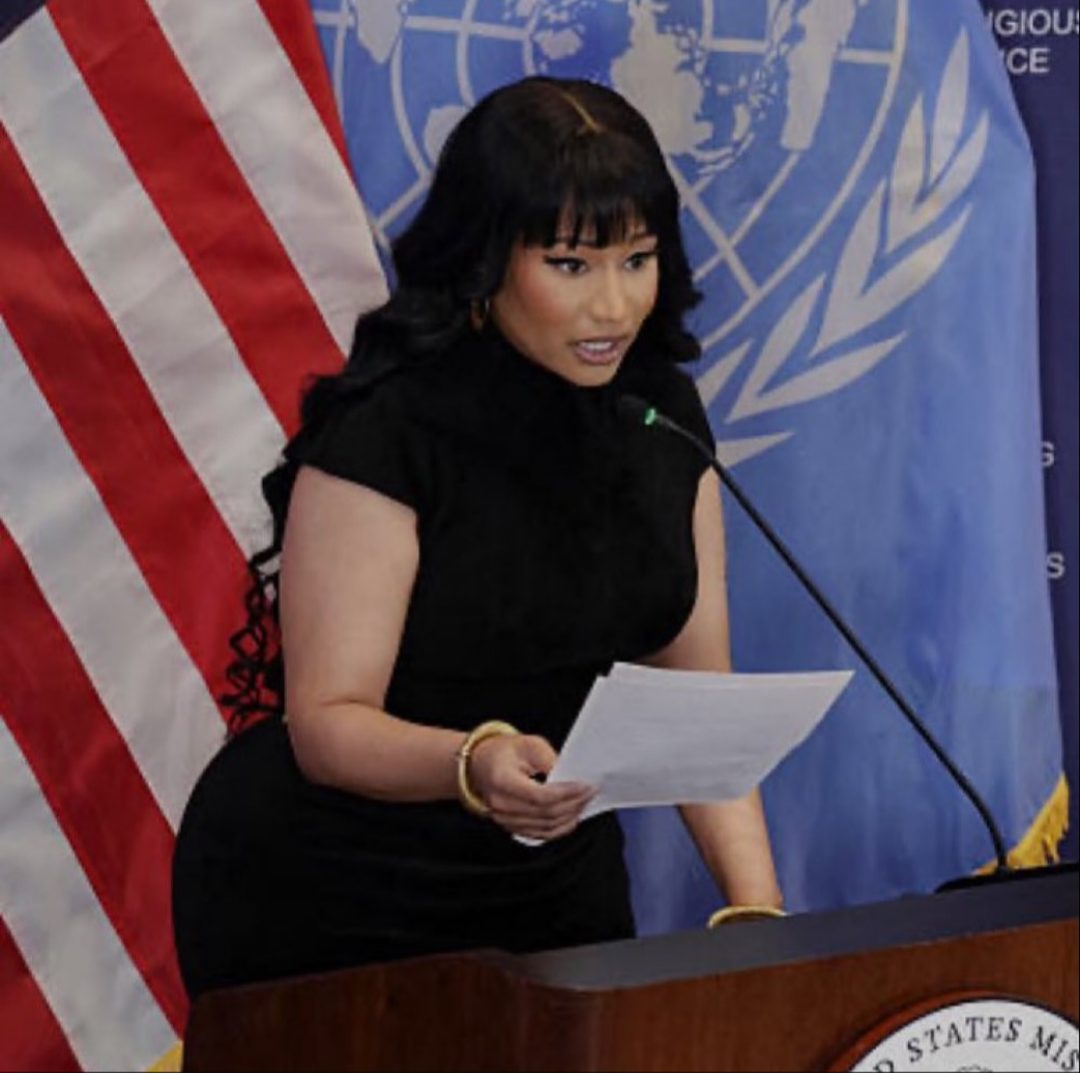
When global music superstar Nicki Minaj stepped onto the United Nations podium on November 18, 2025, she brought her immense celebrity platform into one of Africa’s most complex security situations. Her speech, focusing exclusively on Christian persecution in Nigeria, has ignited both support and concern across the Pan-African community, raising fundamental questions about external narratives shaping African conflicts and the simplification of multifaceted crises into singular religious dimensions.
The Speech: From Music Icon to Diplomatic Voice
Minaj’s appearance at the UN headquarters in New York came at the invitation of U.S. Ambassador Michael Waltz, who described her as “not only arguably the greatest female recording artist, but also a principled individual who refuses to remain silent in the face of injustice” . The event was titled “Combating Religious Violence and the Killing of Christians in Nigeria” .
In her four-minute address, Minaj made several striking claims about the situation in Nigeria:
· “In Nigeria, Christians are being targeted, driven from their homes and killed. Churches have been burned. Families have been torn apart and entire communities live in fear constantly, simply because of how they pray” .
· “Sadly, this problem is not only a growing problem in Nigeria, but also in so many other countries across the world, and it demands urgent action” .
· “Protecting Christians in Nigeria is not about taking sides or dividing people. It is about uniting humanity” .
Addressing her fans directly, Minaj insisted that her involvement “isn’t about taking sides” but rather “standing up in the face of injustice” . She specifically thanked President Donald Trump “for his leadership on the global stage in calling for urgent action to defend Christians in Nigeria” .
The Political Backdrop: Trump’s “Guns-A-Blazing” Threat
Minaj’s UN appearance didn’t occur in a vacuum. It came just weeks after she publicly endorsed a Truth Social post from President Trump in which he threatened dramatic action against Nigeria .
In early November, Trump had declared on Truth Social that he was considering military intervention in Nigeria, threatening to send U.S. troops “guns-a-blazing” to “completely wipe out the Islamic Terrorists who are committing these horrible atrocities” against “our CHERISHED Christians” . He further warned that any U.S. military action “will be fast, vicious and sweet, just like the terrorist thugs attack our cherished Christians” .
The Nigerian government responded with alarm and frustration. Presidential spokesperson Bayo Onanuga expressed that “We are shocked that President Trump is mulling an invasion of our country” , while President Bola Ahmed Tinubu emphasized that Nigeria “is a democracy with constitutional guarantees of religious liberty” .
The Complex Reality: What the Simplified Narrative Overlooks
While Minaj and Trump present Christian persecution as the central crisis in Nigeria, experts and local voices describe a much more complex situation:
Multi-dimensional Violence
Analysts note that violence in Nigeria stems from multiple factors including ethnic rivalries, land and water disputes, political competition, and criminal activity . The Armed Conflict Location & Event Data Project and Council on Foreign Relations have repeatedly stated that “the notion of Christians being disproportionately attacked is a dangerous reduction of the nature of violence in Nigeria that isn’t backed by data” .
Indiscriminate Suffering
Bulama Bukarti, a Nigerian conflict researcher and human rights lawyer, told ABC News that the violence is “indiscriminate” . This perspective was echoed by local religious leaders, with one Imam noting, “The kind of pain we’ve gone through for the past years — this issue affects both faiths” .
Table: Religious Demographics and Conflict Dynamics in Nigeria

Criminal Economics Over Ideology
Some analysts point to economic motives behind attacks on religious figures, noting that “kidnappings of priests and pastors have surged, as criminals see them as high-value targets whose communities can raise ransom quickly” . This suggests profit rather than religious discrimination drives much of this violence.
A Pan-African Concern: External Narratives and African Realities
Minaj’s speech raises significant concerns from a Pan-African perspective:
The Danger of Single-Story Narratives
As renowned novelist Chimamanda Ngozi Adichie has warned, there is a danger in a single story. The reduction of Nigeria’s complex crises to solely religious persecution erases the experiences of millions of Muslims who have also been victims of extremist groups like Boko Haram . Gimba Kakanda, Senior Special Assistant to the President of Nigeria, emphasized in an Al-Jazeera op-ed that “Every region of Nigeria has both Christians and Muslims living side by side, and conflicts typically unfold along community or regional lines rather than strictly religious ones” .
Sovereignty and the Threat of External Intervention
Trump’s threatened military intervention—endorsed by Minaj’s platform—represents a profound sovereignty concern for African nations. The language of “guns-a-blazing” invokes painful colonial and neo-colonial histories of external powers imposing solutions that often exacerbate conflicts .
Nigerian security analyst Nnamdi Obasi challenged the framing, telling CNN that “Reports of widespread persecution and mass slaughter of Christians are seriously misread and exaggerate the challenges of interfaith relations in the country” .
The Bigger Picture: Celebrity Diplomacy in the Digital Age
Minaj’s foray into international diplomacy reflects several evolving trends:
· Social Media Amplification: With 28 million followers on X alone, Minaj can instantly amplify political messages to audiences that traditional diplomats might never reach . Ambassador Waltz acknowledged this advantage, noting “She is reaching a whole other swath of people who may not follow these issues” .
· Celebrity as Political Witness: Waltz introduced Minaj as someone who “steps onto this world stage not as a celebrity, but as a witness” . This represents a growing trend of celebrities transitioning from entertainment to political advocacy, particularly in international affairs.
· Simplified Narratives for Complex Problems: The distillation of Nigeria’s multifaceted conflicts into a religious persecution framework demonstrates how complex crises often get simplified when translated through celebrity platforms.
Conclusion: Beyond the Headlines
While Nicki Minaj has used her platform to draw attention to very real suffering in Nigeria, the Pan-African community must approach such simplified narratives with critical awareness. The situation in Nigeria involves intersecting challenges of governance, economic inequality, historical tensions, and security failures that affect Nigerians of all faiths.
As Africa continues to navigate its relationship with global powers and international voices, the essential work of understanding local complexities must remain paramount. True solidarity with the Nigerian people requires acknowledging the full spectrum of their experience, not just the fragments that fit predetermined narratives.
The conversation Minaj has started is important, but it must expand to include the diverse voices of Nigerians themselves—Christian and Muslim alike—who understand best the complicated reality of their nation’s challenges and the most promising paths toward lasting peace.
Leave a Reply