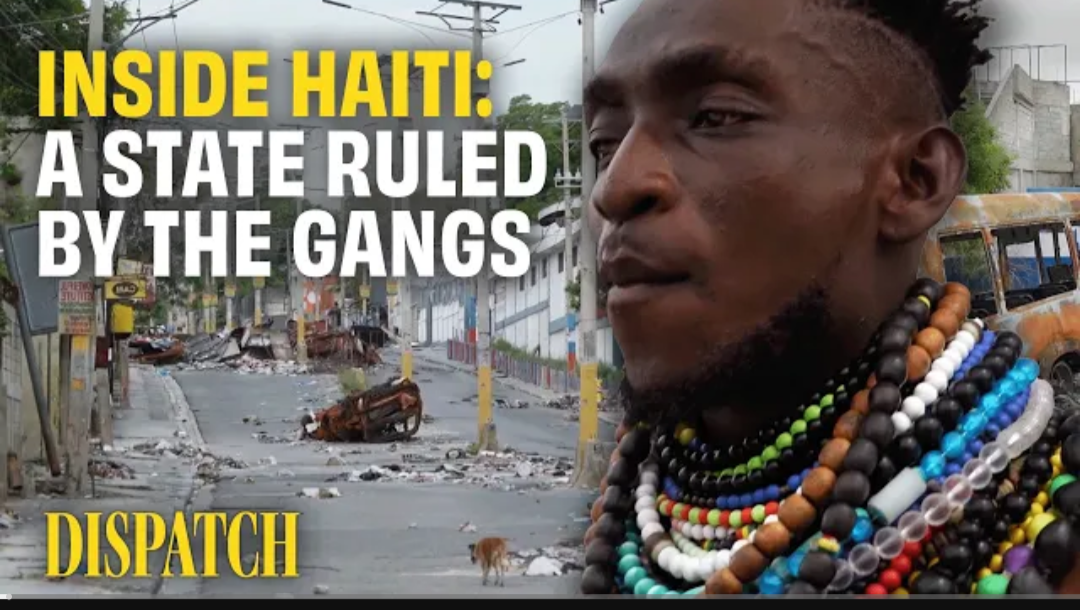
In the crumbling neighborhoods of Port-au-Prince, a new power asserts its authority. It is not the Haitian government, whose police forces are weary and outgunned, nor the beleaguered transitional council trying to steer the country from chaos. The real power lies with men like Jimmy Chérizier, known as “Barbecue,” a former police officer turned gang leader who now controls vast swathes of the capital. From his stronghold, he issues a stark ultimatum to the world: “We demand to be at the negotiating table… If not, we will continue to fight”.
His words underscore a terrifying reality. Today, nearly three million people in Port-au-Prince live under the suffocating grip of an all-out gang war. Armed groups united under the alliance Viv Ansanm (“Live Together”) control more than 80% of the city, having successfully forced the resignation of Prime Minister Ariel Henry and brought the state to its knees. This is not random violence; it is a strategic, coordinated takeover that has created one of the world’s most severe humanitarian crises and poses profound questions about sovereignty, intervention, and resilience for the entire African diaspora.
The Making of a Crisis: From Political Tools to Rival States
Haiti’s descent did not begin with Barbecue’s raids. The gangs have roots entangled with Haiti’s political and economic elites. For decades, political actors and wealthy businessmen used armed groups as tools to attack rivals, pillage businesses, and manipulate elections. As one Haitian editor notes, “Doing business in Haiti often involves violence … and the use of criminal gangs”.
The situation spiraled following the assassination of President Jovenel Moïse in 2021 and a series of natural disasters, creating a vacuum the gangs were poised to fill. What changed in 2023 was the gangs’ evolution from fragmented, competing entities into a unified military and political force. In September 2023, rival factions—notably the G9 and G-Pèp alliances—shocked observers by forming the Viv Ansanm coalition. This was a strategic masterstroke. By declaring a truce with each other, the gangs could redirect their firepower from internal turf wars toward a common enemy: the Haitian state.
· Strategic Target: Key national infrastructure (ports, airports, government buildings).
· Primary Method: Coordinated armed assaults to cripple state function and instill fear.
· Major Outcome: Forced resignation of Prime Minister Ariel Henry, who was blocked from returning to the country.
This unity transformed the conflict. According to conflict data, coordinated attacks by Viv Ansanm in late February 2024 led to Henry’s resignation in March and were followed by a 78% decrease in clashes between the gangs themselves. The truce allowed them to consolidate resources, expand into new territories, and systematize their control.
The Gangs’ Strategy: Control, Capital, and “Crisis Governance”
The gangs’ power rests on three pillars: territorial control, economic strangulation, and a perverse form of local governance.
Territorial and Economic Control
The gangs have seized Haiti’s vital economic lifelines.They control the seafront and areas surrounding the main ports. This is catastrophic for a nation that imports more than 50% of its food. By blocking these gateways, they control the flow of sustenance for millions and generate immense revenue through extortion. Furthermore, they have expanded their reach beyond the capital, targeting agricultural areas like the Artibonite region—Haiti’s breadbasket—further threatening national food security.
A Twisted Social Contract
In their strongholds,gangs like Barbecue’s have crafted a disturbing narrative. They portray themselves as revolutionary forces fighting a corrupt elite, sometimes distributing seized aid to residents. This populist messaging is a calculated attempt to legitimize their rule. Human rights defenders vehemently reject this facade. “The gangs are involved in assassinations, kidnappings, rapes, gang rapes, fires, burning down homes, businesses, banks, courts and police stations,” states Rosy Auguste Ducéna of Haiti’s National Network for the Defence of Human Rights. Of Barbecue, she says, “It is clear that he is not a revolutionary and never will be … he is an armed bandit”.
The Human Cost
The humanitarian impact is staggering.
· Mass Displacement: Over 580,000 people are internally displaced.
· Extreme Hunger: 5 million Haitians face acute food insecurity, with over a million one step from famine.
· Daily Violence: Killings and kidnappings are rampant. A UN report described “harrowing practices,” including the use of sexual violence as a tool of control.
Failed Institutions and the International Quandary
The Haitian state has been unable to mount an effective response. The head of the Transitional Council, Edgard Leblanc Fils, admits to a history of “connivance between state authorities and gangs”. The police force is understaffed, outgunned, and demoralized. In daily patrols through devastated downtown areas, officers in bullet-riddled armored carriers are forced to make grim decisions, with one telling France 24 that in active war zones, they shoot at any suspicious movement because “we don’t need to know whether they’re armed or not”.
The international response has been hesitant and fraught with historical baggage. The United States has pursued sanctions and legal action, indicting Barbecue for conspiring to violate U.S. sanctions and offering a $5 million reward for information leading to his capture. However, it has avoided direct military intervention, a legacy of the painful history of American occupation and failed UN peacekeeping missions, which were marred by scandals like the cholera epidemic introduced by Nepalese troops.
This history has led to the current, unprecedented solution: a Kenya-led Multinational Security Support (MSS) mission. This force represents a significant shift, marking one of the first times a African nation has led a security intervention in the Caribbean. Yet its deployment has been rocky. The gangs perceive it as an existential threat, and their February offensive was partly launched to preempt its arrival. Barbecue has labeled any foreign forces “aggressors” and “invaders”.
An African Lens: Sovereignty, Solidarity, and Neo-Colonial Shadows
The crisis in Haiti resonates deeply across Africa and its diaspora, framed by three critical tensions.
1. The Paradox of Intervention
The Kenya-led mission embodies a powerful idea:African solutions for a crisis in the world’s first Black republic, founded by freed slaves. It is an act of Pan-African solidarity. Yet, it is also backed and funded by powers like the U.S. and Canada, instantly evoking the neo-colonial specter of foreign imposition that both Haiti and Africa know too well. The mission walks a tightrope between solidarity and sovereignty.
2. The Gang Leader’s Gambit and Political Legitimacy
Barbecue’s demand for a seat at the political table forces a brutal moral question.Can those who wield violence against civilians to destabilize a nation be granted political legitimacy? For many African nations that have endured conflicts with warlords and militias, this is a familiar and painful dilemma. Engaging with Barbecue risks rewarding terrorism; refusing to engage may prolong the bloodshed indefinitely.
3. Echoes of Resilience and Exploitation
Haiti’s story—from triumphant revolution to systemic impoverishment and political manipulation—mirrors the post-colonial trajectories of many African nations.The revelation that gangs were initially cultivated by economic elites to secure monopolies feels tragically familiar. It speaks to a global pattern where extreme inequality, weak institutions, and external interference create fertile ground for violent non-state actors.
A Future Foretold?
As of late 2024, the standoff continues. The transitional government is fragile, the Kenyan-led force faces a formidable and entrenched enemy, and millions of Haitians remain trapped. The Viv Ansanm alliance has shown it can be more than a criminal network; it can act as a parallel state with strategic coordination and political goals.
The path forward is perilously narrow. It requires a dual track: a robust security effort to restore basic order and create space for a legitimate political process that addresses the profound social and economic grievances the gangs exploit. This process must include civil society, grassroots groups, and diaspora communities—but the world must grapple with whether it can ever include the men with the guns who set the country ablaze to get its attention.
The tragedy of Haiti is a warning. It shows how quickly order can disintegrate when inequality, political corruption, and historical trauma converge. For Africa and its global diaspora, Haiti’s fight is a stark reminder of the constant work needed to build resilient, just, and sovereign societies—and the high cost of failure.
Leave a Reply