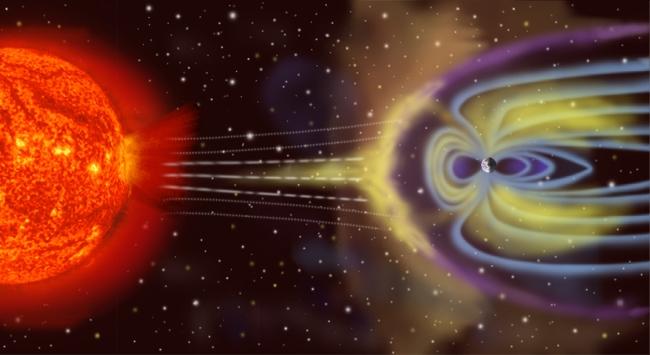
Recent scientific updates reveal our planet is experiencing significant geophysical changes, from a wandering magnetic pole to intensified solar activity. While these events unfold over vast timescales, they have tangible effects on the technology and natural systems we depend on.
🧭 The Moving Magnetic North Pole
The magnetic north pole is not fixed. Unlike the geographic North Pole, it is determined by Earth’s dynamic magnetic field, which is generated by molten metals churning in the planet’s core.
· Recent Movement: The pole has moved decisively from northern Canada towards Siberia. While its drift has slowed from a peak of about 55 kilometers per year in the 1990s, it continues to move at approximately 35 kilometers per year.
· Why It Matters for Navigation: This movement necessitates regular updates to the World Magnetic Model (WMM), which is crucial for the accuracy of global navigation systems used by aviation, shipping, and smartphones. A new, high-resolution model (WMMHR2025) was released to improve directional accuracy.
A Full Pole Reversal? Not Anytime Soon.
While the poles have flipped hundreds of times in Earth’s history,scientists confirm we are not overdue for a reversal. Such events occur randomly and take thousands of years to complete. Life has survived many past reversals, but the gradual weakening of the magnetic field during a shift would pose challenges for satellites and electrical grids.
☀️ Solar Maximum: The Sun’s Active Phase
Our Sun follows an approximately 11-year cycle of activity. We are currently at solar maximum, a phase where sunspots, solar flares, and coronal mass ejections (CMEs) are most frequent and powerful.
· Recent Powerful Storms: In November 2025, Earth was struck by multiple CMEs, triggering a severe geomagnetic storm. This caused radio blackouts across Europe, Africa, and Asia and produced a rare “Ground Level Enhancement” event where solar particles penetrated deep into our atmosphere.
· Constant Monitoring: Agencies like NASA and ESA constantly monitor the Sun. In early December 2025, the Sun emitted another strong X-class solar flare—the most intense category.
These events underscore the need for advanced space weather forecasting.
🌍 Impacts on Technology and Life on Earth
The interplay between Earth’s shifting magnetic field and heightened solar activity has direct consequences.
- Technology and Infrastructure
· Navigation: The moving magnetic pole requires constant software updates for precise GPS and compass functionality.
· Satellites & Aviation: Geomagnetic storms can disrupt satellite communications, increase radiation for astronauts and high-altitude flights, and cause errors in spacecraft systems. Regions like the South Atlantic Anomaly, where Earth’s magnetic shield is weaker, already expose satellites to elevated radiation.
· Power Grids: Intense solar storms can induce powerful electrical currents in long power lines and pipelines, risking widespread blackouts and infrastructure damage.
- Natural World and Climate
· Animal Migration: Species like whales, sea turtles, and birds that use magnetic fields for navigation could be disoriented by long-term magnetic shifts.
· Earth’s Rotation: Separate from magnetic changes, climate change is altering Earth’s spin. The melting of ice sheets and redistribution of water mass are causing a measurable lengthening of the day and a shift in the planet’s rotational axis.
· Auroral Displays: During strong solar storms, auroras (Northern and Southern Lights) can be visible at much lower latitudes than usual, sometimes even near the equator.
A Perspective for Africa
For Africa, these global phenomena present specific considerations:
· Communication Vulnerability: The continent experienced radio blackouts during the November 2025 solar storm. As digital connectivity grows, protecting communication infrastructure from space weather becomes more critical.
· Navigation and Development: Accurate navigation is vital for transportation, surveying, and resource management. Relying on updated global models is essential.
· Scientific Opportunity: Africa’s unique geographic position makes it a valuable site for space weather observation and studying the ionosphere’s response to solar activity.
· Auroral Potential: During extreme solar events, nations at equatorial and moderate latitudes—including parts of Africa—may witness the rare and spectacular sight of auroras.
Looking Ahead
Science is advancing our preparedness. The upcoming ESA Vigil mission, launching in 2031, will monitor the Sun from a side angle to provide earlier warnings of solar storms. Meanwhile, continuous tracking of Earth’s magnetic field ensures our navigational tools remain reliable.
These changes remind us that we live on a dynamic planet within an active solar system. By understanding and adapting to these large-scale forces, we can better safeguard our technological society and appreciate the complex systems that make life on Earth possible.
Leave a Reply