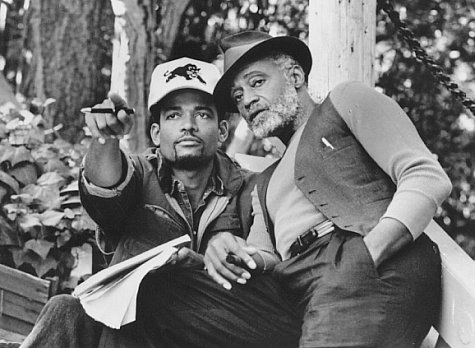
In the sprawling canon of films dedicated to the Black freedom struggle, Mario Van Peebles’ 1995 drama “Panther” occupies a crucial, if contested, space. More than a simple historical record, the film is a passionate, political tapestry that blends documented fact with narrative fiction to plunge audiences into the fiery heart of the 1960s and the meteoric rise of the Black Panther Party for Self-Defense. For a Pan-African audience, the film serves not as a dusty relic, but as a vibrant point of reflection on unity, resistance, and the complex machinery of state opposition.
Van Peebles, both behind the camera and in a supporting role, deliberately moves beyond the mainstream media’s reductionist view of the Panthers as merely armed militants. Instead, “Panther” grounds itself in the community from which the Party grew. Through the lens of a fictional young recruit, Judge (Kadeem Hardison), we are introduced to the Panthers’ foundational Ten-Point Program and, most importantly, their revolutionary community survival programs. The film dedicates significant time to the Free Breakfast for Children initiative, the health clinics, and the educational outreach—programs that directly addressed the neglect and systemic oppression faced by Black communities. This focus aligns perfectly with Pan-Africanism’s principle of self-reliance and the imperative to build institutions that serve and empower our people.
The narrative does not shy away from the Party’s defiant posture against police brutality. Scenes of Panthers exercising their legal right to bear arms while monitoring law enforcement in Oakland are tense and electrifying, capturing the potent symbolism of the black beret and leather jacket. This is balanced with unflinching depictions of the violent, coordinated crackdown by police and federal agencies. The film squarely implicates the FBI’s COINTELPRO program in its mission to sabotage, infiltrate, and dismantle the Party, highlighting the government’s fear of a united, politically conscious Black movement. This historical truth resonates across the diaspora, where movements for liberation have often faced identical tactics of destabilization.

While featuring historical figures like Huey P. Newton (Marcus Chong) and Bobby Seale (Courtney B. Vance), the use of a fictional protagonist allows the audience to experience the awakening, commitment, and internal conflicts of membership. We see the personal costs, the ideological debates between armed resistance and non-violent protest (the latter represented by a character echoing Dr. Martin Luther King Jr.), and the toll of constant surveillance.
The powerful cast, including Angela Bassett, Chris Rock, and a host of renowned actors, brings a visceral humanity to the story. The socially charged narrative refuses to offer easy answers, instead presenting the Panthers as a necessary, flawed, and heroic response to a specific moment of intense repression and possibility.
For our Pan-African readership, “Panther” is more than a movie; it is a tribute to global Black activism. It connects the dots between the grassroots organizing in Oakland to anti-colonial struggles worldwide, all underscored by a soundtrack pulsating with the era’s revolutionary jazz and funk. The film asks us to remember not just the confrontations, but the profound community care that was the Party’s true backbone. It challenges us to examine how those same systems of oppression have evolved and how the legacy of the Panthers—their courage, their programs, and their targeted destruction—informs our ongoing fight for justice, dignity, and true liberation across the globe.
Leave a Reply