Liberia stands at a pivotal crossroads. As one of the world’s ten poorest nations yet endowed with vast natural resources, the West African country has long relied on concession agreements with foreign corporations to spur economic development. These deals, particularly in mining and agriculture, promise significant foreign investment, job creation, and infrastructure development. However, they also pose profound questions about sovereignty, equitable benefit-sharing, and sustainable growth.
The recent $3.5 billion agreement with global steel giant ArcelorMittal — the largest foreign investment in Liberia’s post-war history — has brought these questions into sharp focus. As the government reviews not only this deal but also key agricultural concessions, a critical examination reveals a complex landscape where national aspirations and corporate interests are in constant negotiation.
The ArcelorMittal Expansion: A Monumental Bet on Iron Ore
ArcelorMittal’s relationship with Liberia, forged in the immediate post-civil war era, has entered a new phase with a recently ratified Mineral Development Agreement (MDA). This deal extends the company’s operations to 2050, with an option for a further 25-year renewal.
Financial Scale and Scope:
· Total Investment: $3.5 billion, including a $1.8 billion expansion project now nearing completion.
· Upfront Payment: A $200 million payment to the Liberian government for extended mining rights and reserved rail access.
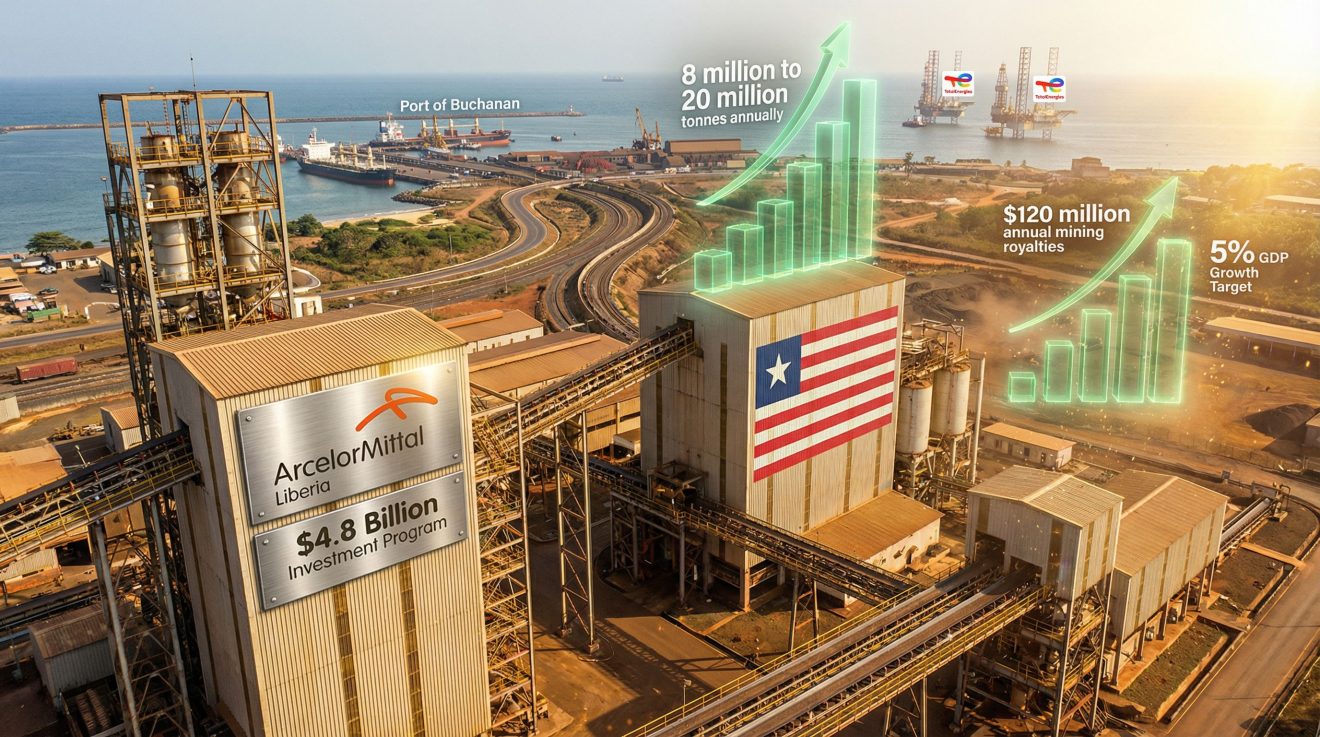
· Production Scale-Up: Annual iron ore shipments are set to quadruple from 5 million tonnes to 20 million tonnes by 2026, with feasibility studies exploring a ramp-up to 30 million tonnes.
· Infrastructure Development: The project centers on a new, state-of-the-art concentrator plant in Nimba County and includes major upgrades to the Tokadeh-Buchanan railway and the port of Buchanan.
Stated Benefits for Liberia:
The government, under President Joseph Boakai, champions the deal as a catalyst for transformative growth. Projected benefits include thousands of direct and indirect jobs (the company already employs about 8,000 people), a substantial rise in future royalties and tax revenues, and the establishment of a multi-user rail corridor to spur broader economic activity. President Boakai has stated the agreement will “deepen the overall impact of the concession on the national economy”.
Controversies and Criticisms:
Despite its scale, the agreement faces scrutiny. Liberia’s Parliament has called for its review and renegotiation, signaling political discontent with the terms. Public skepticism on social media questions whether the $200 million payment is sufficient and highlights community concerns about tangible local benefits. Crucially, while the railway is touted for multi-user access, ArcelorMittal will reserve the expanded capacity for its own use, raising questions about the practical utility for other Liberian businesses.
GVL and Buchanan Renewables: The Agricultural Front
While detailed, Wall Street Journal-comparable financial data for Golden Veroleum Liberia (GVL) and Buchanan Renewables is not fully available in the provided search results, their roles are significant within Liberia’s concession framework.
Golden Veroleum Liberia (GVL – Palm Oil):
GVL holds one of Liberia’s largest palm oil concessions. Palm oil is a major export commodity, and such concessions are specifically mentioned as being under parliamentary review alongside ArcelorMittal’s deal. These agricultural concessions are critical in the tension between export-led revenue and the preservation of Liberia’s vast forests, which are among the largest carbon sinks on the continent. The challenge is to ensure they operate sustainably, respect community land rights, and contribute meaningfully to rural development.
Buchanan Renewables (Biomass Energy):
Originally focused on converting old rubber tree plantations into biomass fuel, Buchanan Renewables’ operations highlight the diversification of Liberia’s concession portfolio. Such projects aim to add value to agricultural by-products and generate energy. Their success depends on stable investment climates and supportive infrastructure, areas where Liberia continues to struggle.
Comparative Concession Overview
Here is a summary of the key concessions based on available data:
ArcelorMittal
· Sector: Mining (Iron Ore)
· Key Financial Terms: $3.5B total investment**; **$200M upfront payment; long-term tax/royalty streams.
· Liberia’s Primary Benefits: Massive FDI, ~8,000 jobs, infrastructure (rail, port), future revenue.
· Key Points of Contention: Parliament-led review; rail access limits; equitable benefit share.
Golden Veroleum Liberia (GVL)
· Sector: Agriculture (Palm Oil)
· Key Financial Terms: Not specified in detail; part of parliamentary review.
· Liberia’s Primary Benefits: Export revenue, rural employment, agricultural development.
· Key Points of Contention: Deforestation risk; land rights conflicts; terms under review.
Buchanan Renewables
· Sector: Agriculture/Energy (Biomass)
· Key Financial Terms: Not specified in detail.
· Liberia’s Primary Benefits: Energy production, agricultural waste utilization, jobs.
· Key Points of Contention: Requires robust infrastructure; success tied to broader investment climate.
Who Benefits More? A Structural Analysis
The balance of benefits is not static but shaped by Liberia’s profound governance and economic challenges.
Advantages to the Companies:
Corporations secure long-term access to valuable resources at a relatively low cost of entry. ArcelorMittal’s 2005 agreement, negotiated when Liberia was emerging from ruin, likely reflects terms favorable to the investor. The amended deal provides legal certainty until mid-century, crucial for recouping a multi-billion-dollar investment. Companies also gain control over strategic infrastructure, like the railway, which creates a formidable competitive moat.
Potential for Liberia:
The potential benefits for Liberia are substantial but often lagging and conditional. Concessions are a primary source of Foreign Direct Investment (FDI) and formal employment in a country where state capacity to provide services is weak. The infrastructure built—ports, railways, power plants—can theoretically serve as a foundation for broader industrialization.
The Critical Impediments:
However, Liberia’s extreme poverty, rampant corruption, and lack of transparency severely undermine its ability to maximize these deals. Revenue can be lost to mismanagement before reaching public coffers. The country’s weak judicial system makes enforcing social or environmental clauses in contracts difficult. Furthermore, an economy tethered to global commodity prices remains vulnerable to boom-bust cycles, as seen during the Ebola crisis and the recent downturn in iron ore prices.
The Path Forward: Toward a Fairer Framework
For Liberia to tip the scales toward more equitable benefits, a multi-faceted approach is essential:
- Strengthen Governance and Transparency: Implementing and enforcing robust anti-corruption measures is non-negotiable. Concession terms, payments, and revenues must be publicly accessible to enable citizen oversight.
- Invest in Expert Negotiation Capacity: The government must leverage independent, expert guidance during negotiations to ensure contracts include fair fiscal terms, strong social and environmental protections, and clear local content requirements.
- Enforce and Monitor Agreements: Signing a contract is only the first step. Liberia needs the institutional capacity to monitor compliance with environmental, labor, and community investment clauses relentlessly.
- Diversify the Economy: Ultimately, reducing dependency on a few mega-concessions requires channeling revenues into sectors like education, healthcare, and diversified agriculture to build a more resilient economy.
Liberia’s concession deals are a double-edged sword. They bring immediate capital and activity but within a high-risk framework of dependency. The $3.5 billion ArcelorMittal agreement symbolizes both the enormous opportunity and the profound challenge. Whether Liberia becomes a true beneficiary of its own wealth or remains a site of extraction for foreign profit depends overwhelmingly on its ability to build a competent, transparent, and accountable state—a task that remains as crucial as attracting the investment itself. The ongoing parliamentary reviews are a positive signal of assertiveness, but their outcome will be the true test of who benefits more in the decades to come.
Leave a Reply