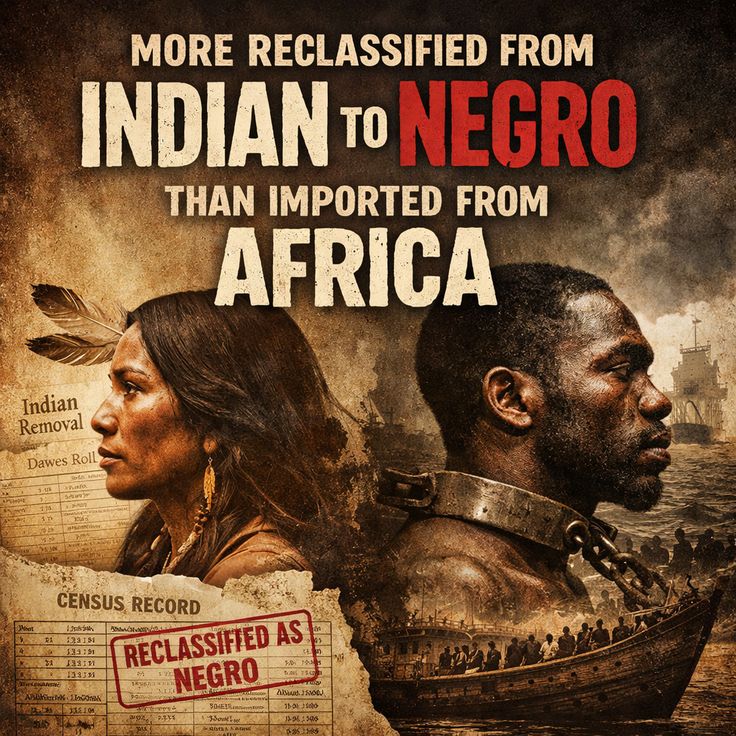
Between 1830 and 1946, U.S. government officials systematically reclassified an estimated 500,000 to 750,000 Native Americans as “Negro/Black” through census manipulations, vital records tampering, and tribal roll exclusions—a scale of “paper genocide” that exceeded the roughly 388,000–450,000 Africans imported directly during the transatlantic slave trade (1619–1808).[1][2][3] This bureaucratic erasure wasn’t random; it was engineered to void treaties, seize sovereign lands, and enforce a racial binary that prioritized white supremacy over Indigenous rights.[4][5][6][7] For Native communities, it meant generational loss of identity, wealth, and self-determination—effects still felt today.[6][7][8]
The Mechanics of Paper Genocide: Census, Rolls, and Vital Records
Paper genocide refers to the deliberate removal of a group’s identity from official records, creating the illusion they never existed.[4][5] In the U.S., this unfolded across federal censuses (1830–1940), the Dawes Rolls (1898–1914), and state vital records, where Native people with any African ancestry—or even suspected “mixture”—were forcibly labeled Black.[4][9][7][2][8]
Key tactics included:
- Census instructions enforcing the one-drop rule: By 1930, enumerators were ordered to classify anyone with “any negro blood” as Negro, regardless of Native heritage, erasing mixed individuals from Indigenous counts.[9][7][2]
- Dawes Act allotments: The Dawes Commission created separate “Freedmen rolls” for Black-Indigenous descendants in the Five Civilized Tribes (Cherokee, Choctaw, etc.), denying them land allotments and tribal citizenship while whites with Native ancestry often retained status.[10][11][12]
- Vital records tampering: Birth, marriage, and death certificates were altered retroactively, rewriting family histories across generations.[4][7][2][8]
Walter Ashby Plecker, Virginia’s Registrar of Vital Statistics (1912–1946), epitomized this cruelty. Enforcing the 1924 Racial Integrity Act, he reclassified nearly all Virginia Indians as “colored,” targeting tribes like the Monacan, Pamunkey, and Chickahominy. Plecker sent lists of “suspect” names to officials nationwide, pressuring them to alter records and block Native recognition.[4][6][7][8][13] One Pamunkey woman, Cora Almond, was listed as Indian in 1940 but reclassified posthumously.[4]
Devastating Impacts on Native Americans: Land, Sovereignty, and Identity
The consequences were catastrophic. Reclassification stripped Natives of treaty rights, federal benefits, and tribal enrollment, enabling land grabs under policies like the Indian Removal Act (1830) and Dawes Allotment Act (1887).[10][11] Tribes lost sovereignty as “paper Indians” vanished from rolls, making federal recognition nearly impossible—Virginia tribes fought for decades to prove continuity.[6][7][8]
Families were torn apart: siblings classified differently based on skin tone, marriages invalidated, children denied heritage.[4][6][7] Economically, it funneled billions in land value to white settlers—Dawes Rolls alone facilitated the transfer of 90 million acres.[10] Culturally, it fractured communities, forcing survival in secrecy or assimilation, with lasting trauma in health, wealth, and identity.[4][5][6]
For Pan-African observers, this engineered Blackness highlights shared colonial tactics: divide, erase, exploit. Yet it also underscores how anti-Black racism was weaponized against Natives, compounding erasure for Black-Indigenous kin.[9][10][2]
The Enslaved Africans’ Role: Captives in a System of Division
Africans played no active role in this genocide—they were its victims too. The 388,000–450,000 imported to U.S. shores (per the Trans-Atlantic Slave Trade Database) were enslaved, stripped of agency, and intermingled with Natives through forced labor on plantations near reservations.[1][14] Enslaved Africans escaped to Indigenous territories, forming alliances like the Seminole Maroons or Cherokee Freedmen, only to face reclassification themselves.[10][11]
Post-emancipation, Black-Native Freedmen fought for inclusion in tribes, but U.S. pressure and internal tribal politics—often mirroring settler racism—led to their exclusion via Dawes Rolls.[10][11][12] Africans were pawns, not perpetrators; their descendants inherited dual erasures, labeled Black to deny Native claims.[9][2]
Pan-African Lessons: Reclaiming Erased Histories Together
This paper genocide reveals U.S. racial engineering as a tool of dispossession, far outstripping slave imports in raw numbers affected.[1][2] For Native Americans, it meant sovereignty stolen on paper, treaties nullified, lands auctioned— a blueprint for colonial erasure worldwide.[4][5][6]
Pan-African solidarity demands we honor these truths: Black-Indigenous coalitions can rebuild from shared archives, DNA, and oral histories. Movements like the Black Indian Gathering and federal recognition pushes show resistance alive.[9][10] As Africa confronts its own border-drawn divisions, understanding paper genocide reminds us: true liberation rewrites records on our terms.[4][5][2]
Citations:
[1] How Many Africans Were Really Taken to the U.S During the Slave … https://www.abhmuseum.org/how-many-africans-were-really-taken-to-the-u-s-during-the-slave-trade/
[2] Vital Records, Racial Reclassification, and the … https://philarchive.org/archive/EMESWA-3
[3] [PDF] Vital Records, Racial Reclassification, and the Administrative … https://philarchive.org/archive/EMESWA-3v1
[4] Records of a Paper Genocide https://uncommonwealth.lva.virginia.gov/blog/2024/11/13/records-of-a-paper-genocide/
[5] Paper genocide https://en.wikipedia.org/wiki/Paper_genocide
[6] The Paper Genocide of Native Americans: The Racial … https://nnkhiddenhistorytrail.org/the-paper-genocide-of-native-americans-the-racial-integrity-act/
[7] How Virginia Used Segregation Law to Erase Native Americans https://time.com/6952928/virginia-racial-integrity-act-history/
[8] Racial Integrity Act of 1924 https://en.wikipedia.org/wiki/Racial_Integrity_Act_of_1924
[9] How the Government Reclassified Native Americans as Black https://www.youtube.com/watch?v=cYOy-L54MvQ
[10] When Tribal Nations Expel Their Black Members https://www.newyorker.com/magazine/2022/07/25/when-tribal-nations-expel-their-black-members-caleb-gayle-we-refuse-to-forget-alaina-e-roberts-ive-been-here-all-the-while
[11] Black Indians in the United States https://en.wikipedia.org/wiki/Black_Indians_in_the_United_States
[12] [PDF] What America Changed About Black History Paper 4 The Dawes … https://philarchive.org/archive/EMESWA-4
[13] Reclassified: Walter Plecker, Native Identity, and the One-Drop Rule | Indigenous Series https://www.youtube.com/watch?v=39N4NyAoIio
[14] Chart: The Trans-Atlantic Slave Trade Uprooted Millions https://www.statista.com/chart/19068/trans-atlantic-slave-trade-by-country-region/
[15] The American Genocide of the Indians—Historical Facts … https://www.mfa.gov.cn/eng/zy/gb/202405/t20240531_11367454.html
Leave a Reply