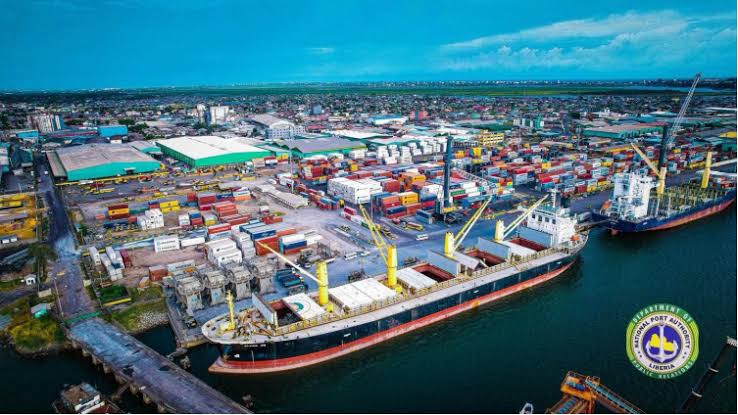
Monrovia — Vice President Jeremiah Koung has renewed attention on one of Liberia’s most persistent business complaints: the rising cost of shipping goods through the Freeport of Monrovia. For importers, wholesalers, and small traders, the port is still the country’s main trade gateway, but many say the total bill for clearing cargo has become too high to bear, especially when demurrage, storage, and cargo-handling charges are added to the final cost [1][2][4].
The concern is not new. Public reporting and business commentary have repeatedly pointed to complaints from traders, brokers, and diaspora Liberians who say the port’s fee structure discourages regular shipping and weakens confidence in using the Freeport for family or commercial consignments [2][3]. In 2021, APM Terminals announced a tariff increase that pushed a 20-foot import container, cleared within storage free time, to US$207.36 from US$189.08, showing how even modest adjustments can add pressure to businesses operating on thin margins [5][4].
Koung’s intervention reflects a broader debate over whether port reform has delivered efficiency at a fair cost. APM Terminals has also said tariff changes are tied to its concession arrangement, which began in 2010 and has continued through annual adjustments, including a 2026 increase of 4.73% [5][6]. Supporters of the concession argue that investment and modernization have improved operations, while critics say the port remains too expensive for ordinary traders and diaspora shippers [7][4].
Why diaspora shipping fell
Diaspora Liberians used to ship more frequently because sending packages home was both a practical support system and a family tradition. That pattern has weakened as shipping bills rose, port charges became less predictable, and handling delays increased the risk of extra fees [2][3]. When people expect a container, barrel, or parcel to attract multiple layers of charges at arrival, they are more likely to stop shipping regularly and instead wait until they can consolidate cargo or avoid the port entirely [2][4].
The problem is not only the listed tariff. Businesses also complain about demurrage, trucker costs, storage, and other add-ons that can turn a planned shipment into an expensive headache [2][8]. For diaspora Liberians, especially those sending consumer goods to relatives or small resale businesses, that creates a simple calculation: the emotional value of shipping home is high, but the financial penalty is often higher [3].
Shipping trend chart
Below is a trend chart showing estimated Freeport shipping activity from 2005 to 2026, built from publicly reported milestone years and interpolated to show the direction of change over time. The key public anchors include cargo and container gains after the 2010 concession era, such as 4,735 TEU in 2012, 76,075 TEU in 2014, and about 98,000 TEU in 2015 [9][10][11].
The chart suggests a sharp expansion after the APM-era modernization push, followed by a more gradual rise in recent years. This helps explain why the port remains central to Liberia’s trade, even as user complaints about cost continue to grow [11][10][12].

Cost before and after APM
A simple fee comparison shows how selected APM cargo charges changed after the 2021 tariff adjustment. The 20-foot container charge moved from US$189.08 to US$207.36, while the 45-foot import container charge moved from US$236.25 to US$213.75 under the same adjustment notice [5][4].
These figures do not capture every port-related expense, but they show why the debate is larger than one invoice line. Even when some charges fall, businesses often still face multiple costs across clearing, storage, inland movement, and customs processing, which shapes the broader impression that the Freeport is expensive [2][4][8].

What the debate means
Koung’s remarks matter because they speak to a bigger question in Liberia’s trade policy: how to keep the Freeport efficient without pricing out the very businesses that depend on it. The port is still the country’s main trade artery, handling the bulk of Liberia’s foreign trade and serving as the gateway for imports and essential consumer goods [11][10][12].
For government, the challenge is to balance revenue, modernization, and public trust. For business owners and diaspora shippers, the priority is simpler: lower friction, clearer fees, and predictable service that makes shipping worthwhile again [1][2][4].
Leave a Reply