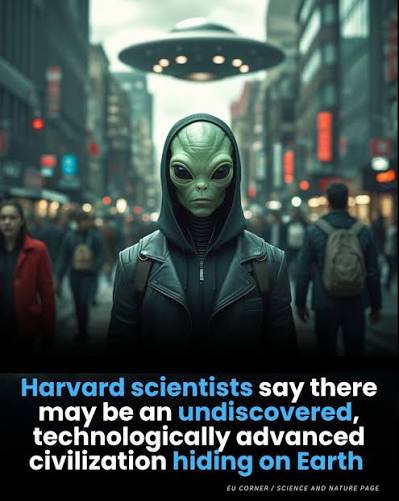
A provocative new study from researchers at Harvard University is challenging not just what we know about extraterrestrial life, but where we should be looking for it. The paper posits a startling theory: that aliens may not be arriving in glowing saucers, but could already be living on Earth, seamlessly integrated into human society.
The research, led by a team from the Harvard Human Flourishing Program, explores the possibility of “cryptoterrestrials”—highly intelligent beings that may have evolved on Earth in parallel to humans, arrived from another planet in the distant past, or even come from a different time or dimension. Their most audacious suggestion is that these entities could be living in disguise among human populations, operating from hidden bases underground, underwater, or even on the moon.
“The study examines the idea that UAP (Unidentified Anomalous Phenomena) may involve forms of non-human intelligence (NHI) that are already present in Earth’s environment,” the authors write, moving the conversation from distant stars to our own backyard.
Scientific Uproar and Raised Eyebrows
Unsurprisingly, the paper has ignited a firestorm of debate within the scientific community. Mainstream astrobiologists and physicists have been quick to label the hypotheses as highly speculative, lacking the empirical evidence required for serious academic consideration.
“The leap from ‘we don’t understand these UAP reports’ to ‘they are intelligent beings living among us’ is enormous and not supported by data,” countered Dr. Aisha Mensah, a Ghanaian astrophysicist based at the South African Astronomical Observatory. “Our scientific process demands evidence, and extraordinary claims require extraordinary proof. This paper offers conjecture, not proof.”
The Harvard authors themselves acknowledge the speculative nature of their work, presenting it as a “provocative thought experiment” intended to expand the scope of discussion around UAP and the search for non-human intelligence.
An African Perspective: Old Stories and New Science
Across the African continent, the conversation takes on a unique dimension. The notion of otherworldly beings or advanced entities sharing our world is not new within many indigenous knowledge systems and oral histories.
“From the Dogon people’s astronomical knowledge to countless cultural lore about ‘star people’ or beings from within the Earth, African traditions have long spoken of connections to intelligences beyond the ordinary,” noted cultural historian Tunde Oloruntoba from Nigeria. “What Harvard frames as a new hypothesis, many communities have engaged with as mythology or spiritual reality for millennia. The question is how to bridge that narrative gap with scientific rigor.”
The Verdict: Intriguing Thought Experiment or Credible Theory?
For now, the consensus remains firmly grounded. The “aliens among us” theory is viewed by most of the scientific establishment as science fiction, not science fact. Skeptics argue that the study risks diverting attention from more tangible, evidence-based research into the origins of life and the legitimate, ongoing search for microbial life or biosignatures on other planets.
However, the study has succeeded in its likely primary goal: forcing a broader, more imaginative conversation. It challenges the assumption that any non-human intelligence must be interstellar, suggesting we should also consider possibilities that are “next door” in dimensions we have yet to fully understand or explore.
As the global UAP discussion continues to evolve, this Harvard paper ensures that all possibilities, no matter how unconventional, are laid on the table for examination. For the Pan-African reader, it blends ancient storytelling with cutting-edge controversy, reminding us that the universe’s greatest mysteries might be hidden not in the far reaches of space, but in the subtle, unexplained details of our own world.
Leave a Reply