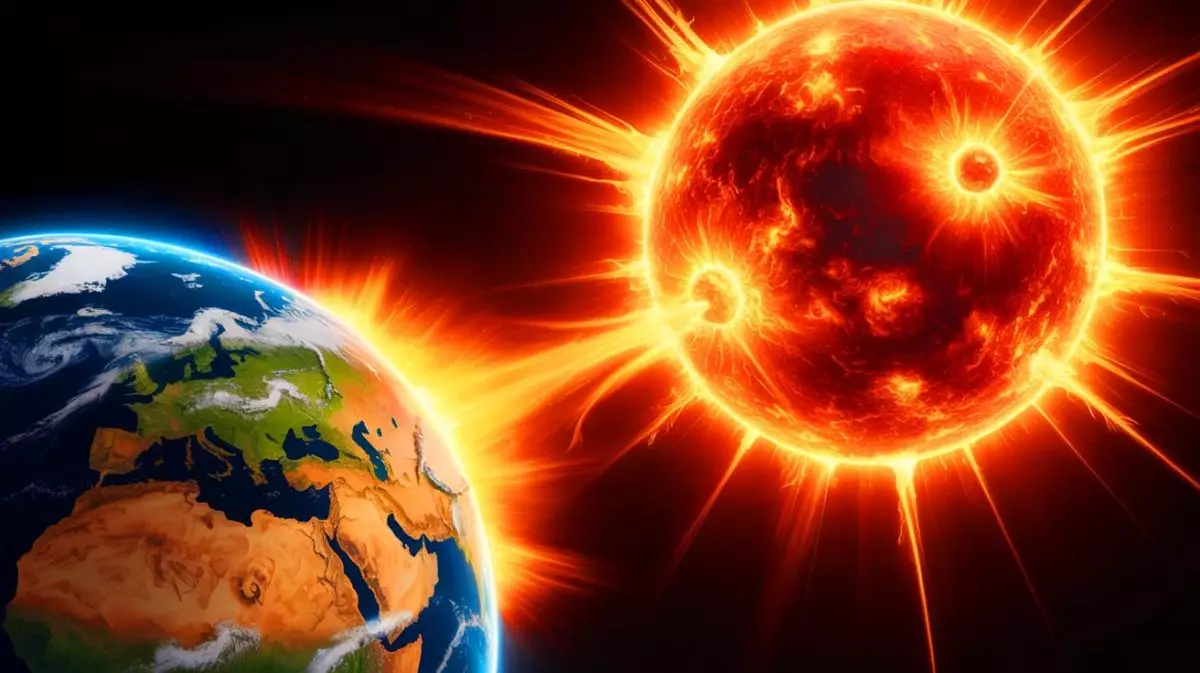
The Sun, our life-giving star, has been unusually active. In recent weeks, a series of powerful solar eruptions have sent waves of charged particles toward Earth, triggering geomagnetic storms that have disrupted technology and painted skies with auroras. For Africa, this isn’t just distant space weather; it has already caused significant radio communication blackouts across the continent. This article breaks down what happened, why it matters for Africa, and what we can expect next.
The Recent Surge: A Recap of Solar Fury
Solar activity operates on an 11-year cycle, and though we passed the peak (solar maximum) in late 2024, the Sun remains restless. The most significant recent event was an X5.1-class solar flare—the strongest of 2025 so far—that erupted on November 11. This blast of radiation caused a strong R3-level radio blackout, primarily affecting high-frequency communications across Africa and Europe during daylight hours.
This X5.1 flare was accompanied by a coronal mass ejection (CME), a massive cloud of magnetized solar plasma. It was part of a trio of X-class flares from the same active sunspot region between November 9-11. The CMEs from the first two flares combined and struck Earth on November 12, sparking a G4 (Severe) geomagnetic storm—the strongest of the year to date.
More recently, in a surprising turn, a G2 (Moderate) geomagnetic storm occurred on December 10, followed by continued unsettled conditions. This shows that space weather remains dynamic and at times unpredictable.
Understanding the Space Weather Scales
To make sense of the reports, it helps to understand the scales scientists use. Geomagnetic storms are rated on a G-Scale from G1 (Minor) to G5 (Extreme). Each level comes with potential technological impacts.
· G1 (Minor) & G2 (Moderate): These are common. They can cause weak power grid fluctuations and require corrective actions for some satellites. High-latitude radio signals may fade.
· G3 (Strong): Can trigger voltage corrections on power grids, cause intermittent satellite navigation issues, and make the aurora visible at lower latitudes.
· G4 (Severe) & G5 (Extreme): These are serious events. They pose a risk of widespread voltage control problems for power grids, can cause prolonged satellite navigation degradation, and may disrupt high-frequency radio communications over a wide area. The May 2024 G5 storm, for instance, caused tractors with GPS guidance to veer off course in the U.S. Midwest and forced trans-Atlantic flights to change routes.
Direct Impacts on Africa and Global Technology
The effects of these storms are not abstract. Africa has felt them directly, and our growing technological infrastructure is susceptible.
· Radio Blackouts: The immediate impact of strong solar flares is on the sunlit side of Earth. The X5.1 flare in November caused a major shortwave radio blackout over Africa. This type of disruption can affect aviation communication, maritime services, and emergency response networks that rely on high-frequency radio bands.
· Navigation & Satellite Systems: Geomagnetic storms disturb Earth’s magnetic field, which degrades the accuracy of Global Navigation Satellite Systems (GNSS), including GPS. This can impact aviation, maritime shipping, and the growing drone industry across the continent. During severe storms, errors can last for hours.
· Power Grids: While the most severe impacts on electrical grids are typically at higher latitudes, the interconnected nature of modern systems means induced currents can potentially affect infrastructure. Long-duration G2 storms can even cause transformer damage.
· Auroral Displays: While the spectacular Northern and Southern Lights are usually confined to polar regions, intense storms can push them toward the equator. During the May 2024 G5 storm, auroras were seen in Florida and Texas. For South Africa, sightings are rare but not impossible during extreme events under very dark, clear skies.
The African Perspective: Monitoring and Mitigation
African nations are not passive observers. The South African National Space Agency (SANSA) plays a crucial role. Its Space Weather Centre monitors solar activity and its impacts using a network of ground-based instruments across Africa, the Southern Ocean, and Antarctica.
SANSA collaborates with global centres to track storms and provide forecasts. The key insight from space weather experts is that while these storms cannot be prevented, their impacts can be managed. Industries that depend on vulnerable technologies—aviation, power distribution, satellite operators, and communications—are advised to implement mitigation strategies based on space weather forecasts.
What’s Next? The Solar Forecast
As of mid-December 2025, solar activity remains at moderate-to-high levels. Forecasters note a continued chance for M-class flares and an isolated possibility of another X-class flare. The geomagnetic field is expected to stay unsettled, with chances for minor G1 storms persisting.
Looking Ahead: Staying Informed
The Sun’s activity will continue to ebb and flow. For those wanting to stay updated:
· Follow updates from SANSA’s Space Weather Centre for regional focus.
· International resources like NOAA’s Space Weather Prediction Center and NASA provide global forecasts and explanations.
· When a significant storm is forecast, critical sectors will receive alerts to take defensive actions, such as putting power grids into a more stable configuration or delaying satellite maneuvers.
In conclusion, the recent solar storms are a powerful reminder that we live in the atmosphere of a dynamic star. For Africa, building resilience in our technological systems and supporting space weather monitoring are essential steps as we navigate an increasingly connected future under an active Sun.
Leave a Reply