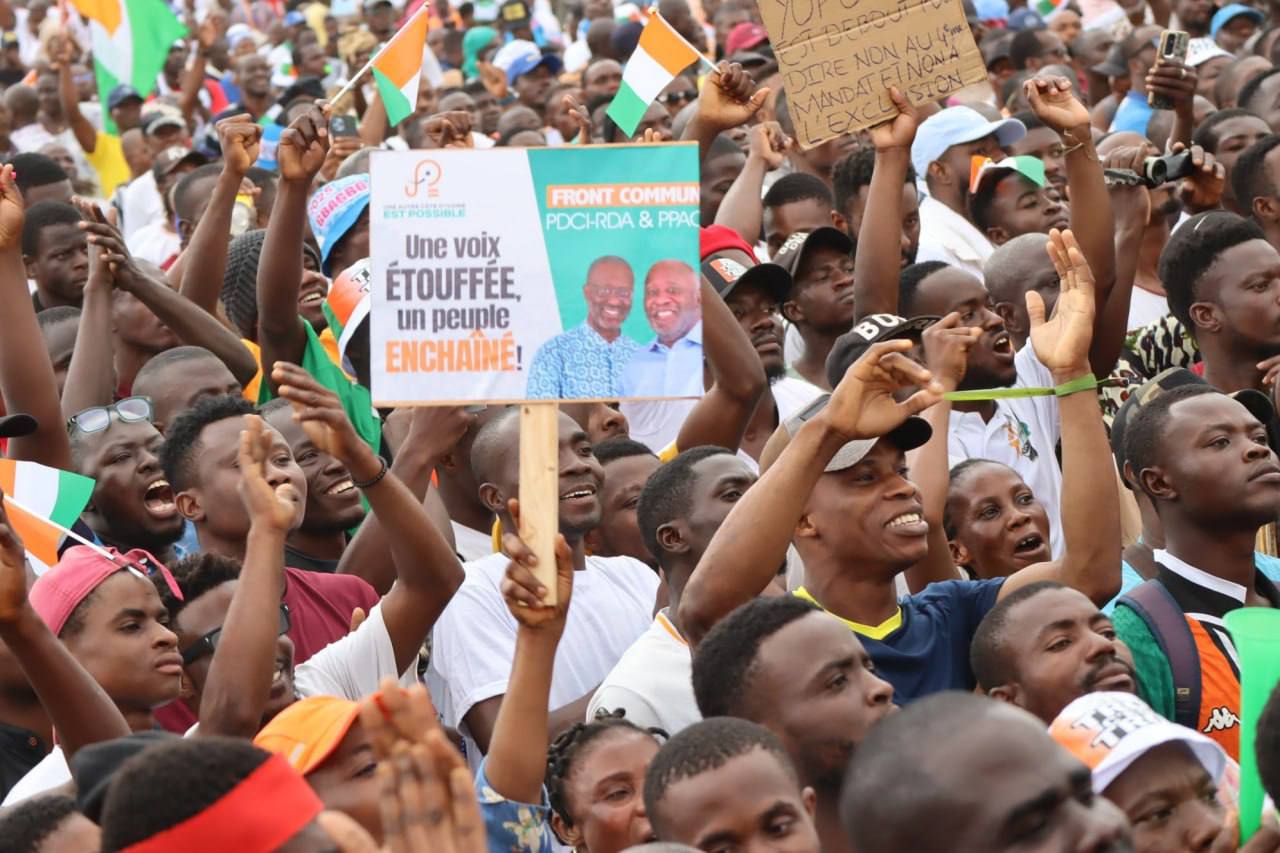
Abidjan, August 9, 2025 – In an extraordinary and rare show of unity, soldiers and civilians have taken
to the streets across Ivory Coast, forming a powerful alliance in protest against President Alassane Ouattara’s decision to pursue a controversial fourth term. The unfolding crisis reflects not only the anxieties of Ivorians but also the mounting democratic strain across West Africa.
What Are Protesters Demanding?
At the heart of the unrest lies deep frustration over the exclusion of key opposition figures from the October 25 presidential ballot. Thousands gathered—particularly in Abidjan’s Yopougon district—wielding banners reading “Enough is enough!” and “No true democracy without true justice.” Many voiced a singular demand: a revision of the electoral roll and the inclusion of all legitimate candidates, especially main challengers like Tidjane Thiam and Laurent Gbagbo .
Protesters have further decried Ouattara’s bid for a fourth term, criticizing his constitutional maneuvering and framing the moment as essential for restoring democratic fairness to the nation .
Who Is Officially Running?
Despite the exclusion of several prominent figures, the final list of candidates released June 4 includes:
Alassane Ouattara (RHDP) – the incumbent, who confirmed his candidacy in July .
Vincent Toh Bi Irié (Independent) – former Mayor of Abidjan.
Gnangbo Kacou (Independent) – former deputy.
Pascal Affi N’Guessan (FPI) – former Prime Minister and leader of the Ivorian Popular Front.
Simone Gbagbo (MGC) – former First Lady.
Ahoua Don Mello (Independent) – former minister .
Meanwhile, opposition heavyweights Tidjane Thiam, Laurent Gbagbo, Charles Blé Goudé, and Guillaume Soro were officially disqualified—sparking widespread outcry over what critics describe as manipulation of the electoral rules to maintain the status quo .
What Do These Protests Mean for Ivory Coast—and West Africa?
The protests in Ivory Coast are a flashpoint in a broader regional crisis: the erosion of democratic norms across West Africa. Ouattara’s constitutional revision to eliminate term limits echoes similar developments in countries like Togo, Cameroon, and the Central African Republic, where incumbents have entrenched themselves in power .
Moreover, the violence and political manipulation that marked past elections—most notably in 2010–11 following Gbagbo’s refusal to concede—loom large, stoking fears of renewed instability .
These protest dynamics pose a direct challenge to ECOWAS’s authority and its commitment to democratic governance. As coups and authoritarian entrenchment spread—with eight coups shaken West and Central Africa since 2020—the situation in Ivory Coast may either catalyze collective reform or further fracture the regional order .
—
In Summary
1. Protests have erupted, led by civilians and even soldiers, calling for democratic fairness and the reinclusion of barred opposition figures.
2. Confirmed candidate lineup includes Ouattara, Toh Bi Irié, Kacou, Affi N’Guessan, Simone Gbagbo, and Ahoua Don Mello.
3. Broader significance: The crisis highlights democratic backsliding in Ivory Coast and across West Africa, putting pressure on institutions like ECOWAS to uphold electoral integrity amid rising instability.
Leave a Reply