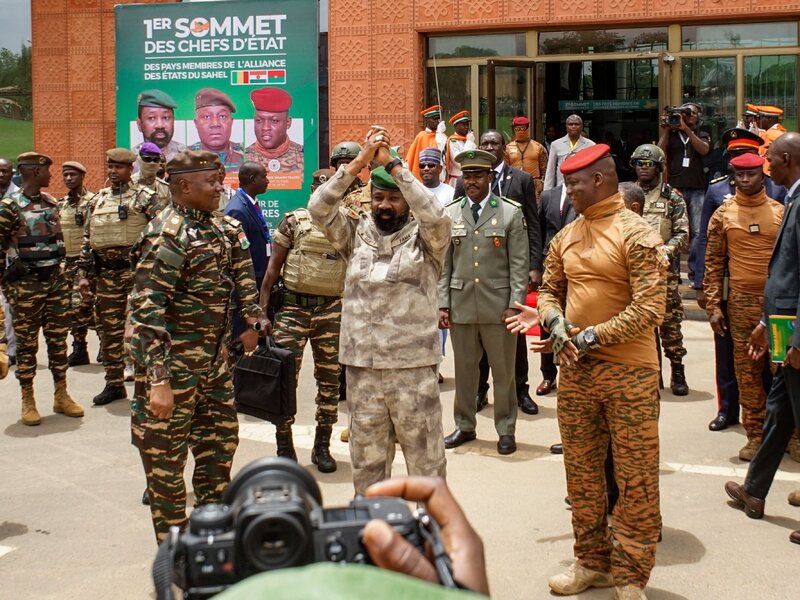
In a move signaling a major geopolitical realignment in West Africa, Russia has agreed to support Burkina Faso, Mali, and Niger in developing a shared communications satellite. This initiative, spearheaded by Moscow, aims to create an independent orbital infrastructure for the Alliance of Sahel States (AES), directly challenging traditional Western hegemony in the region’s critical security and communications architecture.
The planned satellite is designed to operate entirely outside Western control systems. Its core functions will include enhanced border surveillance across the vast and porous Sahelian territories, secure encrypted channels for government and military communications, and improved data relay to accelerate responses to jihadist insurgent threats. For the AES nations, all of which are governed by military-led transitions that have expelled French forces and contested Western partnerships, the project is a cornerstone of their declared pursuit of “strategic autonomy.”
“This satellite deal is more than a technical agreement; it is a decisive step in the materialization of a Moscow-Bamako-Ouagadougou-Niamey axis,” notes Dr. Abena Danso, a senior analyst with the Accra-based Institute for Security and Strategic Studies. “It moves Russian engagement beyond the deployment of Wagner—now Africa Corps—personnel, into the permanent and controlling realm of space-based infrastructure. Whoever controls the communications stack controls a vital nerve center.”

The agreement comes at a moment of profound transition. As traditional European and American counter-terrorism footprints shrink following the breakdown of security partnerships, a strategic vacuum has emerged. Russia has moved assertively to fill it, coupling military assistance with high-level technological and state-building offers. The satellite deal encapsulates this broader package, presenting Russia not merely as a security contractor, but as an enabler of sovereign capability.
For the Sahelian states, the potential benefits are clear: reduced reliance on foreign commercial or governmental satellites, greater control over their own data and intelligence, and a symbol of technological progress. However, analysts warn of long-term dependencies. The infrastructure, while owned by the AES, will likely be built, launched, and initially managed through Russian state-space agency Roscosmos or affiliated private entities. This creates a deep, structural link to Moscow for maintenance, upgrades, and potentially, data access protocols.
“This consolidates Russian influence in a way that boots on the ground do not,” adds Dr. Danso. “It intertwines the core operational security functions of these states with Russian technology. The question for the AES is whether this trade delivers true autonomy or exchanges one form of external dependence for another, albeit one currently more politically palatable.”
The project also marks a significant escalation in the “space race” over Africa, where constellations from the EU, China, the UK, and private companies like Starlink are already vying for influence. Russia’s entry into this domain with a dedicated, government-focused satellite for a specific political alliance is a novel and assertive tactic. It suggests a future where regional blocs in Africa may seek bespoke orbital assets aligned with their geopolitical patrons.
As the technical details are finalized, the development is being watched closely in capitals from Paris and Washington to Abuja and Algiers. It underscores a fragmented global order where African nations are increasingly exercising agency to choose partners, even as those partnerships come with their own sets of constraints and expectations. The success or failure of the AES satellite will likely become a case study in 21st-century African strategic partnerships, balancing the imperative of security with the complex realities of technological sovereignty.
Leave a Reply