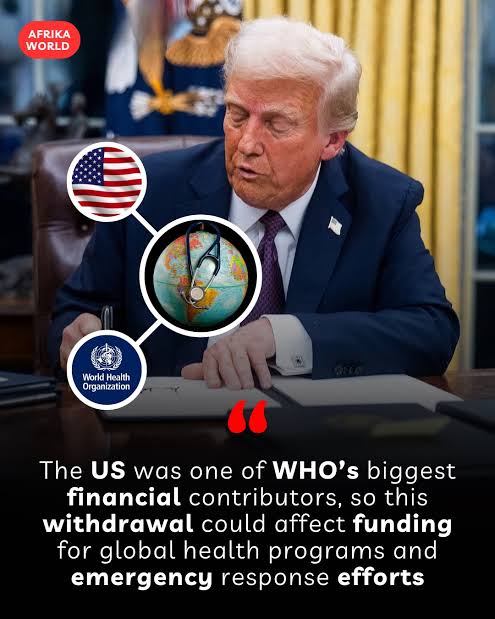
On January 22, 2026, the United States formally completed its withdrawal from the World Health Organization (WHO). The move, initiated by President Donald Trump a year prior, marks a seismic shift in global health governance. For Africa, a continent that has long relied on multilateral cooperation to combat infectious diseases, this rupture presents profound challenges for future pandemic prevention while simultaneously sparking urgent conversations about self-reliance and health sovereignty.
The Withdrawal: Reasons and Immediate Fallout
The U.S. government justified its exit by citing the WHO’s “mishandling of the COVID-19 pandemic,” including delayed emergency declarations and undue political influence from member states like China. Officials also criticized the U.S. financial burden, noting it was the organization’s largest contributor, providing between 12-25% of its budget.
However, the departure is legally contested. The U.S. is exiting without paying an estimated $260-$278 million in outstanding membership dues. WHO bylaws require settling all debts before a withdrawal is complete, but the organization has limited power to enforce this.
The withdrawal is part of a broader U.S. retrenchment from global health. Throughout 2025, the administration dramatically scaled back the U.S. Agency for International Development (USAID), folding its remains into the State Department. This “chainsaw” approach to aid had immediate, tragic consequences:
· 757,314 deaths (mostly children) have been attributed to these funding cuts according to one impact tracker.
· HIV clinics across sub-Saharan Africa were issued immediate “work stop” orders, cutting patients off from antiretroviral medicine.
· The landmark PEPFAR program, which supports 20 million people, was severely disrupted.
Direct Impacts on Africa: A New “America First” Strategy
To replace the multilateral system, the U.S. is pursuing a new “America First” Global Health Strategy built on bilateral memorandums of understanding (MOUs) with individual countries. At least 15 such agreements have been signed with African nations, including Kenya and Malawi.
These MOUs represent a fundamental and transactional shift:
· Conditional Aid: Health assistance is explicitly linked to rapid U.S. access to pathogen data and, in some cases, favorable trade or mineral access deals.
· Shifted Burden: The agreements plan for a rapid transfer of program responsibility to national governments by the second year, requiring them to build expensive surveillance and laboratory networks.
· Marginalized NGOs: The MOUs largely bypass established non-governmental organizations (NGOs) that have historically delivered community health services, except for specific Christian organizations mentioned in some agreements.
This piecemeal, bilateral model has been widely criticized. Public health experts warn it cannot replicate the WHO’s universal, coordinating role during cross-border outbreaks. As one former CDC official noted, the U.S. has staff in about 60 countries, “but that’s not every country, which is why an overarching structure like the WHO is important”.
The Future of Virus Prevention: Blinded Surveillance and Scientific Isolation
The long-term implications for detecting and stopping the next pandemic are severe. The U.S. withdrawal dismantles a key early-warning system.
How Disease Detection Changes:
· With U.S. in WHO: A novel pathogen emerges. The country’s WHO office is alerted, data is shared globally, and member states like the U.S. collaboratively assess the threat and mobilize a response.
· With U.S. Outside WHO: The same pathogen emerges. The U.S. has “no visibility” and “no access to the data”. It may not learn of the threat until it is too late, or it must rely on the political goodwill of individual nations to share information.
Specific critical systems are now compromised:
· Influenza Vaccines: The U.S. will no longer participate in the Global Influenza Surveillance and Response System (GISRS), the vital platform for sharing viral samples to develop effective annual flu vaccines.
· Polio Eradication: The Global Polio Eradication Initiative lost access to the U.S. CDC’s specialized polio laboratory.
· Research & Development: Scientific collaboration suffers, slowing progress on vaccine development and antimicrobial resistance.
As Lawrence Gostin of Georgetown University starkly warned, “When the next pandemic hits (and it will) the United States will not be prepared and our response will be slow and weak. That harms all Americans”—and by extension, its global partners.
African Responses: Crisis as a Catalyst for Sovereignty?
In the face of this disruption, African leaders and institutions are exploring a path away from dependency.
· Political Mobilization: The African Union, led by Rwanda’s President Paul Kagame, hosted a High-Level Health Financing Conference to discuss alternative domestic funding sources.
· Institutional Strengthening: The Africa CDC has launched a new financing guide, aiming to update national health plans in 30 countries and pilot innovative revenue mechanisms.
· Regional Production: There are renewed to support regional vaccine production hubs, like the Institut Pasteur de Dakar in Senegal, to secure supply chains.
This push for health sovereignty is a potential silver lining. As one analysis noted, “the withdrawal of US assistance has seen a renewed call from several African leaders to move away from aid dependency”.
A Fragmented Future
The U.S. withdrawal from the WHO creates a more dangerous and fragmented world. It weakens the only universal body for health cooperation, blind-siding the world’s largest economy to emerging threats and forcing nations into transactional, bilateral health deals.
For Africa, the immediate future is one of increased risk. The new U.S. strategy demands much while offering uncertain, conditional support. However, this profound crisis is also forcing a necessary and overdue conversation. The ultimate legacy of this withdrawal for Africa may depend on whether the continent can harness this moment of peril to build truly resilient, self-determined health systems capable of protecting its people, with or without the support of a wavering superpower.
Leave a Reply