
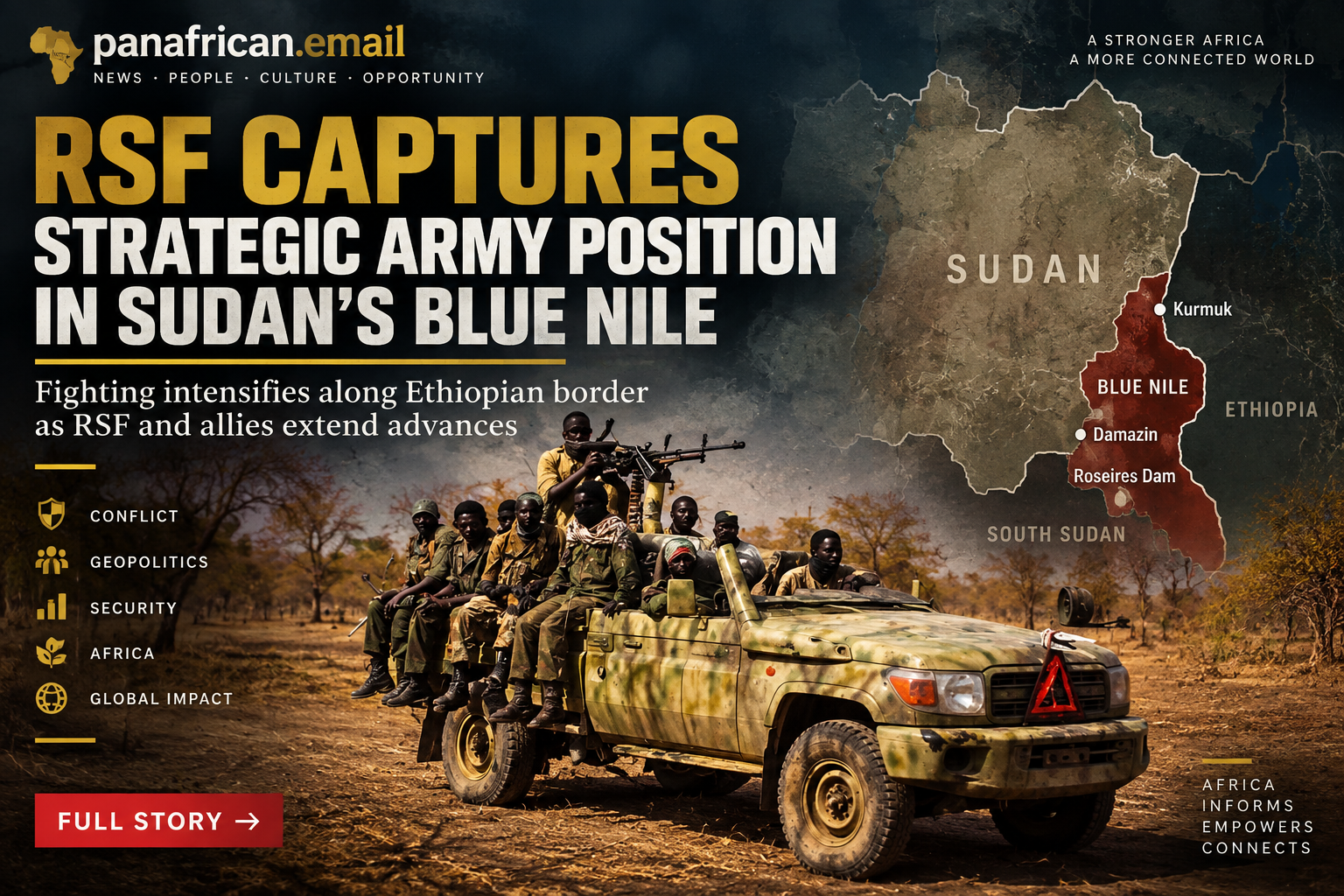
BLUE NILE, SUDAN — Sudan’s war is opening another dangerous front along the country’s southeastern border, where the Rapid Support Forces (RSF) and allied fighters have captured a strategic Sudanese army position near Kurmuk following days of heavy fighting.
RSF forces said they seized Jabal Kadam, in the Bakori area east of Kurmuk, on Wednesday after clashes with the Sudanese Armed Forces (SAF) and allied formations. Footage circulated by RSF-linked accounts appeared to show fighters inside military positions at the site, alongside captured vehicles, ammunition and other equipment.
The development represents another reported gain for the RSF and its allies in Blue Nile state, an area that has become increasingly important to the wider war because of its proximity to Ethiopia, its transportation corridors and the presence of the strategically significant Roseires Dam.
Competing Claims Over Jabal Kadam
The reported capture followed several days of conflicting claims from the two sides.
Sudan’s 4th Infantry Division had previously said it successfully repelled an RSF assault on Jabal Kadam and remained in control of the position. Pro-army platforms also claimed that government forces had destroyed or intercepted RSF drones and captured military equipment.
RSF fighters subsequently released footage that appeared to place them inside the army’s positions at Jabal Kadam.
Sudan War Monitor reported that the footage showed RSF fighters displaying military vehicles, ammunition and other equipment captured at the site. The organization said the footage provided evidence that the RSF had taken the position, despite earlier army claims.
Because battlefield information from Sudan is frequently difficult to independently verify, the precise sequence of events and casualty figures remain unclear.
Allegations Involving Captured Fighters
Some of the footage circulating after the battle showed detained fighters whom RSF members identified as Tigrayan combatants allegedly fighting alongside the Sudanese military.
Their identities, affiliations and circumstances could not be independently established from the footage.
Another video appeared to show a detainee being beaten following his capture. RSF fighters identified the man as an alleged officer of the Tigray People’s Liberation Front (TPLF) who they claimed had been fighting alongside the SAF.
Sudan War Monitor said it could not independently verify the man’s identity, affiliation or whether he had participated in combat alongside the Sudanese army.
The allegations highlight the increasingly complex nature of Sudan’s conflict, in which local militias, regional armed groups and foreign-linked actors have become intertwined with the country’s two principal military forces.
Al-Baraa bin Malik Militia Reports Losses
The Islamist Al-Baraa bin Malik Corps, which fights alongside Sudan’s military, announced the deaths of six members during the fighting around Jabal Kadam.
Those identified by the militia included Amjad al-Tom, Ammar Mohamed al-Mahi, al-Miqdad Yousif al-Nour, Amjad Mahdi al-Tom, Abdulmajid Kamal Abdulmajid and Hassan Awad al-Karim Bashir.
RSF-linked accounts also circulated documents belonging to Mohamed Elias Hassan Mohamed, known as “al-Shaigi,” described as an active member of the Al-Baraa bin Malik Corps. Those accounts claimed he had been killed, although his death has not been independently confirmed.
Why Jabal Kadam Matters
Jabal Kadam sits along an important military corridor connecting Kurmuk, Geissan and Roseires.
The position lies west of the Blue Nile and close to Sudan’s border with Ethiopia, giving it potential importance for surveillance, military movement and control of approaches toward Kurmuk.
A Sudanese military analyst interviewed by Radio Tamazuj described the area as strategically significant because of its location near the Ethiopian frontier.
The reported capture also comes after the RSF and the Sudan People’s Liberation Movement-North (SPLM-N) expanded their presence in Blue Nile.
The alliance has claimed a series of battlefield gains in recent weeks, increasing pressure on government positions around Kurmuk and Damazin.
Pressure Builds Around Damazin and Roseires
In late August, the RSF-SPLM-N alliance claimed control of the Bakori and Sirkum garrisons southeast of Damazin.
The alliance subsequently announced additional advances around Kurmuk, while the Sudanese military reportedly moved reinforcements into Blue Nile to strengthen the 4th Infantry Division and slow the offensive.
The developments are particularly significant because Damazin and the Roseires area are central to the security of Blue Nile.
The region is home to the Roseires Dam, one of Sudan’s major hydroelectric installations and a critical component of the country’s electricity and water infrastructure.
Any sustained expansion of fighting around the dam and surrounding military corridors could therefore have consequences extending well beyond the immediate battlefield.
Sudan’s War Enters Another Phase
Sudan’s war began in April 2023 when fighting erupted between the Sudanese Armed Forces and the Rapid Support Forces.
What began as a struggle for control of the national government has since fragmented across multiple fronts, drawing in regional armed groups and reshaping alliances throughout the country.
For much of the conflict, the major battles were concentrated in Khartoum, Darfur and other western and central regions. Blue Nile has increasingly emerged as another important theater, particularly as the RSF and SPLM-N expand their operations toward Sudan’s southeastern borders.
The latest fighting around Jabal Kadam illustrates the growing importance of that frontier.
With Ethiopia and South Sudan bordering the region, and with major infrastructure such as the Roseires Dam nearby, control of Blue Nile carries military, economic and geopolitical significance.
The battle for Jabal Kadam is therefore more than another contest over an isolated garrison. It forms part of a broader struggle for control of southeastern Sudan, its border corridors and the strategic infrastructure connecting the Blue Nile region to the rest of the country.
As fighting continues, independent verification of battlefield claims, civilian conditions and reports of abuses will remain essential in understanding the rapidly changing situation on Sudan’s southeastern front.
Leave a Reply