
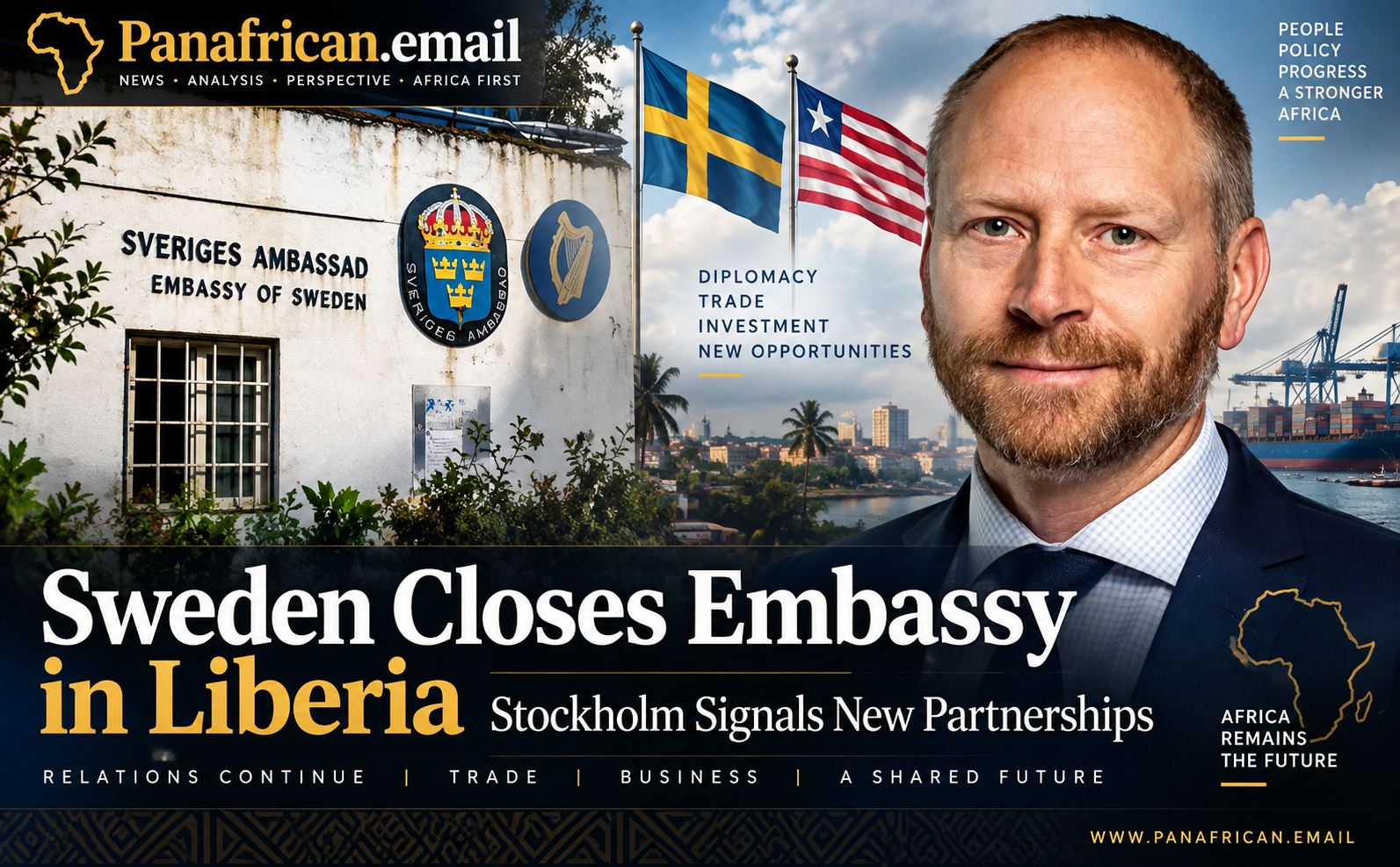
MONROVIA, Liberia — Sweden has officially closed its embassy in Liberia, bringing an end to the country’s resident diplomatic mission in Monrovia while signaling that the relationship between the two countries is not coming to an end.
The closure marks a significant transition in a relationship that has developed over decades through diplomacy, development cooperation, trade, mining, humanitarian assistance and international peacekeeping.
In an interview with Anthony Stephens, the Swedish Ambassador discussed Sweden’s continued interest in maintaining relations with Liberia and the possibility of developing new forms of partnership beyond traditional development assistance.
The transition comes as Sweden phases out its bilateral development cooperation with Liberia. According to Sweden’s official statement, the decision to close the embassy was driven by reductions in Sweden’s overall development-cooperation budget and was not linked to policies or events in Liberia.
The End of an Era in Monrovia
Sweden’s diplomatic presence in Liberia has deep historical roots. The Swedish Embassy was established in Monrovia in 1961, although relations between Liberia and Sweden extend further back. Sweden’s official history of the relationship points to a trade agreement between Liberia and the union between Sweden and Norway dating to 1864.
During the twentieth century, Swedish commercial interests became particularly visible through the Liberian-American-Swedish Mining Company (LAMCO), which operated in Liberia for decades and became one of the country’s major companies during the 1960s through the 1980s. Swedish citizens worked in Liberia during that period, creating another layer of people-to-people and commercial ties between the two countries.
Sweden also supported Liberia during major periods of crisis, including the Ebola outbreak, and contributed personnel to the United Nations Mission in Liberia, or UNMIL.
The embassy therefore represented more than a diplomatic office. It became part of a much longer story connecting Liberia to Scandinavian development cooperation, business and international diplomacy.

Why Did Sweden Close the Embassy?
The Swedish government announced in December 2025 that it would close its embassies in Liberia, Bolivia and Zimbabwe during 2026. Stockholm said the decisions were part of changes to Sweden’s foreign service and development-assistance priorities, including a greater allocation of resources toward Ukraine.
For Liberia specifically, Sweden said bilateral development cooperation would be phased out and embassy operations would end by August 2026.
Sweden emphasized that the decision should not be interpreted as a diplomatic break with Liberia.
The Swedish government stated that diplomatic relations would continue and that Liberia would remain an important partner in Sweden’s broader foreign policy. It also said Sweden intended to strengthen relations beyond development cooperation, particularly through trade and business relations.
That distinction is important.
An embassy can close without diplomatic relations ending. In this case, Sweden is changing the structure and emphasis of its engagement rather than formally ending its relationship with Liberia.
From Aid to Economic Partnership?
The Ambassador’s comments to Anthony Stephens point toward a potentially important question for Liberia: what could a post-development-assistance relationship between the two countries look like?
Sweden’s own documentation has previously identified several areas where Swedish companies could potentially engage the Liberian economy, including information and communications technology, mining, renewable energy and transportation.
These sectors are significant for Liberia because they correspond with some of the country’s long-term development needs.
Digital connectivity, for example, can influence everything from financial services and education to government administration and commerce. Renewable energy has implications for electricity access and productive businesses. Mining remains central to Liberia’s export economy, while transportation infrastructure is critical to moving people and commodities across the country.
A shift toward commercial cooperation could therefore involve Swedish companies, Liberian entrepreneurs, investment institutions, universities and government agencies working through different channels than traditional aid programs.

Monrovia remains a significant diplomatic hub in West Africa, with 31 foreign diplomatic representations listed in the capital. Sweden’s embassy closure changes the composition of this diplomatic network while Stockholm says relations with Liberia will continue through other channels.
What Happens to Swedish Development Assistance?
The end of the embassy does not mean that all Swedish-linked assistance to Liberia disappears.
Sweden has specifically stated that its support for Liberia through multilateral organizations and the European Union will not be affected by the closure.
That distinction matters because development cooperation can continue through international institutions even when a country no longer maintains a resident bilateral development mission.
Under Sweden’s previous 2021–2025 development strategy for Liberia, cooperation covered areas including democracy, human rights, gender equality, rule of law, peaceful and inclusive societies, economic development, environmental protection, climate resilience and sustainable management of natural resources. The strategy allocated approximately SEK 1.85 billion over five years.
Sweden has therefore been a substantial development partner for Liberia, making the transition significant for organizations and programs that depended on direct Swedish bilateral support.
A New Chapter for Liberia-Sweden Relations
The closure also raises a broader issue about how African countries engage with traditional development partners.
For decades, relationships between African states and European countries have often been structured around development assistance. But African economies are increasingly seeking relationships based on investment, trade, technology transfer, industrialization and private-sector development.
Liberia is no exception.
The country’s natural resources, young population, emerging digital economy, agricultural potential and strategic Atlantic location provide opportunities for international businesses.
Sweden’s stated intention to pursue stronger trade and business relations could therefore open a different chapter in the bilateral relationship—one in which private investment and commercial partnerships play a larger role.
But turning that possibility into reality will depend on practical conditions: investment certainty, infrastructure, access to finance, reliable electricity, digital connectivity, skilled workers, transparent regulation and mechanisms that allow Liberian and Swedish businesses to find one another.
The LAMCO Legacy
Few examples illustrate the historical connection between Sweden and Liberia better than LAMCO.
The mining company brought Swedish and Liberian workers together around one of Liberia’s most important natural resources. Its history remains embedded in the country’s economic and industrial story, particularly in Nimba County.
Today, Liberia’s mining sector is again attracting international attention, although the structure of the industry has changed considerably since the LAMCO era.
The historical connection raises an interesting question: can the next generation of Sweden-Liberia economic cooperation move beyond the extractive model toward broader partnerships involving technology, renewable energy, manufacturing, logistics and knowledge industries?
That question may become increasingly important as both countries redefine their relationship.
Sweden’s Message: Relations Continue
The Swedish government’s official message has been consistent: closing the embassy does not mean abandoning Liberia.
Sweden has described its relationship with Liberia as one based on long-standing ties and shared priorities and has pledged to make efforts to preserve those relations despite the end of the resident embassy.
For Liberia, the challenge will be to determine how that diplomatic goodwill can translate into tangible economic and institutional relationships.
For Sweden, the challenge will be maintaining visibility and engagement without a permanent diplomatic mission in Monrovia.
The closure therefore represents both an ending and a transition.
The Swedish flag may no longer fly over a resident embassy in Monrovia, but the relationship between Liberia and Sweden continues through diplomatic channels, multilateral institutions, business connections and the historical ties built over more than a century.
Looking Beyond the Embassy

The next phase of Liberia-Sweden relations will ultimately be measured not by the size of diplomatic missions but by the substance of cooperation.
Can Swedish technology companies find opportunities in Liberia?
Can Liberian entrepreneurs gain access to Swedish markets and investment networks?
Can renewable-energy partnerships help expand electricity access?
Can Swedish and Liberian institutions cooperate on education, digital transformation and skills development?
Can the historical relationship created through mining evolve into a broader economic partnership?
These are the questions that now stand before Monrovia and Stockholm.
The closure of the Swedish Embassy is therefore not simply a story about a diplomatic building shutting its doors. It is a story about how an established relationship adapts to a changing international system.
For Liberia, it marks the conclusion of an important chapter in Swedish development cooperation.
For Sweden, it represents a restructuring of its presence and priorities.
And for both countries, the next chapter may increasingly be written through trade, investment, technology, entrepreneurship and direct economic partnerships rather than through traditional bilateral aid alone.
The relationship has changed—but it has not ended.
Sources: Sweden Abroad and the Swedish Government.
Leave a Reply