
By Panafrican.email
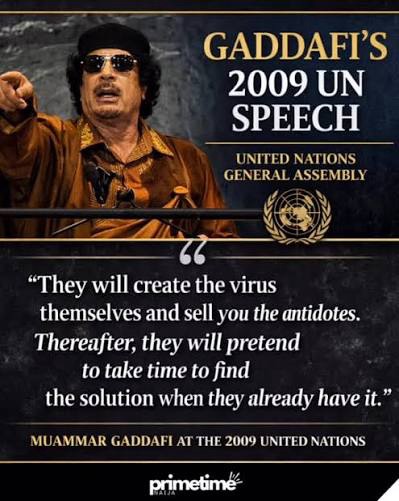
On September 23, 2009, Libyan leader Muammar Al-Qadhafi delivered one of the most unconventional speeches of the 64th session of the United Nations General Assembly.
Speaking in New York, Qadhafi used his appearance before the world’s premier international diplomatic institution to challenge the structure of the United Nations, the authority of the Security Council, the global economic system and what he described as the commercialization of essential human needs.
His speech came during a period of international concern over the emergence of the H1N1 influenza virus, commonly referred to at the time as swine flu. The outbreak had already become a major international public-health issue, with the World Health Organization coordinating the global response. (United Nations)
More than a decade later, excerpts circulating online from Qadhafi’s speech continue to generate debate, particularly his remarks about vaccines, pharmaceutical companies and the possibility that viruses could be created or manipulated for economic or military purposes.
A Speech Against the Existing International Order
Qadhafi did not approach the United Nations podium as a conventional diplomat.
Instead, he questioned the historical foundations of the organization itself.
In the official United Nations record of the September 23, 2009 session, Qadhafi argued that the structure of the UN reflected the power arrangements created after the Second World War. He specifically criticized the permanent membership and veto authority of the Security Council. (Official Document System)
His argument was essentially that much of the international system had been constructed by powerful states at a time when large portions of the world’s population had little influence over the institutions being created.
That criticism was particularly significant coming from an African leader who was also speaking in his capacity as a representative of the African Union.
The UN’s official record identifies Qadhafi’s address as part of the General Debate of the 64th session and preserves the speech in the organization’s documentary archive. (United Nations)
The H1N1 Pandemic and Qadhafi’s Warning
The most controversial portion of the discussion concerns Qadhafi’s comments about influenza and vaccines.
At the time, H1N1 was spreading internationally. The United Nations had already acknowledged the seriousness of the outbreak. In April 2009, Secretary-General Ban Ki-moon described the emergence of the new influenza virus as a potential pandemic and warned that poorer nations could be particularly vulnerable. (United Nations)
By June 2009, the WHO had raised its pandemic alert to Phase 6, formally recognizing the geographic spread of the virus. (United Nations)
Against that background, Qadhafi questioned the economics of pandemic response.
The argument attributed to him in widely circulated recordings and transcripts was that pharmaceutical companies could potentially profit from the production and sale of vaccines during health emergencies.
He went further, alleging that powerful interests could manufacture or spread viruses in order to create demand for vaccines.
That is an extraordinary allegation.
It is important, however, to distinguish Qadhafi’s accusation from an established historical or scientific fact. The available UN documentation establishes that he discussed H1N1 and raised questions about viruses and vaccines, but it does not establish that pharmaceutical companies or intelligence agencies deliberately created and released H1N1 to generate vaccine profits.
“Medicine Should Not Be a Commodity”
At the heart of Qadhafi’s argument was a broader philosophical question:
Should medicine be treated as a commodity or as a fundamental human necessity?
Qadhafi invoked his political philosophy and the Green Book, the ideological text associated with his government.
His argument was that essential medicines and vaccines should be available to everyone rather than being restricted by purchasing power.
In the version of the remarks widely circulated online, Qadhafi argued that vaccines should not be sold and that medicines should be provided freely.
This idea was not simply a question about vaccines.
It reflected a much larger debate over healthcare inequality.
For many developing countries, particularly countries in Africa, access to medicines has historically been affected by income, infrastructure, manufacturing capacity, intellectual-property rules, supply chains and international financing.
During the 2009 H1N1 outbreak, the United Nations itself emphasized the vulnerability of poorer countries and discussed efforts to ensure that developing countries could obtain vaccines at affordable prices. (United Nations)
That historical context makes Qadhafi’s remarks particularly interesting.
Africa and the Question of Medical Sovereignty
The deeper African question is not simply whether Qadhafi was correct about the origins of a particular virus.
The more enduring issue is who controls Africa’s ability to protect its own population during a health emergency?
When a pandemic occurs, African countries can become dependent on international manufacturers for vaccines, medicines, diagnostic equipment and other supplies.
That dependency raises questions about:
- Pharmaceutical manufacturing capacity
- Vaccine production in Africa
- Medical research infrastructure
- Intellectual-property rights
- Technology transfer
- Pharmaceutical pricing
- Public-health financing
- Supply-chain security
- Emergency preparedness
- African ownership of medical data and research
These questions became particularly prominent during later global health emergencies.
Qadhafi’s speech can therefore be read as part of a much broader argument about economic sovereignty: a nation that cannot manufacture essential goods during a crisis can become dependent on the countries and corporations that control their production.
The UN Record and the Online Claim
A claim frequently repeated alongside recordings of Qadhafi’s speech says that the United Nations removed the English transcript of his address and that Western media organizations subsequently removed the transcript from their archives.
The historical record requires some qualification.
The United Nations currently maintains documentation of Qadhafi’s September 23, 2009 address. Its General Assembly page identifies the Libyan leader’s statement and provides links to the speech’s audio/video material. (United Nations)
The UN Digital Library also contains the official meeting record for the session, including Qadhafi’s address. (Digital Library)
The UN’s documentary record therefore remains accessible.
That does not resolve every question surrounding versions of the speech that have circulated online. Different recordings, translations and unofficial transcripts can contain significant differences, particularly because Qadhafi delivered the address in Arabic and interpretation was involved.
For that reason, quotations attributed to him should ideally be checked against the official UN record or a contemporaneous recording rather than relying solely on social-media posts.
What Qadhafi Was Really Challenging
The most important part of the speech may not be the most controversial allegation.
Qadhafi was challenging the underlying structure of global power.
His questions extended across several interconnected systems:
Who controls international institutions?
Who controls money?
Who controls natural resources?
Who controls information?
Who controls medicine?
Who controls technology?
And who ultimately decides what is considered essential for human life?
Those questions remain relevant to Africa.
The continent possesses enormous natural resources, a large and youthful population and substantial scientific potential. Yet many African states continue to rely heavily on external suppliers for strategic products, including medicines and medical technologies.
That creates a paradox.
Africa can possess the raw materials required to produce modern goods while simultaneously importing many of the finished products required by its own population.
From Political Speech to African Strategy
Whatever one’s assessment of Qadhafi’s broader political legacy, his 2009 address provides material for a continuing discussion about African sovereignty.
The lesson does not have to depend upon accepting every allegation contained in the speech.
Instead, the speech can be examined as a challenge:
What would Africa look like if African countries possessed the scientific, industrial and financial capacity to manufacture the medicines and vaccines required during a major emergency?
That question is much bigger than Qadhafi.
It concerns the future of African universities, pharmaceutical companies, laboratories, biotechnology companies, governments and entrepreneurs.
It also concerns whether African countries can move from being primarily consumers of global health products to becoming major producers of them.
The Debate Continues
Qadhafi’s United Nations speech remains controversial because it brought together several subjects that are rarely discussed together: geopolitics, capitalism, medicine, pharmaceutical companies, international institutions and African sovereignty.
His claims about deliberately created viruses should be treated as allegations rather than established facts.
But his broader question about whether essential medicines should be accessible to all remains a legitimate subject for public debate.
The history of the H1N1 outbreak demonstrates that international health crises can quickly become questions of economics, diplomacy and inequality. The United Nations itself recognized the particular vulnerability of poorer nations during the 2009 outbreak. (United Nations)
More than a decade after Qadhafi stood before the General Assembly, Africa continues to face the strategic question he placed before the international system:
Can a continent truly be sovereign if it cannot guarantee access to the essential medicines and technologies its people need?
That question remains open.
And perhaps that is why the speech continues to circulate.
Panafrican.email — African information, African perspective, global context.
Sources and historical references
The United Nations’ official archive identifies Qadhafi’s September 23, 2009 General Assembly appearance and retains documentation of the address. (United Nations)
The United Nations’ contemporary records also document the 2009 H1N1 outbreak, including the international response, concerns about developing countries and efforts to facilitate access to vaccines. (United Nations)
Leave a Reply