
By Panafrican.email News Desk
Dakar, Senegal — Special Report
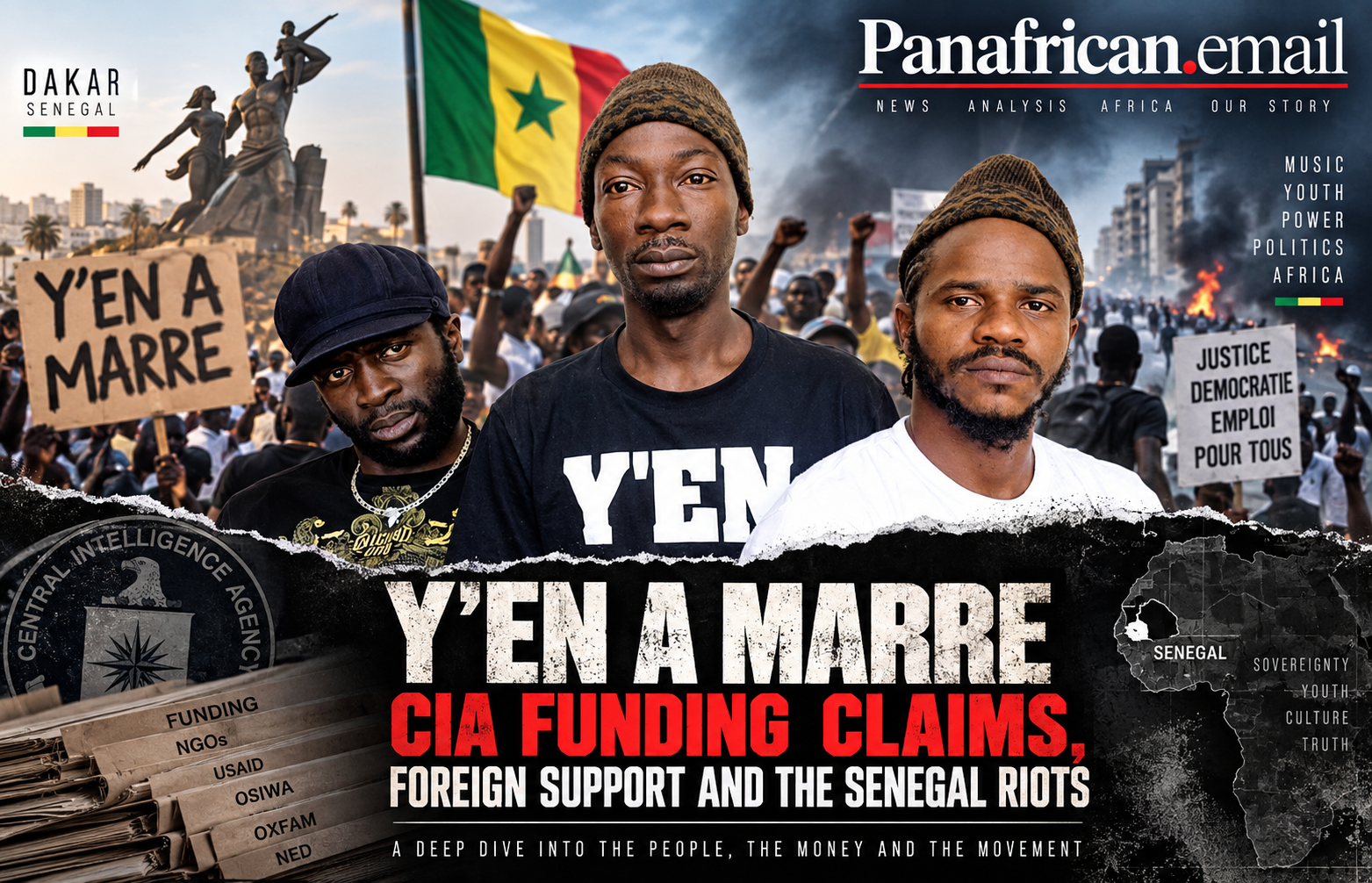
A decade and a half after Senegal’s youth-led Y’en a Marre movement emerged from the country’s hip-hop scene, questions about who financed the movement—and whether foreign governments were behind its political mobilization—continue to circulate.
The movement, whose name translates roughly to “We’re Fed Up,” was founded in 2011 by journalists and rappers including members of the hip-hop group Keur Gui Crew, notably Thiat and Kilifeu. It became one of the most recognizable youth movements in Senegal during the political crisis surrounding President Abdoulaye Wade’s attempt to seek a third presidential term.
But one claim requires particular caution: there is evidence of foreign and U.S.-linked funding connected to Y’en a Marre and its activities, but the sources reviewed for this report do not establish that the CIA directly funded the rappers or ordered the Senegalese riots. That distinction matters.
What the documented record does show is a network involving international NGOs, foundations, U.S.-government-supported democracy programs and civil-society organizations—alongside a genuinely Senegalese protest movement that developed amid electricity shortages, unemployment, political controversy and opposition to constitutional changes.
The movement was born in Senegal’s hip-hop culture

Y’en a Marre did not begin as an American government project in the historical accounts examined for this article.
The movement emerged in 2011 amid widespread frustration over electricity blackouts, unemployment, corruption allegations and political uncertainty. The Keur Gui rappers used music and popular culture to reach young Senegalese who often felt disconnected from conventional politics.
The National Endowment for Democracy (NED), a U.S.-based democracy-promotion organization, itself describes Y’en a Marre as having emerged in 2011 as a grassroots campaign against injustice and inequality. According to NED’s account, the movement was initially spearheaded by Keur Gui in response to local power outages before becoming involved in opposition to Wade’s attempt to remain in office for a third term.
That history is important because it establishes two facts simultaneously:
Y’en a Marre was a genuine Senegalese grassroots movement—and it subsequently developed relationships with foreign-funded civil-society organizations.
Those two facts are not mutually exclusive.
The 2011 crisis that brought Y’en a Marre to national attention
Senegal was already experiencing significant social pressure before the major demonstrations.
Electricity shortages were particularly important. The country’s urban population regularly experienced blackouts, while unemployment and economic frustration affected young people disproportionately.
Then came the political question.
President Abdoulaye Wade had announced his intention to seek another term despite controversy surrounding Senegal’s constitutional term limits.
In June 2011, protests erupted in Dakar after Wade’s government proposed constitutional changes involving the presidential election system and the creation of a vice-presidential position.
The protests became violent, forcing the government to withdraw the proposal.
A Congressional Research Service report on Senegal later described the June 2011 protests and subsequent unrest, noting that demonstrations were followed by riots over electricity shortages in Dakar and that sporadic anti-Wade protests continued into the period leading to the 2012 presidential election.
This was the environment in which Y’en a Marre transformed from a group of politically engaged musicians into a major youth mobilization network.
Who actually funded Y’en a Marre?

This is where the story becomes considerably more complicated.
There was foreign funding.
But foreign funding is not automatically CIA funding.
Among the organizations documented as supporting projects connected to Y’en a Marre were:
1. Oxfam
Oxfam became one of Y’en a Marre’s documented international partners.
A study published by Alternatives Humanitaires reproduced Oxfam’s explanation of its relationship with the movement. Oxfam said its partnership focused on governance and youth participation and that one objective was establishing mechanisms for civic oversight of public action. Because Y’en a Marre was not yet legally recognized when the partnership was established, Enda Lead managed the funding.
Contemporary reporting by Le Monde likewise identified Oxfam as one of the organizations providing support to Y’en a Marre.
2. OSIWA — Open Society Initiative for West Africa
Another major organization associated with Y’en a Marre was OSIWA, the Open Society Initiative for West Africa.
OSIWA is part of the Open Society network established by billionaire philanthropist George Soros.
Reporting from Africa XXI says Oxfam and OSIWA contributed during Y’en a Marre’s early years, while later programs received support from organizations including the Hewlett Foundation and Spanish local authorities.
3. Enda Lead / Lead Afrique Francophone
Enda Lead played an important administrative role because Y’en a Marre initially did not have the legal status necessary to directly manage some external funding.
Y’en a Marre members themselves explained that project funds were administered through Enda Lead, with expenditures documented through project budgets, travel expenses and receipts.
This administrative structure became politically controversial several years later.
4. USAID
The U.S. Agency for International Development (USAID) also appears in the documented history surrounding Y’en a Marre and its regional activities.
A 2015 Le Monde report described Y’en a Marre members traveling to the Democratic Republic of Congo as part of activities involving the Congolese movement Filimbi, with the trip supported through USAID-related arrangements.
Importantly, that evidence concerns USAID, not the CIA.
USAID and the CIA are separate U.S. government institutions with different mandates.
5. National Endowment for Democracy
The National Endowment for Democracy (NED) also had a documented relationship with members of Y’en a Marre.
In 2014, NED’s International Forum for Democratic Studies hosted Thiat for a program examining Y’en a Marre’s youth engagement and its role in Senegal’s political environment. NED describes the movement’s origins and its mobilization around the 2012 election on its own website.
Again, this establishes a relationship with a U.S.-based democracy-promotion organization.
It does not by itself establish CIA financing.
So, was the CIA funding Senegalese rappers?
This is the central question behind the popular version of the story.
Based on the documentary sources reviewed for this article, we cannot substantiate the claim that the CIA directly financed Y’en a Marre or paid Senegalese rappers to create the 2011–2012 unrest.
What can be documented is a broader ecosystem of international support.
That distinction is frequently lost online.
A movement can receive money from NGOs that receive money from governments or international foundations without evidence demonstrating that an intelligence agency secretly controlled the movement.
The available evidence establishes:
Senegalese rappers → Y’en a Marre → civil-society projects → foreign NGO/foundation funding → some U.S./European institutional support.
It does not establish:
CIA → secret payments → rappers → manufactured Senegalese riots.
That second chain requires evidence that has not been demonstrated by the sources reviewed here.
But why did people suspect foreign interference?
The suspicion did not emerge from nowhere.
Foreign financing became one of the most controversial aspects of Y’en a Marre’s later history.
In Senegal, critics questioned whether organizations receiving foreign money could remain completely independent while participating in highly political civic campaigns.
The controversy intensified because Y’en a Marre had become extraordinarily influential among young voters.
The movement was no longer simply producing protest music.
It was mobilizing citizens.
It was encouraging voter registration.
It was challenging constitutional changes.
And it was openly campaigning for political participation.
That made the question of funding politically explosive.
The movement’s own explanation
Y’en a Marre leaders have repeatedly rejected the characterization of the movement as a foreign creation.
In an interview published by SenePlus, coordinator Fadel Barro rejected allegations that the movement had been financially supported by political actors during its original confrontation with Wade.
He said the movement began with seven people and initially operated without outside financial backing, arguing that Senegalese citizens themselves responded to its calls for mobilization.
At the same time, the movement did acknowledge later partnerships with international organizations.
That distinction is important:
The movement’s claim was essentially that its political consciousness and original mobilization were Senegalese, while international organizations subsequently supported particular programs.
The riots: what actually caused them?
The unrest cannot be explained by funding alone.
Senegal was already experiencing several overlapping crises.
Electricity shortages
Power cuts were a major source of public anger.
Youth unemployment
Young Senegalese faced serious economic frustrations.
Constitutional controversy
Wade’s attempt to remain in power generated a major political confrontation.
Distrust of political elites
Many young people believed established political institutions did not adequately represent them.
Social media and hip-hop
Y’en a Marre possessed something traditional political organizations often lacked: direct access to young people through music, street culture and emerging social-media networks.
The result was an unusually powerful political communication system.
The Congressional Research Service documented the connection between electricity shortages, political dissatisfaction and the unrest surrounding the 2011–2012 period.
So the riots had multiple causes.
Foreign-funded civil-society organizations may have contributed resources to civic mobilization, but the available evidence does not demonstrate that foreign funding created the underlying grievances.
The 2012 election
The confrontation eventually moved from the streets to the ballot box.
Y’en a Marre encouraged young Senegalese to register and participate politically.
Its message was not simply “vote for candidate X.”
It promoted the idea of the “new type of Senegalese”—a citizen who was politically conscious, engaged in community affairs and willing to hold government accountable.
The movement became an important part of Senegal’s youth political culture.
Wade ultimately lost the 2012 presidential election to Macky Sall.
That result dramatically increased Y’en a Marre’s international profile.
The foreign-funding controversy did not disappear
The funding question followed Y’en a Marre long after Wade left office.
In 2018, Senegalese authorities summoned representatives of organizations associated with the movement, including Oxfam, OSIWA and Lead Afrique Francophone, amid questions surrounding foreign funding.
Le360 reported that the government was examining issues involving funding from third parties, while OSIWA’s leadership disputed claims that it was being ordered to end its cooperation with Y’en a Marre.
Another report alleged that approximately 350 million CFA francs in funding had moved through Oxfam and Enda/Lead in 2017–2018. Those figures and the government’s interpretation of the legal situation were disputed and should therefore be treated as allegations rather than independently established facts.
The controversy illustrates a larger question facing African civil society:
When does international assistance strengthen civic participation, and when can it create legitimate concerns about external influence?
The 2015 Congo episode added another layer
The foreign-interference debate became even more complicated when Y’en a Marre activists traveled to the Democratic Republic of Congo.
The Senegalese activists participated in events involving Filimbi, a Congolese youth movement, and Balai Citoyen from Burkina Faso.
The U.S. Embassy in the DRC acknowledged that an event involving the movements had received partial U.S. government sponsorship.
Congolese authorities subsequently detained activists and others associated with the event.
The activists denied accusations that they were organizing violence.
Le Monde reported that Y’en a Marre’s Fadel Barro described the event and its U.S.-linked support, while the activists denied being subjected to physical violence during their detention.
This episode demonstrates why the distinction between foreign-funded civic engagement and intelligence-directed political operations matters.
There was documented U.S. government involvement in supporting certain civil-society activities.
That is different from evidence of a CIA-directed operation.
What the evidence establishes—and what it doesn’t
Claim
Evidence
Y’en a Marre was founded by Senegalese rappers and activists
Documented
The movement emerged amid electricity and political grievances
Documented
Y’en a Marre participated in mobilization surrounding the 2012 election
Documented
Oxfam supported Y’en a Marre-related programs
Documented
OSIWA supported Y’en a Marre-related programs
Documented
Enda Lead administered some external funding
Documented
USAID was involved in some regional activities involving Y’en a Marre
Documented
NED hosted/engaged Y’en a Marre figures
Documented
Foreign funding became politically controversial
Documented
The CIA directly funded the rappers
Not established by the sources reviewed
The CIA ordered or engineered the Senegalese riots
Not established by the sources reviewed
The unrest had significant domestic causes
Strongly documented
The larger African question
The Y’en a Marre story is bigger than one Senegalese protest movement.
It raises a question increasingly relevant across Africa:
Who controls the infrastructure of political communication?
In the digital age, political influence does not necessarily arrive through traditional political parties.
It can move through:
- NGOs
- foundations
- media organizations
- youth programs
- cultural organizations
- universities
- social-media networks
- international development agencies
- democracy-promotion programs
- activist movements
- musicians and entertainers
That does not mean every organization involved is an intelligence operation.
But it does mean that funding transparency matters.
African civil-society organizations have legitimate reasons to receive international funding. At the same time, citizens have a legitimate interest in knowing who finances organizations participating in politically consequential campaigns.
The answer should not be automatic suspicion.
It should be documentation.
Y’en a Marre’s complicated legacy
More than a decade after its creation, Y’en a Marre remains an important case study in African political communication.
The movement demonstrated how musicians and journalists could turn popular culture into civic organization.
It demonstrated the political power of Senegal’s youth.
It demonstrated how hip-hop could become an instrument of political education.
And it demonstrated something equally important:
International money can enter a grassroots movement without proving that the movement itself was created by the foreign donor.
The available evidence supports a complicated story rather than a simple CIA-conspiracy narrative.
Y’en a Marre was born in Senegal.
Its early grievances were Senegalese.
Its principal organizers were Senegalese rappers and activists.
Its subsequent programs received support from international organizations—including Oxfam, OSIWA and other foreign-funded institutions.
U.S. government-linked institutions also became involved in democracy and civil-society programming connected to Y’en a Marre and its regional activities.
But the evidence reviewed here does not establish that the CIA secretly financed the rappers or manufactured the Senegalese riots.
For Panafrican.email, that distinction is crucial.
Because the real story is arguably more revealing:
Africa’s political battles increasingly involve not only presidents and opposition parties, but also musicians, NGOs, foundations, international donors, social-media networks and a young population capable of turning culture into political power.
Leave a Reply