
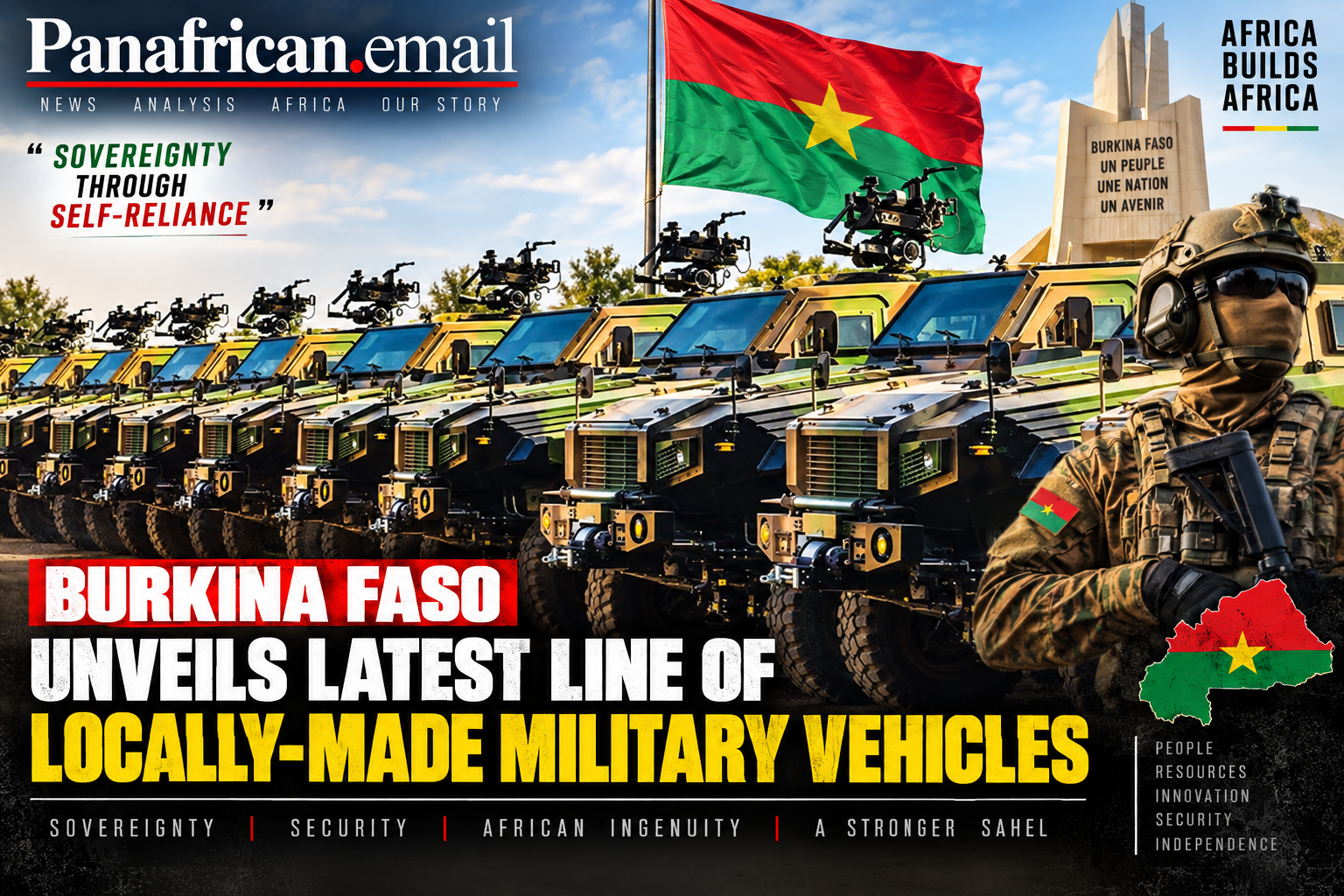
OUAGADOUGOU, BURKINA FASO — Burkina Faso is taking another step toward developing its own defense-industrial capacity, with authorities unveiling a new line of armored vehicles that have been adapted and transformed locally for the country’s security forces.
The latest development was reported by the Burkinabè presidency on September 13, 2026, when the first locally adapted “Nanga” armored vehicles were formally incorporated into the country’s Forces of Defense and Security. The Nanga name refers to the scorpion. (RT en Français)
The development forms part of a broader effort by Burkina Faso to reduce dependence on imported military equipment while expanding domestic industrial and technical capabilities.
From Importer to Builder
For decades, Burkina Faso’s armed forces have depended heavily on foreign suppliers for vehicles, weapons and other military equipment.
That model is now being challenged.
Under the country’s current military-led government, authorities have increasingly emphasized the development of endogenous—or locally driven—solutions for national defense.
The strategy does not mean that every component of Burkina Faso’s military equipment is manufactured domestically. Rather, the emerging defense industry combines local manufacturing, assembly, adaptation, repair and modification with equipment acquired internationally.
That distinction is important when describing the country’s growing military-industrial capacity.
The latest Nanga vehicles are officially described as armored vehicles adapted and transformed in Burkina Faso, rather than necessarily being manufactured entirely from raw materials inside the country. (RT en Français)
The Nanga Enters Service
The arrival of the Nanga vehicles gives Burkina Faso another locally adapted platform for its defense and security forces.
The government’s presentation comes as the country continues its campaign against armed groups operating across parts of the Sahel.
The vehicles are intended to contribute to the operational capabilities of the Forces of Defense and Security while supporting the government’s wider effort to develop domestic defense expertise.
The September 13 announcement was highlighted by the presidency, with the first Nanga vehicles officially entering the arsenal of Burkina Faso’s defense and security forces. (RT en Français)
A Growing Defense Manufacturing Ecosystem
The Nanga program is not occurring in isolation.
Burkina Faso has been developing a broader ecosystem of local industrial production.
One example is BAT Équipements, a Burkinabè company that unveiled an indigenous light armored vehicle prototype at the SYSDEF 2025 defense exhibition.
The company said its vehicle was designed around the realities of Sahelian security operations and could be adapted for different missions. Its prototype incorporated features including a remotely operated turret and surveillance technology. (Military Africa)
Another example comes from the country’s civilian heavy-vehicle manufacturing sector.
Naigaiba Auto Industrie says its industrial complex in Bobo-Dioulasso began producing “Made in Burkina” trucks and subsequently established a partnership to develop and assemble armored defense solutions. The company describes the facility as part of a broader effort to build local industrial capacity and employment. (Naigaiba)
Together, these developments point toward an emerging Burkinabè industrial base capable of supporting portions of the country’s transportation, logistics and defense requirements.
The Push Began With Logistics
The current push toward local production has also involved less visible but strategically important equipment.
In December 2024, the Burkinabè government announced the delivery of new logistical and combat equipment, including armored vehicles, fuel tankers and other equipment.
The government specifically stated that the tankers had been assembled in Burkina Faso by a national company. (Government of Burkina Faso)
That type of production can be strategically significant.
A military does not depend only on tanks and armored personnel carriers. It also requires fuel transportation, maintenance, spare parts, communications equipment, engineering vehicles, transport trucks and other logistical systems.
Building those capabilities domestically can reduce dependence on overseas supply chains and potentially shorten repair and replacement times.
Defense Industry and National Sovereignty
The push for local defense production also fits into Burkina Faso’s broader political emphasis on national sovereignty.
Since the military takeover that brought Captain Ibrahim Traoré to power in 2022, the government has pursued a foreign-policy direction that has included a significant reduction in its traditional military relationship with France.
Burkina Faso subsequently moved closer to Mali and Niger, with the three countries establishing the Alliance of Sahel States (AES).
The development of domestic military-industrial capabilities therefore has both an operational and strategic dimension.
Instead of relying exclusively on foreign suppliers, Burkina Faso is attempting to develop the ability to design, adapt, assemble, maintain and eventually manufacture more of what its security forces require.
The Sahel’s Security Challenge
The urgency behind the effort comes from Burkina Faso’s continuing struggle with armed extremist organizations and insecurity.
The country has faced a prolonged insurgency that has placed enormous pressure on its armed forces and contributed to large-scale displacement.
The government has consequently prioritized military procurement and equipment.
In January 2024, authorities announced the delivery of a major package of military equipment acquired through contributions from Burkinabè citizens. The government said the delivery was part of a strategic plan to equip the armed forces. (Government of Burkina Faso)
By September 2024, Burkinabè state media reported that the armed forces had received substantial quantities of equipment, including armored vehicles, ambulances and other vehicles as part of the government’s military-equipment strategy. (AIB Media)
The subsequent development of local production and adaptation represents another stage in that process.
More Than Military Hardware
The potential significance of Burkina Faso’s emerging defense industry extends beyond the battlefield.
A domestic military-vehicle industry can create opportunities for:
- Mechanical engineering
- Welding and metal fabrication
- Automotive technology
- Electronics
- Communications systems
- Software and surveillance technology
- Vehicle maintenance
- Spare-parts manufacturing
- Technical education
- Skilled employment
That makes defense manufacturing potentially relevant to Burkina Faso’s wider industrialization strategy.
The challenge will be developing reliable production at sufficient scale while maintaining quality, safety and operational standards.
A Regional Market?
Burkina Faso’s ambitions could eventually extend beyond its national borders.
The three AES countries—Burkina Faso, Mali and Niger—represent a combined market for military transportation, logistics and security equipment.
BAT Équipements, for example, has explicitly discussed the AES market as a potential destination for its locally developed armored-vehicle technology. (Military Africa)
If production expands, regional cooperation could allow manufacturers to spread development costs across several countries while creating larger markets for locally produced equipment.
Such cooperation could eventually support a more integrated Sahelian industrial base.
The Meaning of “Made in Burkina”
The latest development also raises an important question about how Africa defines local manufacturing.
There is a significant difference between:
Imported equipment → assembled locally
Imported vehicles → modified locally
Locally designed vehicles → manufactured domestically
and
Complete domestic production, including engines, electronics, armor and other critical components.
Burkina Faso is currently developing capabilities across several of these categories.
The Nanga vehicles are being described officially as locally adapted and transformed, while other projects involve assembly and locally produced components. (RT en Français)
The distinction does not diminish the industrial significance of the developments. Instead, it provides a clearer picture of where Burkina Faso’s defense industry stands today.
From Dependency Toward Capacity
The larger story is about capacity.
For Burkina Faso, producing or adapting military vehicles domestically means that engineers, mechanics, technicians and manufacturers gain experience working on equipment designed around local conditions.
The Sahel presents demanding operating environments: extreme heat, dust, long distances and difficult terrain.
Local manufacturers have an opportunity to develop equipment specifically suited to those conditions rather than relying exclusively on platforms designed for entirely different environments.
That could eventually become one of the strongest arguments for African defense manufacturing: equipment designed by Africans, for African operating environments.
A New Chapter for Burkina Faso
The September 2026 introduction of the Nanga armored vehicles is therefore part of a larger industrial experiment.
Burkina Faso is attempting to move beyond simply purchasing military equipment and toward developing the capacity to build, adapt and maintain more of its own defense infrastructure.
The country remains dependent on imported equipment and technologies, and the full development of a sophisticated defense industry will require years of investment, engineering expertise, financing and industrial infrastructure.
But the direction is increasingly visible.
From locally assembled fuel tankers and heavy trucks to armored-vehicle prototypes and now the Nanga vehicles entering service, Burkina Faso is building the foundations of a domestic defense-industrial ecosystem.
For a country that has spent years fighting an insurgency while simultaneously redefining its relationship with former colonial powers, the message is clear:
Military sovereignty increasingly depends not only on who supplies the weapons—but on who has the ability to build, repair, adapt and sustain them.
Panafrican.email will continue tracking Burkina Faso’s defense industry, the AES countries’ emerging industrial cooperation, and the development of African-made military and civilian technologies.
Leave a Reply