
By Panafrican.email News Desk
September 24, 2026
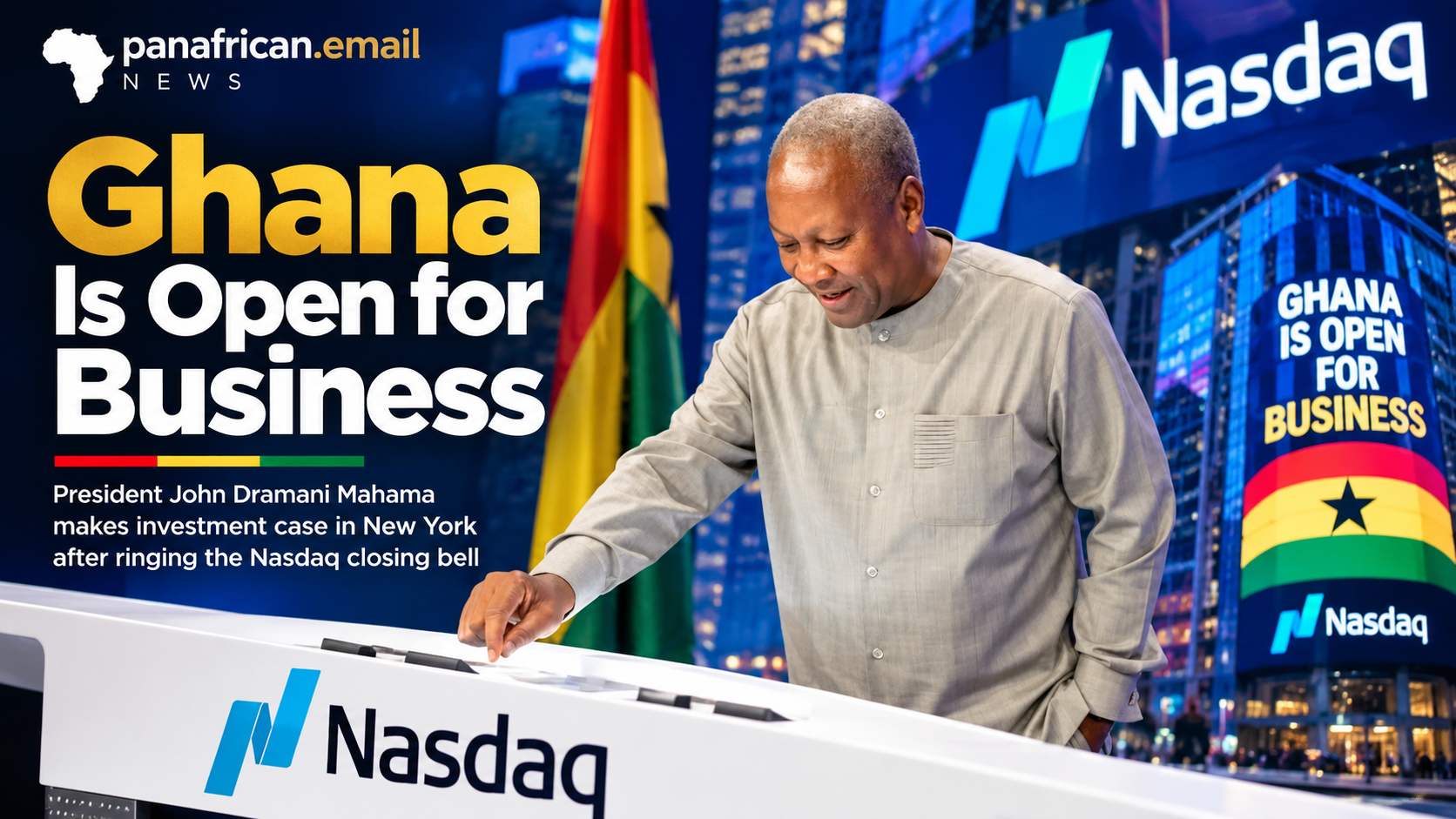
Ghana has placed its investment ambitions on one of the world’s most visible financial stages, with President John Dramani Mahama declaring that the country is “open for business” during a high-profile appearance at the Nasdaq MarketSite in New York.
Mahama rang the Nasdaq Stock Market closing bell on Wednesday, September 23, during an event that Nasdaq described as symbolizing the economic ties between Ghana and the United States and Ghana’s openness to business. The ceremony formed part of the President’s engagements in New York during the 81st United Nations General Assembly. (Nasdaq)
The message was reinforced by a Nasdaq billboard in Times Square featuring Mahama alongside the words “Ghana Is Open for Business.” The imagery provided a highly visible backdrop to Ghana’s effort to present itself to international investors as a destination for capital, partnerships and long-term economic activity. (Ghana News Agency)
A message aimed at global investors
The Nasdaq appearance was more than a ceremonial event. It provided Ghana with an opportunity to place its investment proposition before an international business audience at a time when the government is seeking to attract private capital into productive sectors of the economy.
According to Ghana’s Information Services Department, the government is targeting investment opportunities across agriculture, manufacturing, energy, infrastructure, technology, mining, health and pharmaceuticals. Mahama said Ghana had taken steps to improve the investment environment and was ready to work with businesses seeking opportunities in the country. (ISSER)
The President’s remarks come against the backdrop of a broader effort by his administration to restore macroeconomic stability and rebuild investor confidence.
At a related U.S.–Ghana Presidential Roundtable, Mahama said Ghana had continued work on restoring macroeconomic stability, strengthening public finances and rebuilding confidence in the economy. He also argued that when obstacles to investment are identified, they should be removed and that government should be accountable for commitments it makes to investors. (3News)
From commodities to industrial investment
Ghana’s investment pitch is built partly around its established natural-resource base.
The country is a major producer of commodities including cocoa and gold, while manganese, oil and gas also form important components of its resource economy. Mahama has increasingly emphasized the need to move beyond the export of raw commodities toward greater domestic production, processing and industrial activity.
The government has also highlighted opportunities in manufacturing, agriculture, technology and infrastructure as areas where investment could support employment and expand productive capacity.

Earlier in 2026, Mahama announced new commitments in Ghana’s oil sector totaling $3.5 billion. The commitments included $2 billion from Jubilee partners for new drilling and $1.5 billion from OCTP partners for field development and exploration. The government has presented the investments as part of an effort to reverse declining oil production and strengthen Ghana’s energy sector. (The Presidency, Republic of Ghana)
The 24-hour economy proposition
Another central component of Ghana’s economic strategy is the government’s 24-Hour Economy programme.
The initiative is intended to encourage greater production and industrial activity by supporting businesses and facilities capable of operating around the clock. Government has connected the programme to manufacturing, agriculture, markets, infrastructure and job creation.
The administration has also described Ghana as a potential gateway into the wider African market, pointing to the country’s position in West Africa and Accra’s role as host of the African Continental Free Trade Area Secretariat.
The broader objective is to make Ghana not only a destination for investment but also a base from which companies can reach markets across Africa.
A new pitch to American business
The U.S.–Ghana investment relationship was a central theme surrounding Mahama’s Nasdaq appearance.
By combining the closing-bell ceremony with a presidential business roundtable, Ghana sought to use the international visibility of the United Nations General Assembly to engage directly with investors and business leaders.
The approach reflects a wider effort by Ghana to strengthen economic relationships beyond traditional development assistance and encourage more private-sector investment.
For American companies, the areas highlighted by Ghana include energy, infrastructure, technology, agriculture, manufacturing, healthcare and natural resources. For Ghana, increased investment could provide capital, technology, market access and employment opportunities.
The challenge will be translating international visibility into actual investment commitments, new businesses, expanded production and jobs inside Ghana.
What investors will be watching
The phrase “Ghana Is Open for Business” creates a clear investment message, but international investors ultimately assess countries through measurable conditions.
These include macroeconomic stability, access to foreign exchange, taxation, infrastructure, energy reliability, regulatory predictability, dispute resolution, access to finance and the ability to move capital across borders.
Ghana’s recent economic reforms and investment initiatives will therefore be watched alongside their implementation.
The country’s pitch in New York is ultimately about more than a Nasdaq ceremony. It is about whether Ghana can convert renewed international attention into sustained investment and productive economic activity.
From New York to Accra
The Nasdaq closing bell gave Ghana a global platform. The next stage is domestic.
The investment message now has to be translated into projects, factories, farms, technology companies, infrastructure, energy production and new businesses operating in Ghana.
For the government, the test will be whether the commitments made to investors can be implemented consistently.
For investors, the question will be whether Ghana’s improving economic environment and investment opportunities justify new capital commitments.
And for Ghanaians, the most important measure will ultimately be whether investment produces broader economic opportunities, stronger businesses, higher productivity and jobs.
From the Nasdaq MarketSite in New York, President Mahama delivered a simple message: Ghana is open for business.
The coming months and years will show how effectively that message is converted into investment and economic activity on the ground.
Leave a Reply