
By Panafrican.email
Telegram has become one of the world’s most important communications platforms, connecting more than a billion users through private messaging, public channels, large groups, bots and an expanding ecosystem of applications.
For Africa, Telegram’s importance goes beyond messaging.
Across the continent, the platform is used by journalists, political movements, businesses, technology communities, cryptocurrency users, civil-society organizations and ordinary people who need a communications channel that can operate across borders.
That makes the growing legal pressure on Telegram important for Africa.
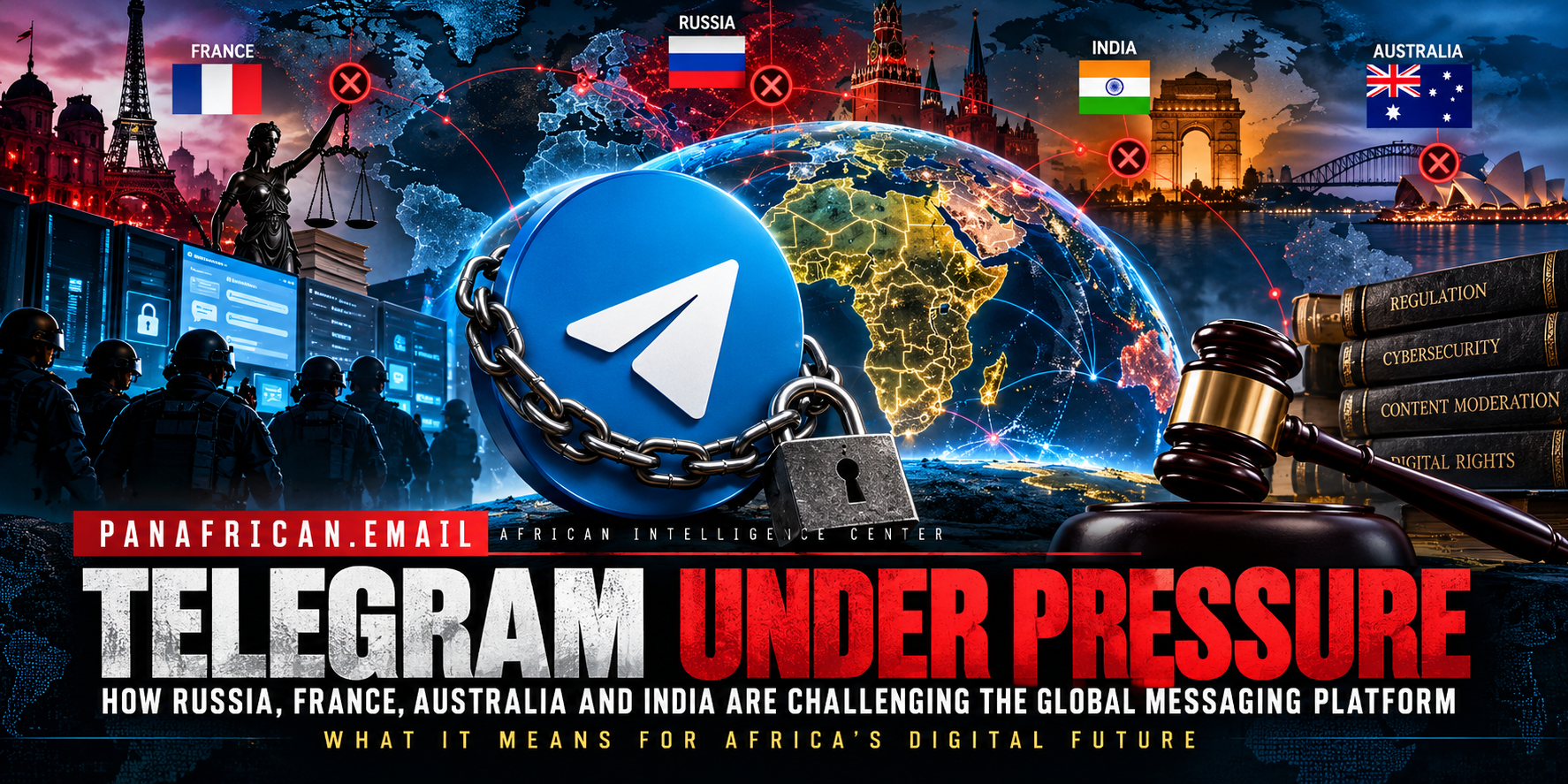
In recent years, governments in Russia, France, Australia and India have taken very different approaches to the platform. Their disputes involve terrorism-related material, criminal activity, platform responsibility, government blocking powers and demands for greater cooperation with authorities.
The cases are different. But together they raise a question that African governments and technology companies will increasingly have to answer:
Who should be legally responsible when a communications platform becomes part of a country’s critical information infrastructure?
Russia: Telegram and the battle for control
Telegram’s relationship with Russia has been complicated for almost a decade.
Russian authorities first confronted Telegram over demands connected to access to encrypted communications. Telegram’s refusal eventually contributed to a major attempt by Russian regulators to block the service in 2018.
The blocking effort became notorious for disrupting large numbers of unrelated internet services while failing to completely remove Telegram from the Russian internet.
For a period after Russia’s full-scale invasion of Ukraine, Telegram became particularly important inside Russia because it remained a major source of information outside traditional state-controlled media.
The relationship changed again as Russian authorities increased pressure on Telegram.
In 2026, Russian officials escalated their confrontation with Pavel Durov, accusing Telegram of failing to prevent alleged use of the platform by Ukrainian intelligence and extremist organizations.
Those accusations are claims by Russian authorities, rather than established findings that Durov personally committed the alleged offenses.
The significance for Africa is broader than the Russian case itself.
Many African countries are still developing their own approaches to digital sovereignty, cybersecurity and online speech. Governments are watching what happens when a globally distributed communications platform refuses or fails to comply with national demands.
The Russian experience demonstrates one possible outcome:
a government can move from regulation to throttling, blocking and eventually direct pressure on the platform’s leadership.
France: When platform responsibility becomes a criminal question
France represents a different legal confrontation.
French authorities began investigating Telegram over allegations concerning criminal activity occurring through the platform and the company’s cooperation with law enforcement.
The investigation eventually led to Pavel Durov’s detention in France in August 2024.
The allegations included claims concerning illegal content and criminal activity conducted through Telegram, as well as questions about the company’s response to requests from authorities.
Durov disputed the accusations and argued that some government requests had not followed appropriate procedures.
The French case is particularly important because it raises a difficult question:

At what point does a communications platform become legally responsible for criminal activity carried out by its users?
That question has enormous relevance to Africa.
African technology platforms are growing rapidly. Messaging applications, fintech services, social networks and online marketplaces increasingly connect millions of people.
If regulators establish that platforms have substantial legal responsibility for user activity, African companies could eventually face similar demands.
The issue is therefore not simply Telegram versus France.
It is part of a global debate about the legal responsibilities of digital infrastructure.
Australia: Online safety becomes enforceable
Australia has taken another route.
Its online-safety regulator has brought civil proceedings against Telegram, alleging that the platform failed to meet obligations concerning unlawful material, including terrorist content.
The case is significant because Australia is not simply accusing Telegram of committing a crime.
Instead, the regulator is asking the courts to determine whether Telegram complied with statutory online-safety obligations.
That difference matters.
Governments increasingly want social and messaging platforms to demonstrate that they have effective systems for detecting, responding to and removing illegal material.
For Africa, this creates a major policy question.
African governments are introducing or expanding cybersecurity, data-protection and online-safety legislation. At the same time, many African citizens and organizations depend on international platforms whose headquarters, engineers and servers may be located outside the country.
A Nigerian user, a Ghanaian journalist, a Liberian business owner or a Kenyan technology company may all communicate through a platform governed by laws originating somewhere else.
The result is a new kind of digital jurisdiction.
India: When governments use blocking powers
India’s Telegram dispute developed around alleged misuse of the platform connected to the country’s National Eligibility-cum-Entrance Test.
Indian authorities used powers under the country’s Information Technology Act to restrict access to Telegram-related material.
Telegram challenged the government’s actions, while authorities argued that the platform had been used to distribute unlawful examination-related material.
The case demonstrates another regulatory option available to governments:
blocking.
Rather than relying exclusively on individual content removals, governments can attempt to restrict access to a platform or particular material through national legal mechanisms.
This is especially relevant for Africa.
Across the continent, governments have previously restricted social-media access during elections, protests, periods of civil unrest and political crises.
Telegram’s experience shows how digital platforms can become caught between national security arguments and concerns about freedom of communication.
Four countries, four different approaches
The four cases should not be treated as identical.
Russia’s confrontation with Telegram is deeply connected to state control over information and national security.
France’s case concerns alleged criminal activity and questions surrounding cooperation with law enforcement.
Australia’s proceedings focus on statutory online-safety obligations.
India’s dispute demonstrates the use of national blocking powers in response to alleged misuse of the platform.
The common factor is that governments increasingly expect large technology companies to accept responsibilities that extend beyond simply providing software.

Africa is watching
Africa is entering this debate at an important moment.
The continent is experiencing rapid growth in digital communications, mobile banking, artificial intelligence, social media and online commerce.
But Africa also has some of the world’s most diverse regulatory environments.
A platform operating across 54 countries may face dozens of different legal systems.
One government may demand rapid removal of particular content.
Another may demand user information.
Another may impose data-localization requirements.
Another may restrict access to the entire service.
For African technology entrepreneurs, this creates an enormous challenge.
A company can build a platform in Lagos, Accra, Nairobi, Monrovia or Johannesburg and reach users throughout the continent almost immediately.
But the legal obligations do not travel as easily as the technology.
Who actually engineers Telegram?
Telegram’s engineering structure is also unusual.
According to Telegram’s own account, the company was built around brothers Pavel Durov and Nikolai Durov.
Pavel Durov provides financial and ideological leadership, while Nikolai Durov is responsible for the company’s technological foundation.
Nikolai developed Telegram’s custom data protocol, designed to operate across multiple data centers while emphasizing speed, reliability and security.
Telegram says its development team is currently based in Dubai.
The company also says that many of its developers originally came from St. Petersburg, Russia, and that the team moved away from Russia because of local information-technology regulations. Before establishing itself in Dubai, Telegram experimented with bases including Berlin, London and Singapore.
That history is significant for Africa.
Dubai has increasingly become a major meeting point between African business, technology and global capital.
Telegram’s engineering presence there also illustrates how modern technology companies can separate their users, engineers, corporate structures and infrastructure across multiple jurisdictions.
Telegram’s code is not entirely open
Another important distinction concerns Telegram’s technology.
Telegram’s client applications are open source, and the company provides verifiable builds for its iOS and Android applications.
Its server-side code, however, is not publicly released.
Telegram argues that publishing server code would not necessarily prove what software is actually running on its servers. The company instead says that its encryption and API specifications are documented and available for security review.
This distinction matters when discussing digital sovereignty.
African governments increasingly want greater visibility into the technologies their citizens depend upon.
But visibility into an application’s publicly available client code does not necessarily provide visibility into the entire infrastructure behind the service.
What this means for African technology
Telegram’s legal troubles offer African developers several lessons.
First, scale creates regulatory responsibility.
A platform used by a small community can sometimes operate under a very different regulatory environment from one used by hundreds of millions or billions of people.
Second, location matters.
Where engineers work, where companies are registered, where servers operate and where users are located can all produce different legal obligations.
Third, content moderation is becoming infrastructure.
Moderation is no longer simply a question of deleting offensive posts. Governments increasingly expect technology companies to detect terrorism-related material, fraud, child exploitation, criminal marketplaces and other illegal activity.
Fourth, privacy remains a major issue.
African users need communications systems that protect legitimate privacy without becoming safe havens for organized criminal activity.
Finding that balance will be one of the defining technology-policy challenges of the next decade.
A warning for African startups
The Telegram experience should also be studied by African entrepreneurs building the next generation of platforms.
A company may begin with a simple objective:
connect people.
But once millions of people depend on that service, governments may begin to treat the platform as part of national infrastructure.
The company then faces questions about:
- Data protection
- User privacy
- Law-enforcement requests
- Content moderation
- Cybersecurity
- Terrorism-related material
- Financial crime
- Child safety
- Political speech
- Government censorship
- Data localization
- Cross-border investigations
These issues should be considered during the architecture stage—not after the platform becomes successful.
The future of African digital communication
Telegram’s legal battles demonstrate that the future of communications will not be determined solely by engineers.
It will also be shaped by courts, regulators, governments and users.
For Africa, the debate presents an opportunity.
The continent should not simply import regulatory models developed in Europe, Russia, Australia or Asia.
African countries need frameworks that protect legitimate expression and privacy while providing effective tools against genuinely illegal activity.
They also need technology policies that allow African developers to build competitive communications infrastructure without creating unnecessary barriers to innovation.
Telegram’s story is therefore bigger than Pavel Durov.
It is about the future of digital sovereignty.
It is about who controls the infrastructure through which Africans communicate.
And ultimately, it raises a question that African technology leaders should be asking now:
Can Africa build communications platforms that are globally competitive, technically secure, legally resilient and accountable to African users?
That may be the more important lesson emerging from Telegram’s battles around the world.
Leave a Reply