
By panafrican.email News Desk
September 28, 2026
Africa’s Missing Permanent Seat at the UN Security Council
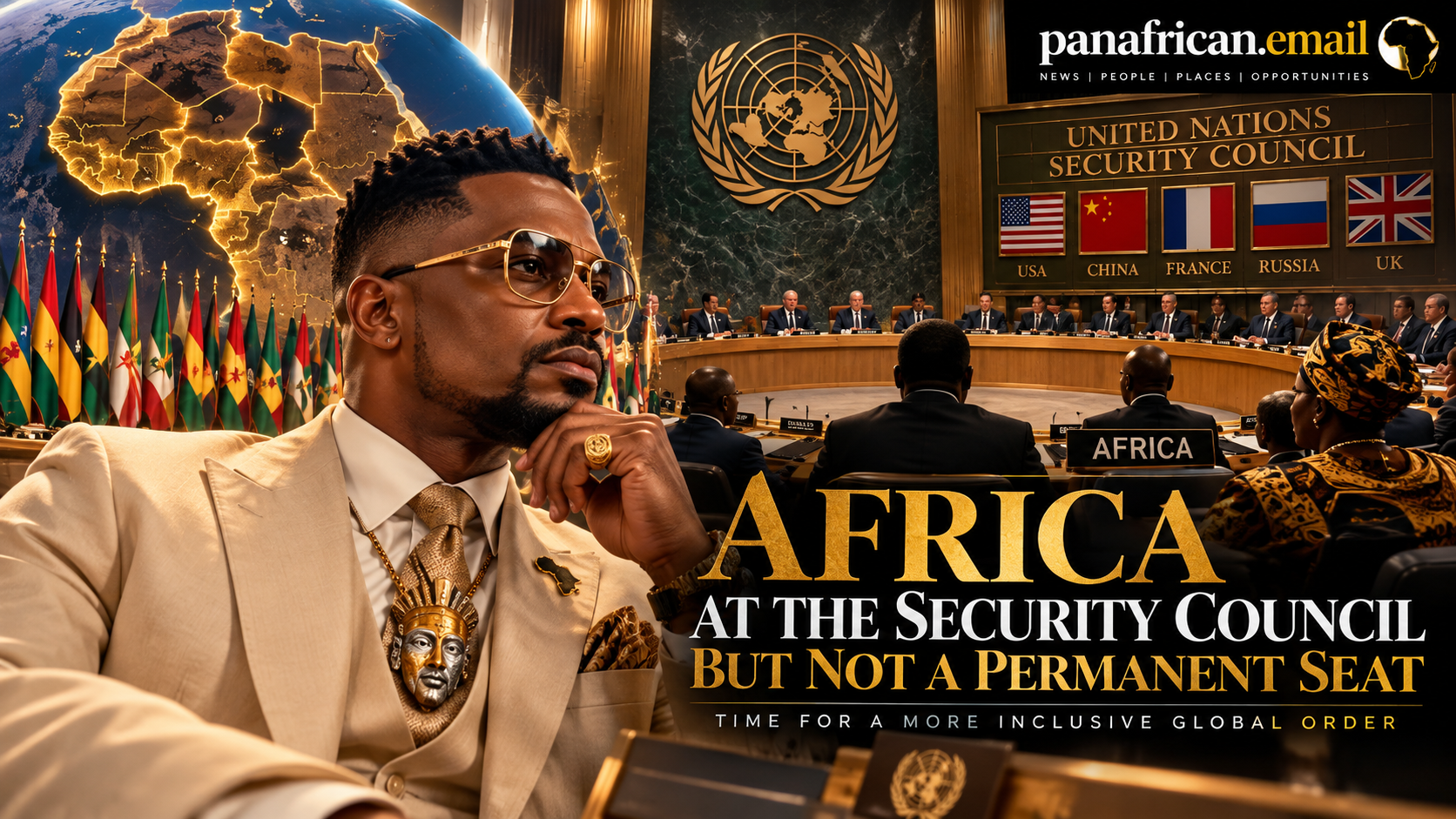
Africa is represented at the United Nations Security Council — but it has no permanent seat.
That distinction sits at the heart of a renewed African campaign to reform one of the world’s most powerful international institutions.
As African leaders gather at the 81st United Nations General Assembly in New York, governments across the continent are again challenging a Security Council structure whose five permanent members have remained unchanged since the organisation was established in the aftermath of the Second World War.
The five permanent members are China, France, Russia, the United Kingdom and the United States. They possess veto power over substantive Security Council decisions.
The remaining 10 seats are elected by the General Assembly for two-year terms.
In 2026, three African countries — the Democratic Republic of the Congo, Liberia and Somalia — hold elected seats on the Council. But those positions are temporary and do not carry the veto enjoyed by the permanent five. (United Nations)
The issue, therefore, is not whether Africa has any representation.
It is whether Africa has permanent representation with the same institutional authority as the states that currently hold permanent seats.
A Council Designed in 1945
The Security Council was created in a dramatically different geopolitical era.
In 1945, much of Africa remained under colonial rule. The political map of the continent was fundamentally different from today’s independent African states.
More than eight decades later, African governments argue that the composition of the Council no longer corresponds to the distribution of countries, populations, economies and security challenges in the modern international system.
UN Secretary-General António Guterres has renewed the call for reform, saying Africa’s absence from the permanent category can no longer be justified. His intervention came during the opening of the 81st General Assembly. (allAfrica.com)
The question has consequently moved beyond African governments alone.
It has become part of a broader international debate about whether the Security Council can retain legitimacy while large regions of the world remain outside its permanent decision-making structure.
Africa’s Common Position
The African Union has maintained a common position on Security Council reform for years.
Under the Ezulwini Consensus and Sirte Declaration, Africa calls for:
- At least two permanent seats for African countries;
- Full rights and privileges for those permanent members;
- Veto power for African permanent members for as long as the veto remains part of the Council;
- Five additional non-permanent African seats in an expanded Council.
The African Union reaffirmed this position in 2026. Its African Reform Model was submitted during the ongoing intergovernmental negotiations on Security Council reform. (World Bank Maps)
The African Group has also rejected proposals that would merely create longer-term or renewable African seats without permanent membership.
In its submission to the reform negotiations, the African Group argued that such arrangements would not resolve the underlying issue of permanent African representation. (UN Transcripts)
Ghana: Reform Is Not a Favour
Ghanaian President John Dramani Mahama has also placed the issue directly before the General Assembly.
Mahama argued that reform of the Security Council should not be regarded as a concession to Africa, but as a question affecting the legitimacy and credibility of the United Nations itself. (Al Jazeera)
That argument reflects a broader African position: the continent is not simply asking for additional diplomatic seats. African governments want participation in the institution where some of the world’s most consequential decisions on war, sanctions, peacekeeping and international security are made.
The issue is particularly significant because Africa remains heavily represented in the Council’s workload.
According to reporting on the current reform debate, 18 of the 24 Security Council resolutions adopted under Chapter VII of the UN Charter in 2025 concerned Africa. Chapter VII provides the Council with powers relating to measures such as sanctions and authorisations concerning the use of force. (Al Jazeera)
That creates a fundamental question:
How should decisions about African security be made when no African state possesses a permanent vote on the body making those decisions?
The African Countries Already Serving
Africa’s temporary representation should not be overlooked.
The Democratic Republic of the Congo, Liberia and Somalia are serving as elected members during 2026. Their presence gives African governments a direct channel into Council deliberations. (United Nations)
But elected membership expires.
A country may serve for two years, participate in debates and vote on resolutions, yet leave the Council without having the institutional continuity or veto authority of the permanent members.
That is precisely why the African Union’s reform position seeks both permanent and additional non-permanent representation.
The proposal is intended to create continuity while expanding the number of African voices participating in Council decisions.
Who Would Represent Africa?
Another difficult question remains unresolved.
The African Union has not designated specific countries to occupy the proposed permanent seats.
Potential candidates discussed in African diplomatic circles have included major regional powers such as Nigeria, Egypt and South Africa, but the African Union’s official position is framed around seats for Africa rather than an established allocation to particular states. (Al Jazeera)
Nigeria has been particularly vocal.
At the 81st General Assembly, Vice President Kashim Shettima, delivering President Bola Tinubu’s national statement, called for at least two permanent African seats with the same rights and responsibilities as existing permanent members, including veto power for as long as the veto remains. Nigeria also called for five non-permanent African seats. (Anadolu Agency)
The question of which countries would ultimately occupy new African permanent seats would therefore require a separate continental political process.
The Veto Is the Hardest Question
The debate is not simply about adding chairs around the Security Council table.
It is about power.
The five permanent members can veto substantive resolutions. A single veto from China, France, Russia, the United Kingdom or the United States can prevent a resolution from being adopted.
The African Union’s position is that if the veto continues to exist, newly created African permanent members should have equivalent rights.
This creates a difficult negotiating problem.
A reform package could theoretically expand the Council without expanding veto power. But the African position is that permanent membership without equivalent privileges would not provide the level of representation the continent is demanding. (United Nations)
Why Reform Has Been So Difficult
Changing the permanent membership of the Security Council requires changing the UN Charter.
Under Article 108, Charter amendments require approval by two-thirds of the General Assembly and ratification by two-thirds of UN members, including all five permanent members.
That means the states that currently possess permanent membership and veto power are themselves part of the legal process required to change the system.
The result is a diplomatic structure in which reform requires broad international support while also requiring the cooperation of the existing permanent powers.
The intergovernmental negotiations on Security Council reform have been underway since 2008, covering questions including membership categories, regional representation, the Council’s size, working methods and the veto. (Al Jazeera)
Support Beyond Africa
Africa’s position has also received support from countries seeking broader reform of the Security Council.
The G4 — Brazil, Germany, India and Japan — reiterated support in September 2026 for enhanced representation of Africa, including permanent membership. The group has called for expansion of the Council in both permanent and non-permanent categories. (Punch Newspapers)
That places the African demand within a wider movement involving countries across Asia, Latin America and Europe that argue the Council should better reflect today’s international system.
What Is at Stake?
For Africa, the debate reaches beyond prestige.
The Security Council authorises peacekeeping missions, imposes sanctions, establishes international security mandates and responds to conflicts that can have direct consequences for African populations.
African states therefore want a stronger role in decisions affecting conflicts, peace operations, terrorism, sanctions, humanitarian crises and international security on the continent.
The reform question is ultimately about who gets to shape the rules of the international security system.
Africa has 54 UN member states and represents one of the largest regional blocs in the General Assembly. Yet it remains the only major region without a permanent member of the Security Council.
The continent has temporary seats.
It has a collective position.
It has a growing diplomatic and economic presence.
But it still does not have a permanent seat.
A Different United Nations for the 21st Century?
The argument now entering the centre of the 81st General Assembly is straightforward: can an institution created in 1945 adequately represent the geopolitical realities of 2026?
For African governments, the answer requires structural reform.
The question is no longer simply whether African countries should be invited into the room.
They are already there.
The question is whether Africa should have permanent institutional authority in the room where the world’s most consequential security decisions are made.
That debate remains unresolved.
But with the African Union reaffirming its common position, Ghana and Nigeria renewing their appeals, Kenya pressing for permanent African representation, and the UN secretary-general again calling for reform, the question of Africa’s permanent place on the Security Council has once again moved to the centre of global diplomacy.
panafrican.email Analysis
Africa’s campaign for Security Council reform is therefore not merely a campaign for additional diplomatic positions. It is a debate over the architecture of global power, the distribution of veto authority and the legitimacy of international institutions in the 21st century.
The outcome will depend on negotiations among all UN member states — including the five existing permanent members — and on how African states ultimately coordinate their position on the continent’s future representation.
Watch this video on TikTok
Leave a Reply