
By panafrican.email News Desk
September 28, 2026
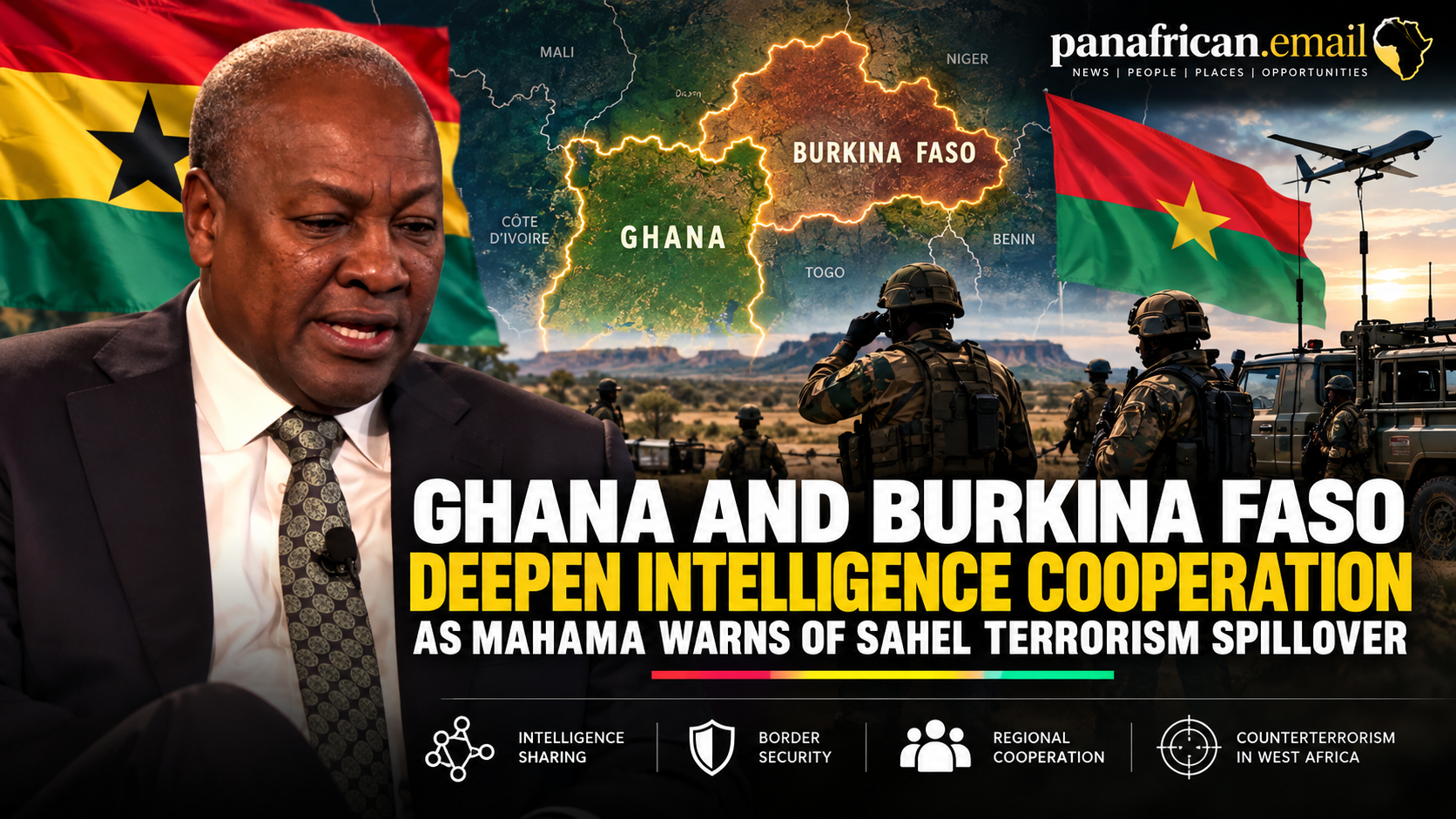
Ghana and Burkina Faso are strengthening intelligence cooperation as concerns grow over the movement of armed groups across the Sahel and toward the Gulf of Guinea, President John Dramani Mahama has said.
Speaking in New York on September 25 during a discussion on the security situation in West Africa, Mahama said Ghana and Burkina Faso are exchanging intelligence and tracking the movement of fighters as Ghana increases efforts to protect its northern frontier from possible terrorist spillover.
According to reporting on the president’s remarks, Mahama said Ghanaian and Burkinabè intelligence agencies are tracking movements and passing information to one another. He also said Ghana has expanded intelligence cooperation with international partners, including the United Kingdom, Germany, France and the United States.
The comments come as Ghana continues to navigate a changing security environment along its northern border with Burkina Faso, where armed extremist groups have operated for years.
A border security challenge
Burkina Faso occupies a strategically important position between the Sahel and the coastal states of West Africa. Its southern border connects the country directly with Ghana, Côte d’Ivoire, Togo and Benin, creating significant economic and social links as well as security challenges.
For Ghana, developments in Burkina Faso have particular importance because northern communities are connected to communities across the border through trade, family ties, migration and longstanding cultural relationships.
The concern is not new. Ghana has participated in regional security initiatives designed to improve intelligence sharing, border security and cooperation against terrorism and organized crime. The Accra Initiative, for example, was established as a regional framework involving Ghana, Burkina Faso, Benin, Côte d’Ivoire and Togo, with cooperation including intelligence sharing and counterterrorism activities.
Seven agreements strengthen bilateral cooperation
The intelligence cooperation described by Mahama follows a broader effort to rebuild Ghana-Burkina Faso security relations.
In February 2026, the two countries signed seven bilateral agreements covering security, border cooperation, transportation, disaster response and the fight against illicit drugs. The security framework included provisions for intelligence sharing, joint patrols and coordinated counterterrorism efforts along the countries’ shared border.
The agreements followed heightened concern after the killing of eight Ghanaian tomato traders in northern Burkina Faso in February.
The development also has an economic dimension. Ghana is an important transportation and maritime gateway for Burkina Faso, while traders and commercial operators depend heavily on cross-border routes connecting the two countries.
Security along those routes therefore has implications beyond counterterrorism. Disruptions can affect food supplies, trade, transportation and the livelihoods of communities on both sides of the frontier.

Mahama warns Ghana cannot assume it is immune
In his New York remarks, Mahama warned that Ghana cannot assume it will remain permanently insulated from the violence affecting parts of the Sahel.
The president said Ghana is increasing surveillance and intelligence exchanges while allocating additional resources to defence and national security. He acknowledged that those resources compete with other national priorities, including education and healthcare.
His warning reflects a wider concern among Gulf of Guinea states that armed groups operating farther north could expand their activities toward coastal West Africa.
The Ghanaian government has consequently placed greater emphasis on intelligence-led prevention, border surveillance and cooperation with neighbouring countries.
A wider regional security architecture
The Ghana-Burkina Faso relationship is also part of a broader attempt to establish a more coordinated West African security framework.
In January 2026, Ghana hosted a High-Level Consultative Conference on Regional Cooperation and Security. Leaders and representatives from Ghana, Liberia, Sierra Leone, Burkina Faso, Mali, Mauritania, Nigeria, Senegal and Togo participated in discussions focused on terrorism, violent extremism and transnational organized crime. The meeting, chaired by Mahama, produced a commitment toward a more permanent and structured framework for regional security cooperation.
For Ghana, cooperation with Burkina Faso is particularly significant because security threats do not necessarily follow national borders.
Intelligence sharing can allow authorities to identify potential movements and networks earlier, while coordinated border operations can improve the ability of security agencies to respond to threats that cross jurisdictions.
At the same time, the effectiveness of such cooperation will depend on implementation, communication between agencies, resources and relationships with communities living along the border.
The road ahead
The latest comments from Mahama indicate that intelligence cooperation has become an increasingly important component of Ghana’s strategy toward the Sahel security crisis.
Rather than treating Ghana’s northern border as an isolated national security issue, Accra is increasingly approaching it as part of a wider regional challenge involving Burkina Faso and other Sahelian states.
The immediate objective is to prevent armed groups and associated criminal networks from exploiting the movement of people, goods and resources across borders.
For communities in northern Ghana and Burkina Faso, however, security cooperation also intersects with everyday economic life. Maintaining safe commercial corridors, protecting border communities and keeping legitimate trade moving will be essential to ensuring that stronger security measures do not undermine the cross-border relationships that have connected the region for generations.
The intelligence relationship between Accra and Ouagadougou therefore represents more than an exchange of security information. It is becoming part of a broader effort to manage the increasingly interconnected security, economic and humanitarian challenges facing West Africa.
Editorial note
The intelligence-sharing statements in this report are attributed to President John Dramani Mahama’s September 25, 2026 remarks in New York and to reporting on those remarks. panafrican.email has not independently verified classified intelligence or specific operational movements referenced by the president.
@diplomatictimesghana
Leave a Reply