
By Panafrican.email Editorial Desk
In the history of modern medicine, few names have become as deeply connected to scientific discovery as Henrietta Lacks.
Yet for decades, the woman behind one of the most important biological tools in medical research remained largely unknown to the public — and, for many years, even to her own family.
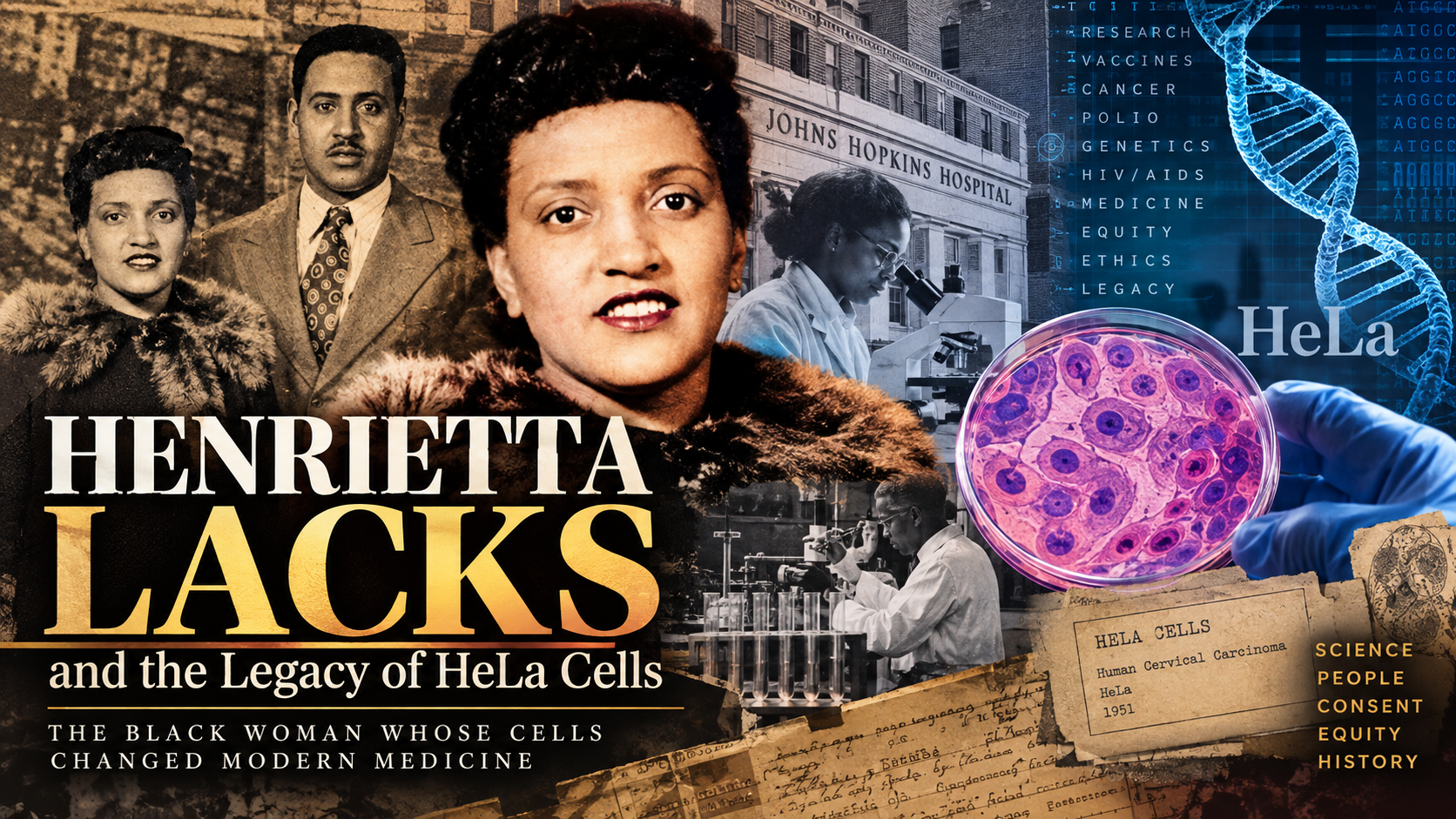
Lacks was a 31-year-old Black mother of five who sought treatment for cervical cancer at Johns Hopkins Hospital in Baltimore in 1951. During her treatment, tissue was taken from her tumor and provided to researcher George Gey’s laboratory. The cells behaved differently from previously studied human cells: rather than dying after a limited number of divisions, they continued multiplying in laboratory culture.

The resulting cell line became known as HeLa, derived from the first two letters of Henrietta’s first and last names. (Office of Strategic Planning)
What followed would transform biomedical research.
A Cell Line That Would Not Die
Before HeLa, researchers struggled to keep human cells alive and reproducing outside the body. Lacks’ cancer cells proved remarkably resilient.
According to Johns Hopkins, the cells could double approximately every 20 to 24 hours. Researchers began distributing them to laboratories around the world, creating a biological resource that could be used repeatedly for experiments. (The Hub)

HeLa cells became instrumental in research involving cancer, infectious diseases, vaccines, genetics and other areas of biomedical science. The National Institutes of Health says its review of scientific literature identified more than 110,000 publications citing HeLa cells between 1953 and 2018. (Office of Strategic Planning)
That number illustrates something extraordinary: Henrietta Lacks’ biological legacy did not remain confined to one hospital or one research laboratory. Her cells became part of an international scientific infrastructure.
The Polio Vaccine and Beyond
HeLa cells became particularly important during the development and testing of the polio vaccine.
Researchers needed large quantities of human cells on which to study poliovirus. Because HeLa cells could reproduce rapidly, they provided an unusually useful laboratory system.
Over subsequent decades, HeLa cells were used in research into cancer, infectious diseases and fundamental questions about human biology. Johns Hopkins describes their contribution as extending from polio vaccine research to studies of leukemia and other cancers, HIV/AIDS and the human genome. (Office of the President)
The cells also became part of research that contributed to discoveries associated with Nobel Prize-winning work, according to the NIH. (Office of Strategic Planning)
The significance of HeLa is therefore not simply that one cell line survived in a laboratory.
It is that those cells became a platform upon which generations of researchers could conduct experiments that would have been difficult or impossible using conventional human tissue.
The Ethical Question at the Center of the Story
But the scientific achievement carries an equally important ethical history.
Henrietta Lacks did not knowingly consent to her cells being used for research. The NIH explicitly states that tissue specimens were obtained without her knowledge or consent in 1951. (Grants.gov)
This was consistent with medical practices of that era, when the rules governing consent, biological specimens and research privacy were substantially different from today’s standards.
But the consequences extended far beyond the laboratory.
For decades, Lacks’ family did not fully understand what had happened to Henrietta’s cells. Meanwhile, HeLa became one of the most widely used human cell lines in biomedical science.
That contrast — enormous scientific value alongside the absence of informed consent — became one of the most important ethical dimensions of her story.
Henrietta Lacks Was More Than Her Cells
One danger in telling the HeLa story is that Henrietta can disappear behind the science.
She was not simply a source of biological material.
She was a daughter, wife, mother and member of a family whose history continued after her death.

Johns Hopkins has acknowledged that, over the decades following Lacks’ death, the institution could have done more to inform and work with her family regarding their privacy and personal interests. (Hopkins Medicine)
That acknowledgement is important because the story of HeLa is not only about scientific progress. It is also about who receives recognition when discoveries are built from the bodies and biological materials of ordinary people.
The Genome Created a New Privacy Problem
The ethical debate entered another chapter in 2013.
Scientists published information about the HeLa genome, raising concerns because genomic data can reveal information not only about the biological material being studied but potentially about living relatives.
The publication generated discussions involving Henrietta Lacks’ descendants, researchers and bioethicists. The controversy helped lead to a landmark agreement between the National Institutes of Health and members of the Lacks family. (Grants.gov)
Under the 2013 NIH-Lacks Family Agreement, access to certain NIH-controlled HeLa genomic data was placed under a controlled-access system. A review process involving scientists, bioethicists and members of the Lacks family was established to consider requests for access. (Grants.gov)
The arrangement represented an important shift.
The descendants of Henrietta Lacks were no longer simply observers of the scientific use of her biological legacy. They became participants in decisions concerning access to certain genomic information.
A New Model of Scientific Partnership
The NIH says that its relationship with the Lacks family continued into the following decade.
In 2023, NIH marked ten years of the partnership, reporting that 90 researcher requests had been approved for controlled access to HeLa whole-genome data and that 14 HeLa genome sequences had been deposited in its database during that period. (Stagetest Domain 3)
NIH subsequently updated its expectations for investigators generating or accessing HeLa genomic data, including requirements connected to the Lacks Family Agreement and NIH’s broader data-management policies. (Grants.gov)
This is one of the most consequential aspects of the Lacks legacy: the story helped force institutions to confront questions that extend beyond a single family.
Who owns information derived from human biological material?
Who should control access to genomic information?
How should researchers acknowledge the people whose biological materials made discoveries possible?
And how can scientific openness be balanced against privacy?
The Lacks Legacy and the Question of Equity
For Black communities, the story carries an additional historical dimension.
Henrietta Lacks lived at a time when American medicine was marked by racial inequality and when Black patients often had limited power within medical institutions.
Her story subsequently became part of wider discussions about trust, informed consent, research ethics and racial disparities in medicine.
That does not mean that every scientific use of HeLa cells can be reduced to race. The scientific contributions of the cells are independently documented. But the circumstances surrounding their collection and the decades-long absence of meaningful family involvement have made Henrietta Lacks an important figure in conversations about equity in biomedical research.
Her story raises a question that remains relevant across the world:
Can scientific progress be considered complete if the people who make that progress possible are not recognized, informed or included?
Africa and the Global Meaning of HeLa

For African countries and the global African diaspora, the story of Henrietta Lacks also offers an opportunity to examine the relationship between scientific advancement, human rights and ownership of biological knowledge.
Modern African biomedical research increasingly involves genomic medicine, biobanks, clinical trials, precision medicine and international research collaborations.
Those developments create opportunities for African scientists and institutions — but they also make questions of consent, data governance and community participation increasingly important.
The lesson from the Lacks story is not that biological research should stop.
It is that scientific progress can be pursued alongside transparency, ethical consent, privacy protections and meaningful recognition of the people and communities whose participation makes research possible.
A Legacy Larger Than HeLa
Henrietta Lacks died in 1951, but the cells taken from her tumor continued multiplying.
Her family lived with the consequences of that extraordinary scientific legacy for decades.
Today, her name is increasingly recognized alongside the cells that once carried only the anonymous designation “HeLa.”
Johns Hopkins has taken steps to memorialize Lacks, including the development of a building bearing her name. The university has described that effort as part of a broader commitment to recognizing her humanity and the ethical lessons of her story. (Office of the President)
The most important legacy of Henrietta Lacks may therefore be twofold.
The first is scientific.
Her cells helped researchers conduct experiments that contributed to an enormous body of biomedical knowledge.
The second is ethical.
Her story helped expose the human questions that accompany biological research: consent, privacy, ownership, recognition, family participation and justice.
HeLa cells became extraordinarily durable in laboratories.
But Henrietta Lacks’ name should be just as durable in the history of science.
The cells changed medicine.
Her story changed the conversation about who gets recognized when medicine advances.
And that conversation is still unfinished.
Leave a Reply